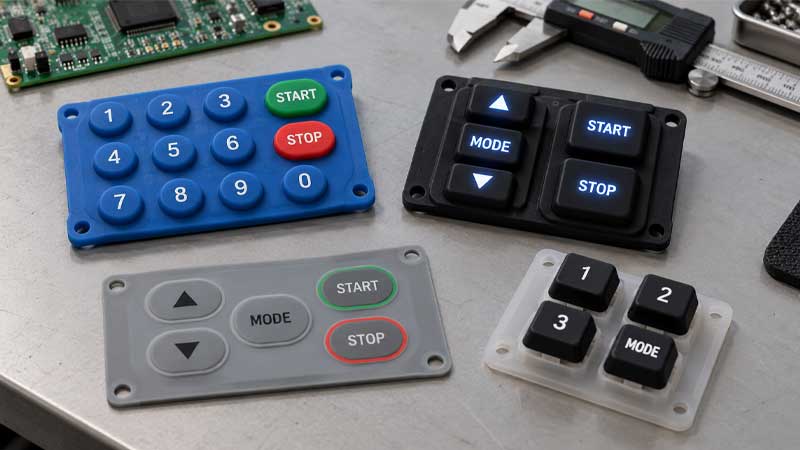
There is a classification of silicone rubber keypads, which refers to conductive silicone keypads or non-conductive silicone keypads. You may wonder, is a silicone keypad a conductor or conductive? The answer is no. Standard silicone rubber, which is the main material of a silicone keypad, is not a conductor but an insulator.
However, silicone keypads are key components in switches, electronics, input devices, and machinery because they facilitate interaction between machines and humans via physical button pressing.
The following article will discuss the properties of silicone rubber and its conductivity when used with a silicone keypad.
Silicone Rubber: Conductor or Insulator?
Does silicone conduct electricity?
Although silicone rubber has electrical resistivity, it is not a conductor. The insulation performance of silicone rubber won’t decrease when immersed in liquids.
However, when combined with special additives or fillers, silicone rubber becomes electrically conductive, which can be used to activate switches and send electrical signals.
What Is Conductive Silicone?
Silicone is an electrical insulator that does not allow electricity to flow through it. Conductive silicone is typically made from a silicone base polymer and conductive metal fillers. It is processed through compounding, curing, post-curing, finishing, and quality control.
Silicone Keypad In Switches and Machines
Tough rubber keypads mainly consist of non-conductive silicone rubber. These keypads are combined with electrical contacts, printed circuit boards (PCBs), protective plastic or stainless steel keycaps, environmentally sealed housings, and other assemblies to create reliable, multifunctional devices and equipment.
Note that silicone keypads do not contain conductive silicone but rather integrate with electrical contacts and circuitry.
Differences Between Conductive and Non-Conductive Silicone Keypads

Conductive Silicone Keypads
These keypads have conductive carbon pills underneath the buttons, surrounded by a webbing structure. These conductive pills cannot be observed directly when operating user interfaces in machinery.
Our custom silicone keypads can be designed with carbon pills of different sizes and shapes. Gold pills are also an option for enhanced performance of silicone keypads due to their superior conductivity of electricity and heat. Gold plating improves the resistance to corrosion, oxidation, and mechanical wear.
Nonetheless, carbon pills remain a reliable and beneficial solution for electrical contacts in switches and other user interfaces.
Non-Conductive Silicone Keypads
Non-conductive silicone keypads have no conductive layers or pills beneath the buttons. Electricity is transmitted by additional domes located below the keypad and above the circuit boards. Similar to conductive silicone keypads, the contacts of non-conductive silicone keypads do not touch until the buttons are pressed.
More information about the comparison between conductive and non-conductive silicone keypads can be found in SKF.
How Do Silicone Keypads Establish Electrical Contact?
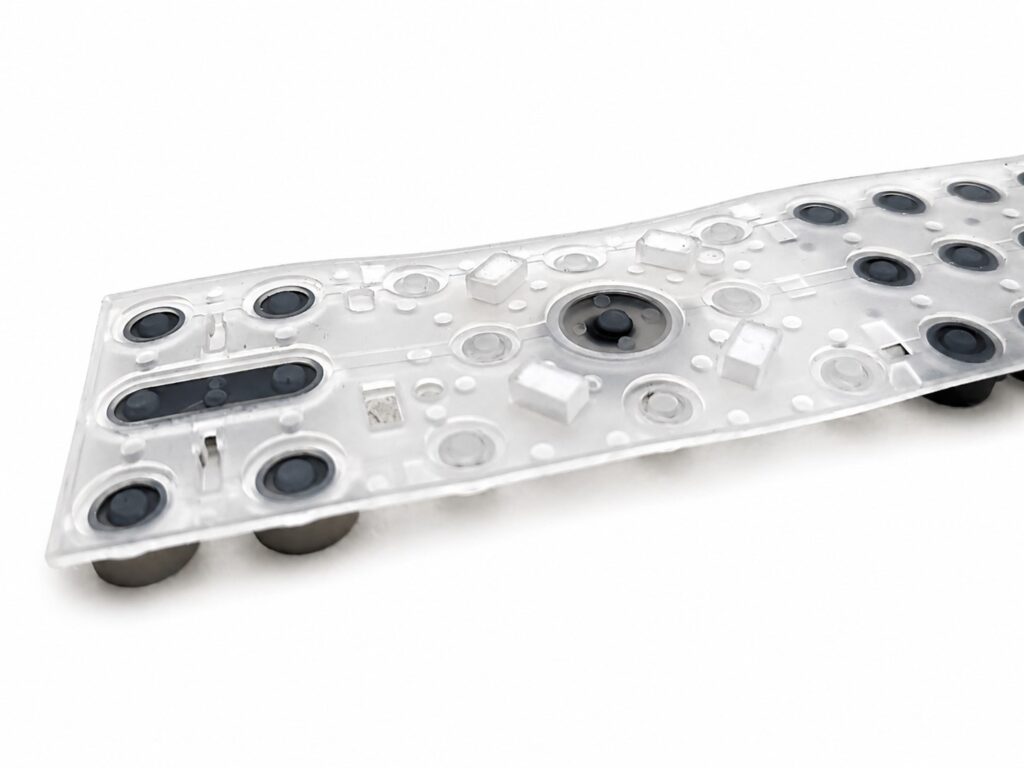
Both conductive and non-conductive silicone keypads are molded from natural, elastic silicone, which is an insulator. Electrical signals are transmitted by actuators and circuit boards when the elastomer keypad’s webbing structure deforms and rebounds.
Buttons typically won’t make electrical contact unless you press and activate the switches. Electrical signals are only sent when the switch contacts touch while pressing the buttons of the silicone keypad due to deformed webbing from the force of your fingers.
Actuation of a Circuit & Actuator
This component is the external part of a switch in machines that users can press. It is made of insulated silicone material. The selection of actuator materials ranges from metal to plastic.
Natural elastic keypads eliminate the need for a return spring in normal metal or thermoplastic switches because they rebound gently due to their flexible, elastic structure.
Standard metal button switches may fail due to a broken or ineffective return spring. This issue can only be resolved by replacing the spring or applying extra lubrication. As elastic polymers, silicone keypads provide a pleasant tactile experience and can interact with an electrical circuit by incorporating conductive materials beneath them.
Electrical Contacts
Electrical contacts are usually connected to the contact interface of conductive silicone keypads. The carbon pill, conductive layer, or metal dome then makes contact with the printed circuit board, completing the current flow.
Different Electrical Contacts for Silicone Keypads
Standard methods exist for creating electrical and conductive contacts between silicone keypads and electrical circuits. These contacts are formed by integrating conductive materials into the non-conductive silicone keypads to create electrical switches.
More information about custom silicone keypad design of electrical contacts, webbing, actuation force, and travel distance, can be found in SKF.
Conductive Rubber Pills: A Durable and Long-Term Solution
To make the silicone keypad electrically conductive, a small conductive rubber pill is inserted into its contact surface during the molding process, which refers to carbon pill silicone keypads. Although mold designs incur a slightly higher cost, this method provides enhanced stability, durability, and longevity for silicone keypads.
These pills can be produced with matte or textured surfaces and in various shapes, including round, square, and custom designs. There are various types of conductive pills available for your custom silicone keypad, including conductive carbon pills, low-resistivity conductive carbon pills, nickel-plated metal pills, gold-plated metal pills, and stainless steel pills.
However, the cost of inserting conductive pills into silicone keypads increases due to the complexity of the mold design.
Carbon Dip Printing for Non-Conductive Silicone Keypads
The next step involves silicone keypad molding. Non-conductive keypads are printed with a conductive carbon dip layer, consisting of carbon-based particles or a conductive carbon dip. This cost-effective conductive ink facilitates the flow of current, generating an electric signal when pressure is applied to the interface. Finally, the silicone keypads undergo processing to ensure conductive integrity.
Metal Domes for Non-Conductive Silicone Keypads
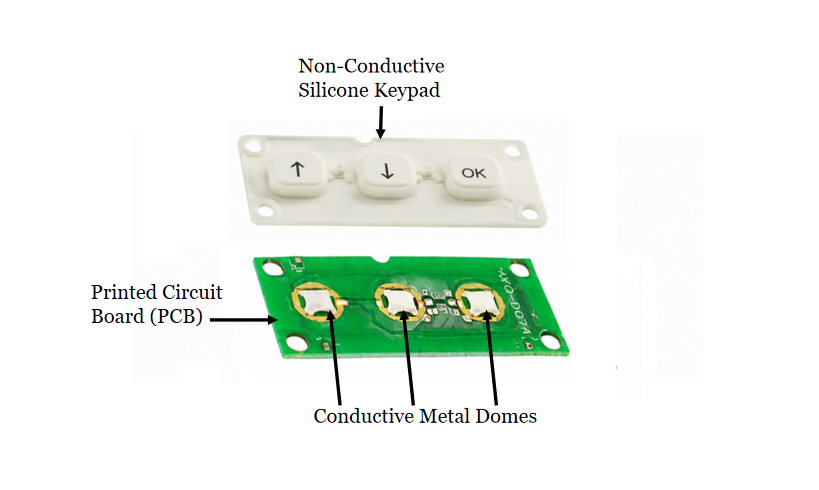
Metal domes act as electrical contacts in non-conductive silicone keypads, offering crisp tactile responses. They are placed underneath silicone buttons. These snap dome switches are compatible with compact designs and provide tactile feedback for diverse electronic devices and user interfaces.
In addition to deforming the silicone keypad’s webbing structure, the metal domes themselves deform physically with a reliable lifetime. This lifetime can be customized from ~100,000 to 500,000 cycles for standard consumer electronics, 500,000 to 1,000,000 cycles for industrial applications, and over 1,000,000 cycles for highly robust applications.
We will take into consideration your specific tactile response, structural stability, and the expected lifespan of your silicone keypads for actuation methods and relevant performance.
FAQs
Are carbon pills resistant to moisture and dust?
Yes. We can design and produce carbon pills for your rubber keypad project with improved durability, expected lifetime, and resistance under wet and dusty conditions.
Is there a risk of electric shock when using a conductive silicone keypad?
No. Our conductive silicone keypads from SKF are safe to operate.
Can I customize non-conductive silicone keypads with tactile feedback?
Yes. A snap dome switch can be integrated with non-conductive silicone keypads, ensuring a noticeable tactile response.
What is the general electrical resistance of a conductive silicone keypad?
Generally, the resistance reaches less than 150 Ohms.
Can a silicone keypad provide environmental sealing for electronics or instruments?
Yes. Our custom silicone keypads from SKF can be produced with well-designed sealing performance by wrap-around bezel, gasket, or special structure against the ingress of contamination entering internal contacts or circuits.
Conclusion
Understanding the conductivity mechanism and different conductivity solutions, including conductive ink layers or carbon pills, may help you select the desired conductivity for your silicone keypad or keyboard projects according to cost, electrical specifications, and durability.