
IP Ratings Explained: IP65, IP66, IP67 and IP68
IP ratings describe the level of protection an enclosure provides against solid objects, dust and water under specified test conditions. This guide explains how to read IP codes, compare common ratings and choose a suitable protection level. It also covers the design factors that affect IP protection in custom silicone keypads and their installed enclosures.
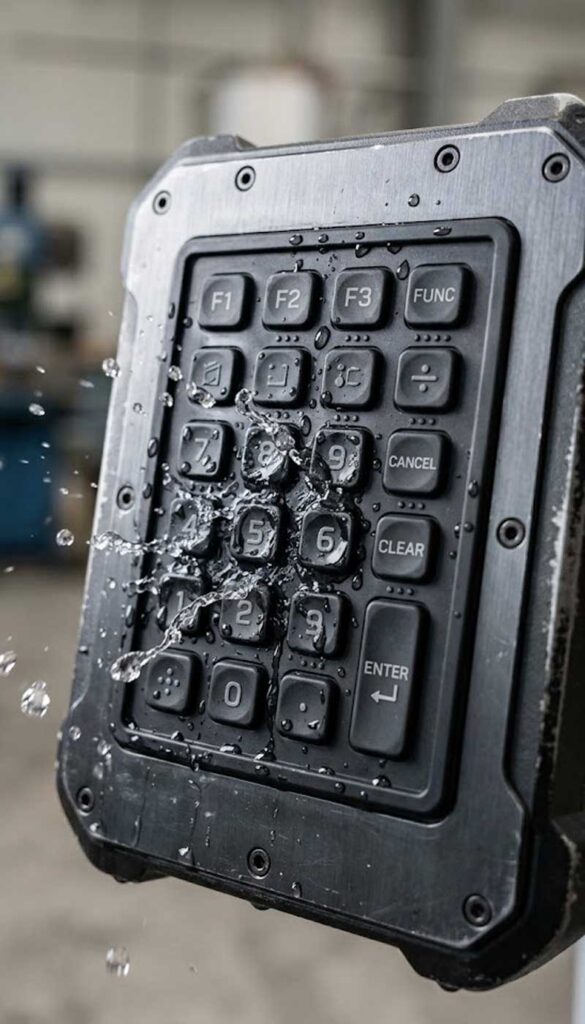
What Is an IP Rating?
An IP rating, or Ingress Protection rating, classifies the protection provided by an enclosure against access to hazardous parts and the ingress of solid foreign objects and water. The rating system is defined by IEC 60529, Degrees of protection provided by enclosures.
IP ratings are commonly used for industrial control panels, electronic equipment, outdoor devices and other products exposed to dust or moisture.
The rating provides a more specific description of protection than general terms such as waterproof or dustproof. However, it does not describe every aspect of environmental durability. An IP rating alone does not establish resistance to chemicals, UV exposure, temperature extremes, impact or long-term wear.
For equipment with silicone keypads, the rating must also be considered in relation to the complete assembly. The silicone material, keypad geometry, mounting interface and enclosure all influence the final protection performance.
How to Read an IP Rating
An IP code normally consists of the letters IP followed by two characteristic digits. Each digit describes a different type of protection.
The first digit indicates protection against access to hazardous parts and solid foreign objects, including dust. The second digit indicates protection against water ingress under specified test conditions.
For example, IP67 combines a first digit of 6, indicating a dust-tight enclosure, with a second digit of 7, indicating protection against the effects of temporary immersion under the prescribed test conditions.
The letter X may replace either digit when that characteristic is not specified or rated. For example, IPX7 specifies a water protection level without stating a solid-object protection level. It should not automatically be interpreted as proof that the product has no dust protection; the relevant characteristic simply has not been established by that code.
When reviewing a product specification, check both digits rather than treating the rating as a single measure of overall durability.
IP Rating Chart: Common Dust and Water Protection Levels
The following table summarizes several IP ratings commonly encountered in industrial equipment design.
IP Rating | Solid-Object and Dust Protection | Water Protection |
|---|---|---|
IP54 | Dust protection is provided, although some dust ingress may occur | Protection against splashing water from any direction |
IP65 | Dust-tight | Protection against water jets under specified test conditions |
IP66 | Dust-tight | Protection against powerful water jets under specified test conditions |
IP67 | Dust-tight | Protection against the effects of temporary immersion under specified test conditions |
IP68 | Dust-tight | Protection against the effects of continuous immersion under conditions specified for the product |
The first digit 5 indicates that dust ingress is not completely prevented but must not occur in a quantity that interferes with satisfactory operation or safety. The first digit 6 indicates a dust-tight enclosure under the applicable test requirements.
The water-protection digits represent different test methods. A higher digit does not automatically mean that a product has passed every test associated with lower water-protection digits.
For IP68, the applicable immersion depth and duration depend on the conditions specified for the product. There is no single depth-and-duration combination that applies universally to every IP68-rated enclosure.
These ratings should be treated as defined test classifications rather than unrestricted guarantees for every real-world operating condition.
IP65 vs. IP66 vs. IP67 vs. IP68
IP65, IP66, IP67 and IP68 are often compared when selecting protection for industrial electronic equipment. The main difference is the type of water exposure covered by the test.
| Comparison | IP65 | IP66 | IP67 | IP68 |
|---|---|---|---|---|
| Main water test | Water jets | Powerful water jets | Temporary immersion | Continuous immersion under specified conditions |
| Primary design concern | Sealing against water jets | Sealing under more demanding jet conditions | Maintaining enclosure integrity during immersion | Maintaining enclosure integrity under the specified immersion conditions |
| Conditions to confirm | Applicable jet test requirements | Applicable jet test requirements | Immersion depth and duration | Agreed immersion depth, duration and other applicable conditions |
| Automatically proves protection against all other water tests? | No | No | No | No |
IP65 vs. IP67
IP65 addresses water jets, while IP67 addresses temporary immersion. These are different exposure conditions, so the two ratings are not interchangeable. A device designed for rain or occasional water jets may have different requirements from equipment that could be submerged during use or cleaning. The appropriate rating depends on the actual exposure and the applicable verification requirements.
IP66 vs. IP67
IP66 focuses on protection against powerful water jets. IP67 focuses on protection against the effects of temporary immersion. An IP67 rating alone does not establish that an enclosure has passed the IP66 water-jet test. If the equipment may face both conditions, confirm whether both tests are required.
IP67 vs. IP68
Both ratings address immersion, but IP67 covers temporary immersion under prescribed conditions, whereas IP68 covers continuous immersion under conditions specified for the product. IP68 should not be interpreted as permission for unlimited immersion at any depth. The actual conditions and limitations must be established for the product. For industrial equipment, the best rating is the one that matches the defined operating environment and verification requirements, not necessarily the highest available number.
How to Choose the Right IP Rating
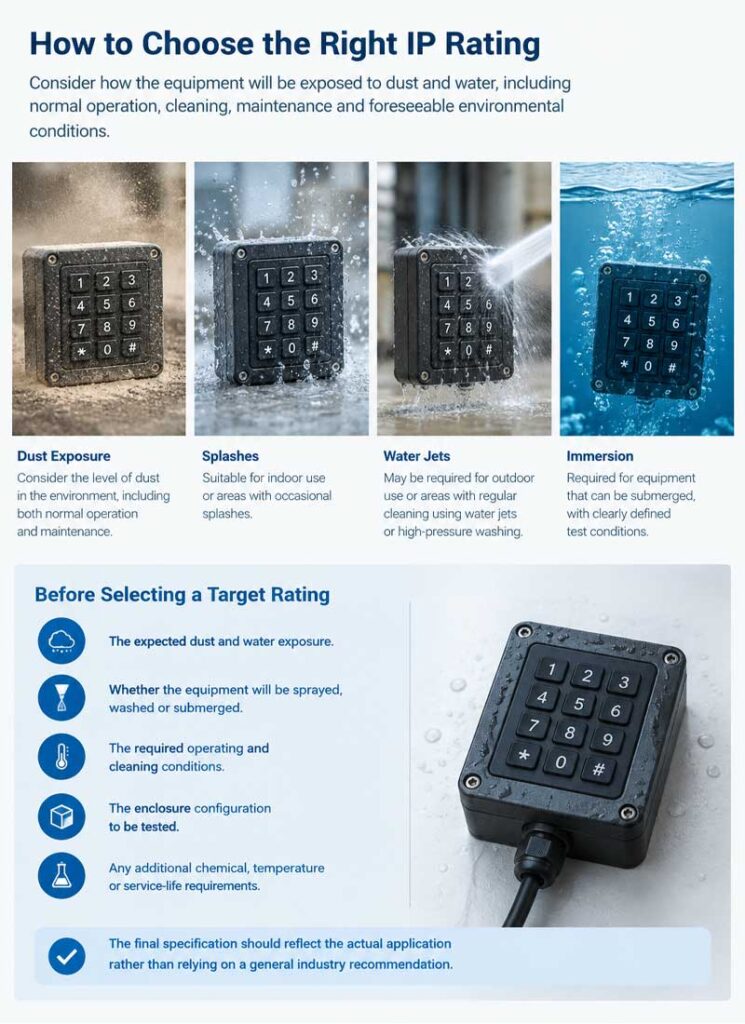
Start by identifying how the equipment will be exposed to dust and water. Consider normal operation as well as cleaning, maintenance and foreseeable environmental conditions.
For indoor equipment exposed mainly to occasional splashes, a lower water-protection level may be sufficient, depending on the application. Outdoor equipment exposed to rain or water jets may require a different rating. Equipment that can be submerged needs an immersion-related requirement, including clearly defined test conditions.
Cleaning procedures deserve particular attention. Routine splashing, powerful water jets, high-pressure washing and immersion are not equivalent conditions. Water temperature, cleaning chemicals and repeated exposure may also introduce requirements that an IP rating does not address by itself.
Before selecting a target rating, establish:
The expected dust and water exposure.
Whether the equipment will be sprayed, washed or submerged.
The required operating and cleaning conditions.
The enclosure configuration to be tested.
Any additional chemical, temperature or service-life requirements.
The final specification should reflect the actual application rather than relying on a general industry recommendation.
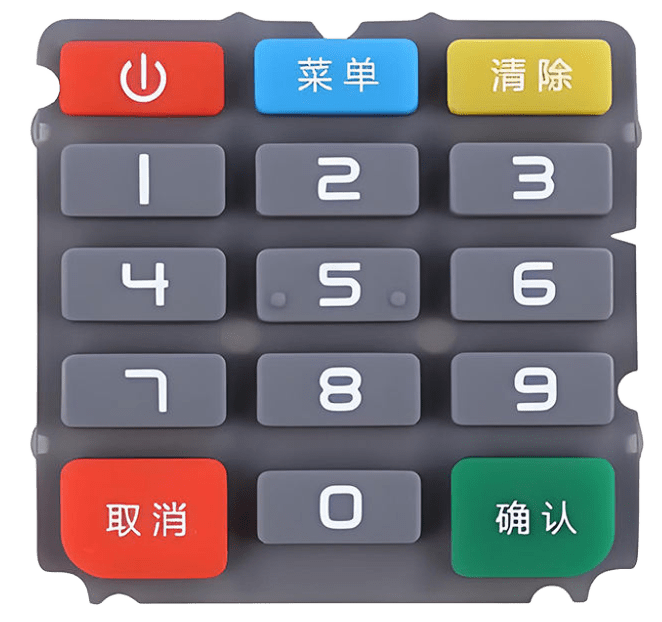
Explore Waterproof Silicone Keypads
Choosing an IP rating involves matching the protection level to the actual environment and confirming that the complete design meets the required conditions.
For custom silicone keypad projects, SKF can help evaluate the keypad design, mounting interface and sealing requirements. Share your target IP rating, application environment and available drawings to begin a technical discussion about the appropriate design approach.
IP Ratings for Silicone Keypads: Design Considerations
Silicone keypads are used in industrial control panels, handheld equipment, outdoor electronics and other products that require protection against dust and water. Silicone rubber can be molded with sealing features, but the IP rating depends on the keypad design, its installation and the complete equipment enclosure—not the material alone.
Several factors need to be considered when designing a silicone keypad for a specific IP rating.
Sealing Geometry
A molded sealing lip or separate gasket creates a barrier between the keypad and the enclosure. Its effectiveness depends on the seal geometry, contact surfaces and consistency of the installed interface. The sealing feature must suit the required protection level and the available mounting space.
Compression and Mounting
The keypad must be mounted so that the sealing interface maintains consistent contact. Insufficient or uneven compression can leave gaps, while excessive compression may deform the keypad or affect its operation. Compression requirements depend on the silicone grade, seal geometry, assembly design and manufacturing tolerances. They should be established for the specific product rather than taken from a universal value.
Enclosure Interfaces
The keypad is only one part of the sealing system. Water or dust may enter through housing joints, connectors, cable entries or other openings, even if the keypad interface is properly sealed. The complete ingress path must therefore be considered during design and testing.
Material and Operating Conditions
Silicone formulation and hardness affect the keypad's flexibility and mechanical behavior. Temperature changes, cleaning agents and repeated key operation may also influence long-term performance. Material selection should reflect the actual operating environment and the requirements of the finished assembly.
Verification of the Complete Assembly
An IP rating applies to the enclosure or assembly tested under specified conditions. A rating verified for one keypad and housing combination should not automatically be applied to another installation or product variant. For a project targeting IP65, IP67 or another protection level, the design should define the mounting arrangement, sealing interfaces and test configuration before the rating is claimed.
For product-specific requirements, see the Silicone Keypad Design Guide.
If you are developing a custom solution, Waterproof Silicone Keypads provides a starting point for discussing the application and protection requirements.
How Are IP Ratings Verified?
IP protection is verified through tests appropriate to the claimed rating. Depending on the rating, these may include tests involving solid-object or dust ingress, water jets, or immersion.
The test configuration is important. The housing, keypad, gasket, connectors and other interfaces should represent the configuration covered by the claim. If the product is intended to operate with a specific mounting arrangement, that arrangement should be addressed in the verification plan.
The test requirements and acceptance criteria should be established before testing. A product should not be described as IP67-rated solely because its materials appear waterproof or because a similar design has performed well in use.
For custom silicone keypads, it is useful to clarify whether the requirement applies to the keypad assembly or the complete device. The responsible parties should also agree on the applicable standard, test conditions and evidence needed to support the rating.
Silicone Keypad IP Rating Selection Checklist
Before requesting a custom silicone keypad, prepare the following information:
Specify the required level and whether multiple water-exposure tests are needed.
Describe expected dust, rain, splashing, water jets or immersion.
Identify the cleaning method, frequency and any relevant chemicals or temperatures.
Provide enclosure drawings, available space and details of the keypad-to-housing interface.
Include operating temperature, mechanical use, material requirements and expected service conditions.
Define the test configuration, applicable conditions and whether testing must cover the complete device.
Frequently Asked Questions
Is IP67 waterproof?
IP67 indicates protection against the effects of temporary immersion under specified test conditions. It does not mean that a product is waterproof under every depth, duration, temperature or operating condition.
Is IP68 better than IP67?
IP68 addresses continuous immersion under conditions specified for the product, while IP67 addresses temporary immersion under prescribed conditions. Which is appropriate depends on the application and the required test conditions.
Are silicone keypads waterproof?
Silicone rubber can be used to create sealing features, but a silicone keypad is not automatically waterproof as an assembly. Its protection depends on the design, mounting interface, enclosure and other potential ingress paths.
How do I choose an IP rating for a silicone keypad?
Start with the expected exposure to dust and water, then define the target rating and test conditions. The keypad's sealing structure and mounting arrangement must support those requirements, and the relevant assembly should be verified in its intended configuration.