
Snap Ratio in Silicone Keypads
Snap Ratio is a core mechanical parameter in silicone rubber keypad engineering. It defines how sharply the silicone diaphragm transitions from elastic deformation to structural collapse and recovery during actuation.
Unlike simple force values, Snap Ratio reflects the dynamic behavior of the force curve. It directly determines tactile sharpness, perceived quality, and long-term mechanical stability in high-cycle applications.
In real production, Snap Ratio is controlled through structural design, not material hardness alone.
Mechanical Definition and Force Curve Behavior
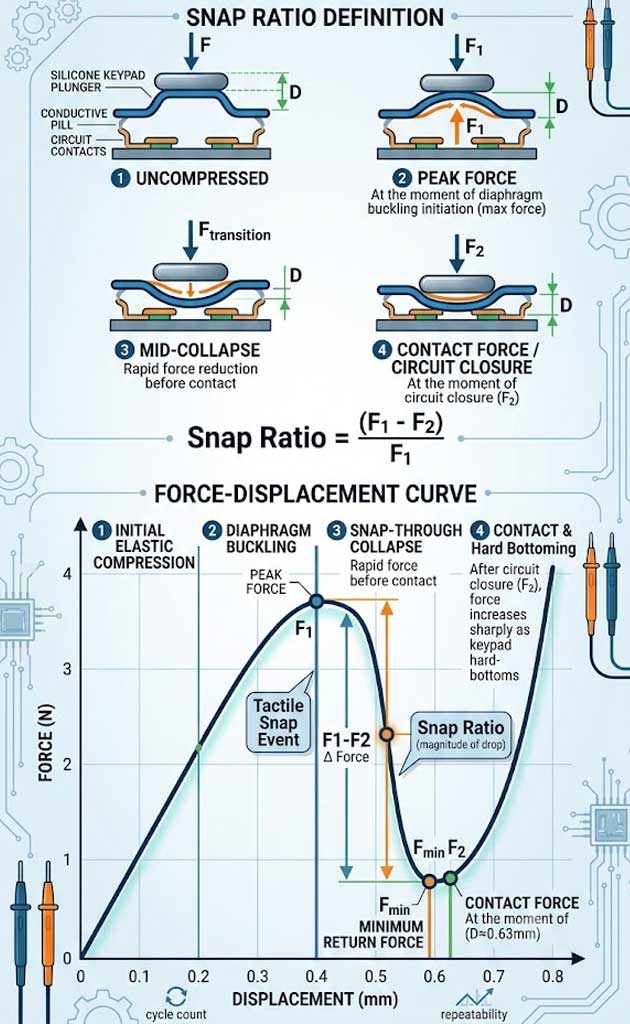
Snap Ratio describes the relative force drop between peak actuation force and contact force.
Formula:
Snap Ratio = (F1 − F2) / F1
Where:
- F1 (Peak Actuation Force)
Maximum force required to initiate diaphragm buckling - F2 (Contact Force)
Force at the moment conductive pill or contact interface is about to close the circuit
This force transition defines the tactile “snap event”.
Force Curve Interpretation
A typical silicone keypad force curve includes four stages:
- Initial elastic compression
- Linear force increase
- Diaphragm buckling (instability point)
- Snap-through collapse and contact stabilization
Snap Ratio is essentially the magnitude of force loss during stage 3.
A well-optimized curve should show:
- A clear and stable peak (F1)
- A fast and controlled drop to F2
- No secondary rebound oscillation
- Consistent curve repeatability across cycles
Engineering Significance of Snap Ratio
Snap Ratio is not only a tactile parameter. It influences multiple performance dimensions simultaneously:
Tactile Feedback Quality
Higher Snap Ratio increases perceived click sharpness and improves user confidence in actuation.
Mechanical Fatigue Life
Excessive Snap Ratio concentrates stress at the diaphragm hinge area, accelerating micro-crack formation under long-term cycling.
Electrical Contact Stability
Unstable Snap Ratio can cause inconsistent carbon pill or metal dome engagement, leading to signal noise or missed inputs.
Product Perception
Premium input devices often rely on well-controlled Snap Ratio to create a crisp and clean typing feel.
Recommended Engineering Range and Practical Trade-Offs
Optimal Range: 40% – 60%
This range is widely used in industrial and consumer-grade silicone keypad designs.
It represents the balance between:
- tactile clarity
- structural durability
- production consistency
Below 40% Snap Ratio
- Smooth and soft key travel
- Weak tactile break point
- Reduced click perception
- Improved fatigue resistance
This range is typically used in silent interfaces or soft-touch control panels.
Above 60% Snap Ratio
- Very sharp tactile response
- High stress at diaphragm edges
- Increased fatigue risk
- Strong feedback, lower safety margin
This range is often used in gaming devices or industrial control panels requiring strong tactile feedback.
Structural Parameters That Control Snap Ratio
Snap Ratio is determined primarily by geometry and structural tuning.
Webbing Angle
The webbing angle is one of the most sensitive parameters in silicone keypad design. It directly determines how the diaphragm behaves during buckling. A larger wall angle tends to create higher structural instability, which results in a stronger and more pronounced snap feeling. In contrast, a smaller angle allows the diaphragm to collapse more gradually, producing a smoother and softer tactile response. Even a small adjustment of 2–3 degrees can noticeably shift the balance between F1 and F2, making this parameter critical in fine-tuning tactile performance.
Diaphragm Thickness Profile
The thickness distribution of the diaphragm plays a direct role in shaping the force curve. A thicker diaphragm generally increases the peak actuation force (F1) and slows down the collapse response, resulting in a more resistant key feel. A thinner structure reduces overall force and allows faster actuation, but may reduce structural robustness. When thickness is not uniform across the keypad, it often leads to inconsistent Snap Ratio behavior between keys. For this reason, precise and stable molding control is essential to maintain batch-to-batch consistency.
Buckling Radius and Stress Concentration Zone
The transition radius at the diaphragm edge defines how stress is distributed during initial collapse. A sharper radius concentrates stress in a smaller area, which typically leads to a higher Snap Ratio and a more aggressive tactile snap. A smoother and larger radius spreads the stress more evenly, resulting in a softer and more controlled force transition. In practical mold development, this parameter is frequently adjusted during tooling optimization because even small geometric changes can significantly alter the force curve shape.
Conductive Pill Position and Contact Geometry
The positioning of the conductive pill relative to the diaphragm has a direct impact on contact force stability. When alignment is accurate, the contact force (F2) remains consistent and the electrical response is stable. However, when there is offset positioning, the force distribution becomes uneven, which leads to fluctuations in contact behavior. In more severe cases, poor alignment can cause unstable tactile feedback and inconsistent actuation across repeated cycles. This makes precise placement control a key factor in ensuring reliable keypad performance.
Air Venting and Pressure Balance Design
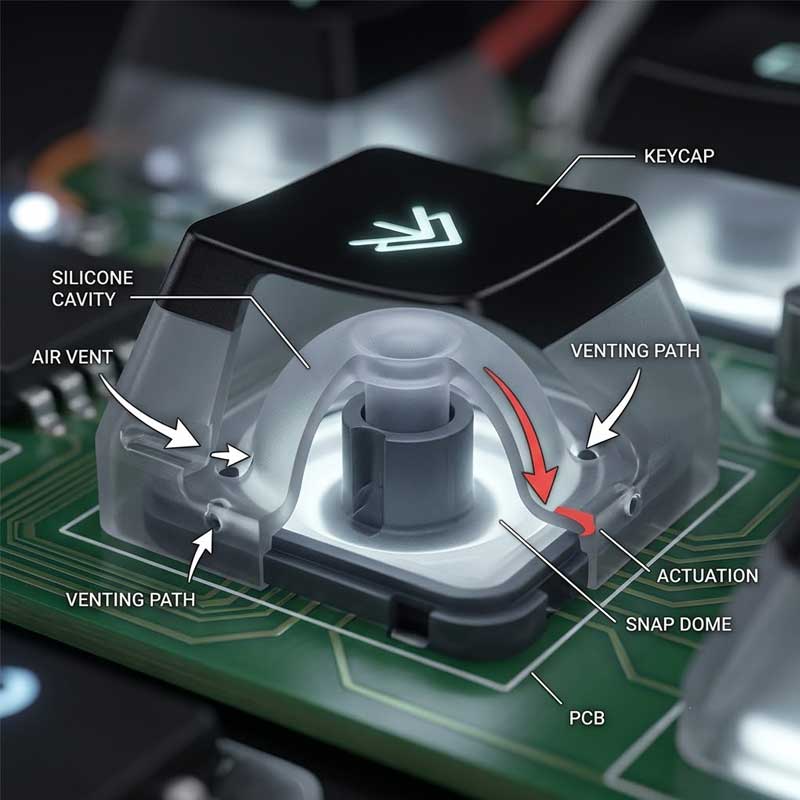
During actuation, trapped air inside the silicone cavity creates resistance known as pneumatic damping.
If not properly controlled, it leads to:
- Artificial increase in F1
- Distorted Snap Ratio curve
- Delayed rebound response
- Inconsistent key feel across production batches
Recommended Venting Strategy:
- Minimum two air channels per structural zone
- Continuous airflow path between compression and release phases
- Separation of venting path from stress-bearing diaphragm area
Proper venting ensures the force curve reflects pure mechanical behavior rather than air compression effects.
Anti-Rocking Structure for High-Profile Keycaps
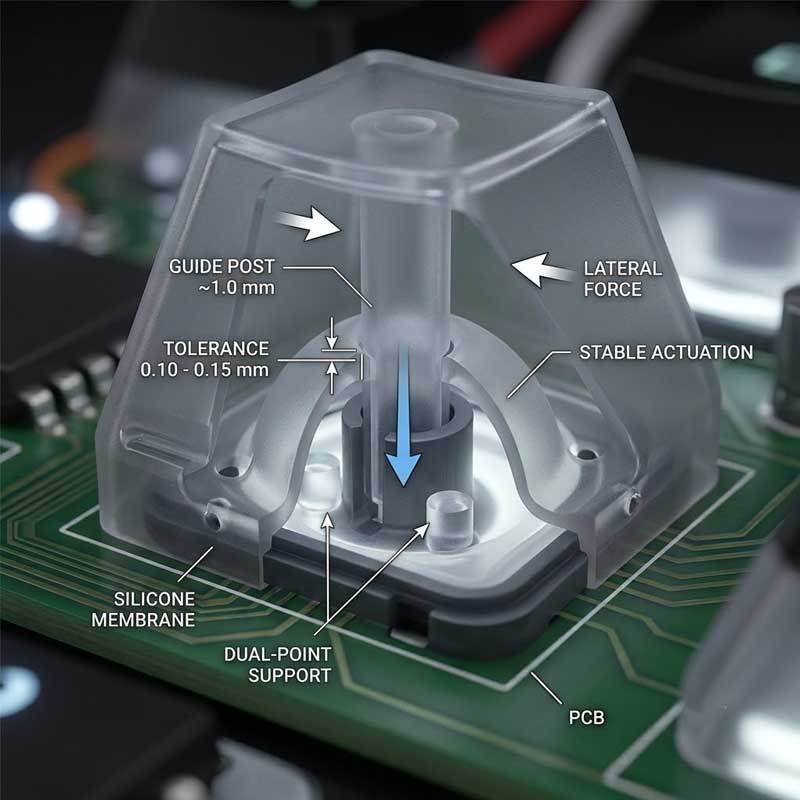
For key heights above 15 mm, lateral force becomes a critical issue.
Without structural stabilization, users may experience:
- Key tilting during off-center press
- Uneven diaphragm loading
- Accelerated edge wear
Recommended Design:
- Guide post diameter: ~1.0 mm
- Vertical clearance tolerance: 0.10 – 0.15 mm
- Dual-point support structure for key stability
This ensures consistent diaphragm compression under real-world usage conditions.

Hybrid Systems: Metal Dome and Silicone Interface Design
In hybrid keypad systems, silicone does not directly generate tactile snap. Instead, it acts as a force transmission layer.
Recommended Structure:
Pusher Pad + Dead Web Architecture
- Pusher Pad transfers force to metal dome
- Dead Web eliminates silicone snap interference
Benefits:
- Eliminates dual tactile feedback conflict
- Prevents double-click sensation
- Ensures dome controls full tactile response
Preload Optimization:
A slight preload of approximately 0.13 mm (0.005 inch) is often applied to:
- reduce dead travel
- stabilize actuation timing
- improve response consistency
Production Control and Validation of Snap Ratio
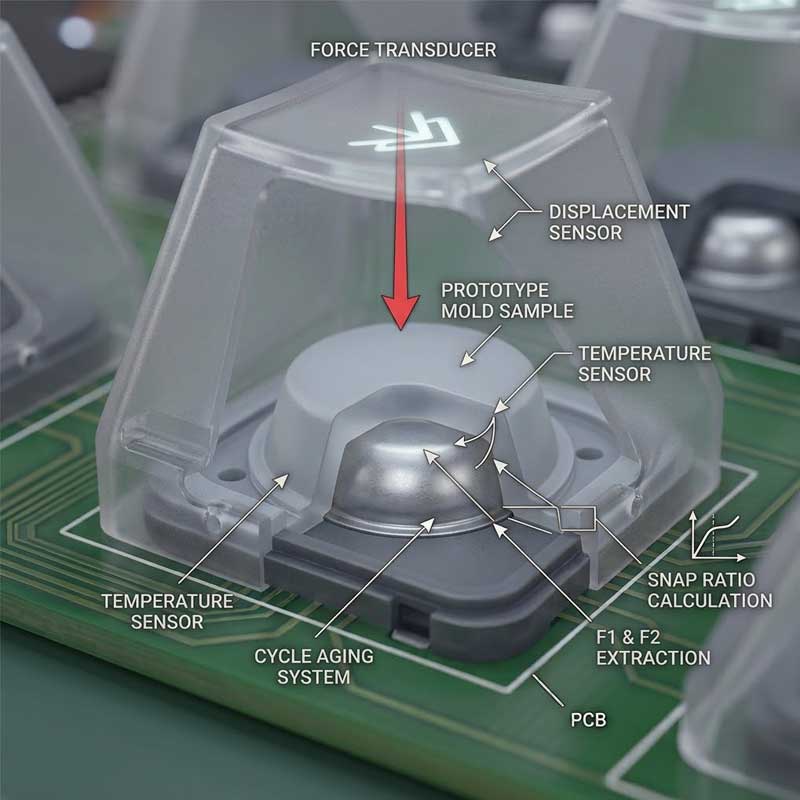
In mass production, Snap Ratio must be validated through force curve testing.
Standard verification process:
- Prototype mold sampling
- Force-displacement curve measurement
- F1 and F2 extraction
- Snap Ratio calculation
- Cross-key consistency analysis
- Temperature and cycle aging testing
Acceptance criteria typically include:
- Consistent Snap Ratio across all keys
- Stable F1/F2 variance within defined tolerance
- No curve distortion after extended cycling
Frequently Asked Questions
What is the ideal Snap Ratio for silicone keypads?
The most commonly used industrial range is 40% to 60%, balancing tactile feedback and durability.
Can Snap Ratio be different across one keypad?
Yes. Different keys can be tuned individually by adjusting diaphragm geometry and thickness.
What causes inconsistent Snap Ratio in production?
The most common causes are:
- uneven diaphragm thickness
- poor mold venting
- carbon pill misalignment
- unstable silicone curing conditions
Is Snap Ratio more important than hardness (Shore A)?
Yes. Hardness affects overall stiffness, but Snap Ratio defines the actual tactile behavior.