
Silicone Keypad Design Guide
Design reliable, durable, and custom silicone rubber keypads with the right structure, materials, and printing solutions.
What Is a Silicone Keypad?
Silicone keypad is a flexible switching interface made from molded silicone rubber, typically integrated with PCB, membrane circuit, or metal dome structures to provide tactile input control.
Compared with mechanical switches or plastic keypads, silicone keypads offer:
- High environmental sealing capability (IP65–IP68)
- Excellent resistance to moisture, dust, and chemicals
- Customizable tactile feedback
- Long lifecycle (up to 1,000,000+ actuations)
- Integrated waterproof structure without extra sealing parts
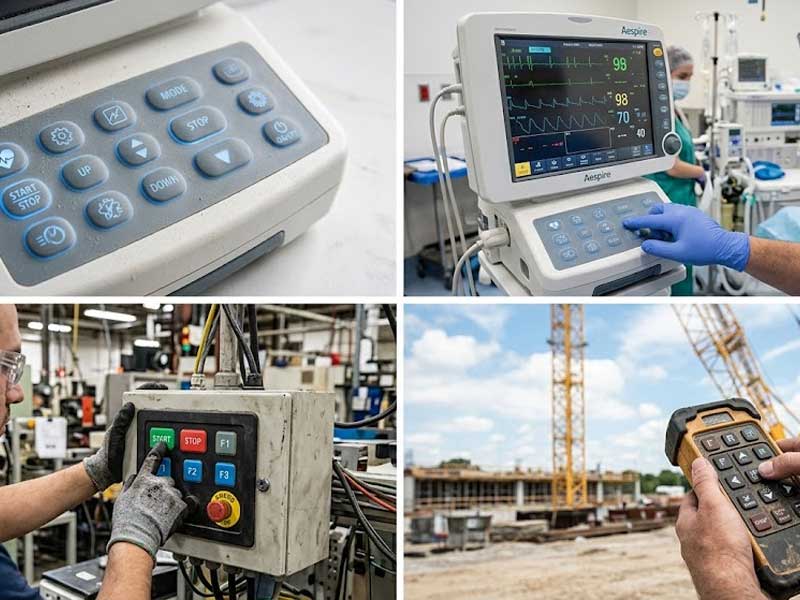
They are widely used in industrial control systems, medical devices, automotive interfaces, marine electronics, and consumer electronics.
Silicone Keypad Design Objectives
Before designing a silicone keypad, engineers must define functional and environmental requirements
Functional Objectives
- Stable electrical contact with PCB or conductive layer
- Consistent tactile feedback across all keys
- Clear user interaction layout (ergonomic design)
- Backlight visibility (if required)
Environmental Objectives
- Waterproof level (IP65 / IP67 / IP68)
- Temperature resistance (-40°C to +200°C typical range)
- UV resistance for outdoor use
- Chemical resistance (oil, cleaning agents, alcohol)
Mechanical Objectives
- Durability under repeated pressing
- Structural stability of domes
- Resistance to deformation over time
Key Structural Design Parameters
Silicone keypad performance is determined mainly by structural design.
Key travel defines how far a key moves before actuation.
Typical design ranges:
- 0.3–0.8mm → ultra-sensitive control panels
- 0.8–1.5mm → standard electronic devices
- 1.5–3.5mm → industrial equipment requiring strong feedback
Short travel improves speed
Long travel improves confirmation feeling
Incorrect travel design often causes:
- accidental pressing (too short)
- fatigue (too long)
Actuation force determines user effort required to press a key.
Common ranges:
- 50–80g → soft-touch consumer devices
- 80–150g → general electronics (most common range)
- 150–250g → industrial or glove-use applications
Key considerations:
- High force reduces accidental activation
- Low force improves usability but may reduce precision
Tactile Ratio
Tactile ratio = peak force / return force
This determines “click feeling”.
- 40–55% → soft and quiet feedback
- 55–70% → balanced tactile experience
- 70–85% → strong mechanical click sensation
Industrial devices often require higher tactile ratio for confirmation feedback
Medical devices prefer moderate tactile ratio for precision and comfort
Key spacing affects usability and error rate:
- Small devices: 0.5–1.5mm spacing
- Standard panels: 1.5–3mm spacing
- Industrial control panels: 3–6mm spacing
Design rules:
- Avoid overcrowding function keys
- Group related functions visually
- Separate critical emergency keys
Silicone Material Engineering
Material selection directly affects performance and lifespan.
Standard Silicone Rubber
Standard silicone rubber is the most widely used material for silicone keypads due to its balanced performance and cost efficiency. It offers excellent elasticity, reliable recovery after repeated actuation, and good resistance to temperature fluctuations, moisture, and aging. This material is suitable for general-purpose applications where standard durability and consistent tactile performance are required.
Liquid Silicone Rubber (LSR)
Liquid Silicone Rubber (LSR) is a high-performance silicone material processed through injection molding, offering excellent dimensional accuracy, consistency, and production efficiency for high-volume silicone keypad manufacturing. Compared with conventional solid silicone rubber, LSR provides superior flowability, enabling the production of complex geometries, thin walls, fine details, and integrated structures with tight tolerances. It delivers excellent resistance to heat, UV exposure, chemicals, and aging while maintaining stable elasticity and tactile response over long-term use. LSR silicone keypads are widely used in automotive controls, medical devices, wearable electronics, industrial equipment, and other applications requiring precision molding, clean production, and reliable performance.
High-Temperature Silicone
High-temperature silicone is formulated to maintain its mechanical properties and flexibility in extreme heat conditions, typically up to 200°C–250°C. It resists thermal degradation, cracking, and hardening during prolonged exposure to elevated temperatures, making it a preferred choice for automotive controls, industrial equipment, and other applications operating in demanding environments.
Medical Grade Silicone
Medical grade silicone is manufactured using highly purified materials and is designed for applications that require biocompatibility and strict regulatory compliance. It provides excellent chemical stability, low toxicity, and resistance to repeated sterilization processes. These characteristics make it suitable for medical devices, diagnostic equipment, laboratory instruments, and other healthcare-related applications that must meet FDA and relevant ISO standards.
Flame Retardant Silicone (UL94-V0)
Flame retardant silicone is engineered to reduce flame spread and improve safety in electrical and electronic applications. Meeting UL94-V0 requirements, this material can self-extinguish after the ignition source is removed, helping minimize fire risks. It is commonly used in control panels, power equipment, communication devices, and other systems where fire safety standards are critical.
Conductive Silicone
Conductive silicone contains carbon-based or metal-filled conductive particles that enable reliable electrical contact between the keypad and the circuit board. In addition to maintaining the flexibility and durability of standard silicone rubber, it provides stable conductivity over millions of actuation cycles. This material is widely used in silicone keypads for industrial controls, medical devices, consumer electronics, and other products that require dependable switching performance.
Dome Structure Design
Dome Types
The dome structure is one of the most important factors affecting tactile feedback, actuation force, and keypad lifespan. Round domes are commonly used in consumer electronics because they provide a smooth and comfortable pressing feel with consistent performance. Cross domes distribute force more evenly across the key surface, improving stability and extending service life in applications with frequent use. Pillar domes generate stronger tactile feedback and a more pronounced click sensation, making them suitable for industrial control panels and equipment that require clear operator confirmation.
Wall Thickness Engineering
Wall thickness plays a critical role in determining the actuation force, tactile response, and long-term durability of a silicone keypad. Thinner walls generally create a softer touch and require less force to activate, while thicker walls increase structural strength and provide a firmer tactile feel. Most silicone keypad designs use wall thicknesses between 0.6 mm and 1.0 mm to achieve a balance between comfort and durability. If the wall is too thin, the dome may deform or collapse after repeated use, whereas excessive thickness can reduce tactile responsiveness and make the keypad feel stiff during operation.
Return Force Design
Return force refers to the ability of a silicone key to return to its original position after being pressed. Proper return force design ensures consistent key recovery, reliable actuation, and a comfortable user experience throughout the product's lifecycle. A higher return force enables faster recovery and better performance in applications with frequent or rapid key presses, while a lower return force creates a softer and quieter touch that may be preferred in consumer devices. Engineers must carefully balance return force with key travel and actuation force to achieve the desired tactile characteristics and operational reliability.
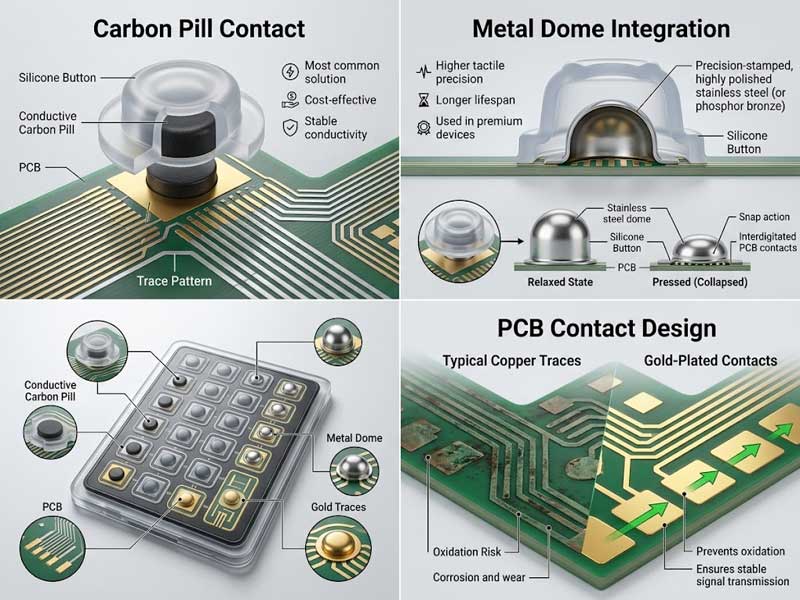
Conductive Contact Design
Carbon Pill Contact
- Most common solution
- Cost-effective
- Stable conductivity
Metal Dome Integration
- Higher tactile precision
- Longer lifespan
- Used in premium devices
PCB Contact Design
- Gold-plated contact points
- Prevents oxidation
- Ensures stable signal transmission
Surface Treatment
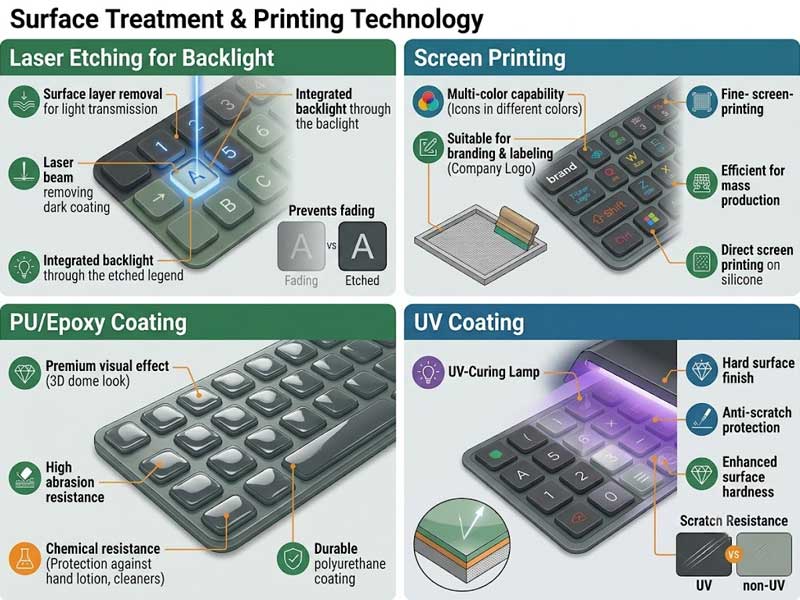
Laser Etching for Backlight
- Removes surface layer for light transmission
- Prevents fading
- High precision for symbols and icons
Screen Printing
- Multi-color capability
- Cost-efficient for mass production
- Suitable for branding and labeling
PU/Epoxy Coating
- High abrasion resistance
- Chemical resistance
- Premium visual effect (3D dome look)
UV Coating
- Anti-scratch protection
- Enhanced surface hardness
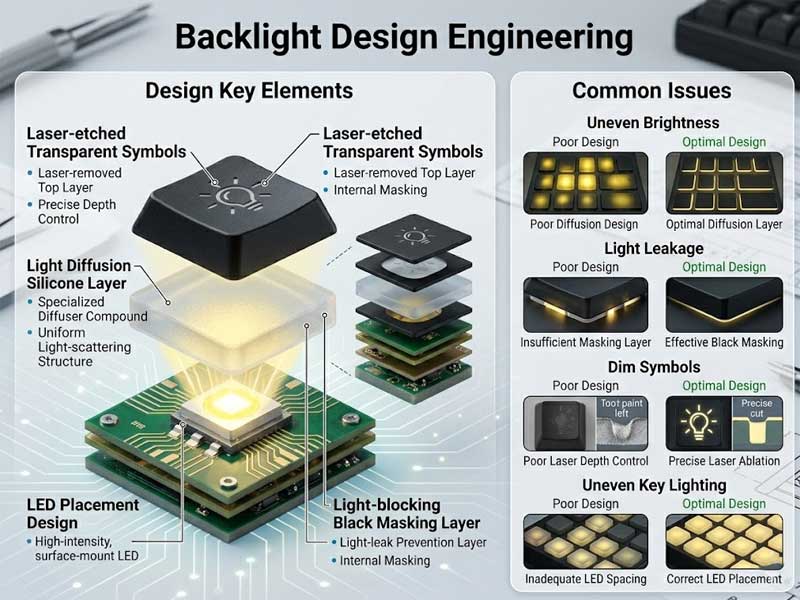
Backlight Design Engineering
Backlit silicone keypad requires optical design optimization:
Key elements:
- LED placement design
- Light diffusion silicone layer
- Laser-etched transparent symbols
- Light-blocking black masking layer
Common issues:
- Uneven brightness → poor diffusion design
- Light leakage → insufficient masking layer
- Dim symbols → poor laser depth control
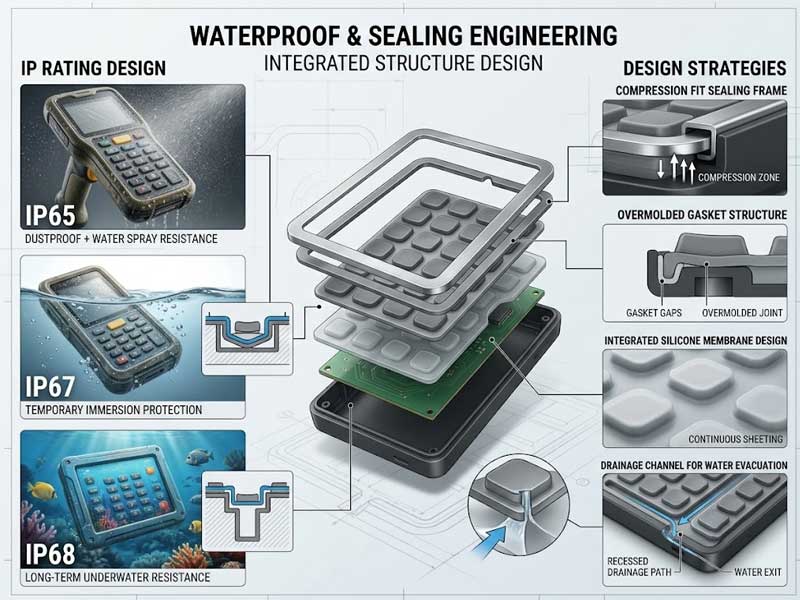
Waterproof & Sealing Engineering
Silicone keypads achieve sealing through integrated structure design.
IP Rating Design:
- IP65 → dustproof + water spray resistance
- IP67 → temporary immersion protection
- IP68 → long-term underwater resistance
Design strategies:
- Compression fit sealing frame
- Overmolded gasket structure
- Integrated silicone membrane design
- Drainage channel for water evacuation
Common Design Failures
Wrong force distribution → inconsistent feel
Incorrect wall thickness → early fatigue
Backlight mismatch → uneven illumination
Poor dome alignment → missed actuation
Weak sealing design → water leakage
Poor printing adhesion → symbol fading
Silicone Keypad Development Process
A complete OEM/ODM workflow:
- Requirement definition (application + environment)
- Industrial design review
- 2D/3D engineering drawing (CAD)
- Prototype tooling (sample mold)
- Functional testing (force, travel, conductivity)
- Design optimization
- Mass production tooling
- Quality control & shipment
For more information about available solutions, explore our product catalog featuring a wide range of silicone keypad products.