For a custom silicone keypad, tactile feel is more than a user experience factor. It directly affects operating accuracy, product quality perception, and long-term reliability.
A button that feels too soft may not provide enough confirmation during operation. A button that requires excessive force can increase user fatigue, especially in equipment that requires frequent input.
Many customers initially evaluate keypad feel by simply pressing a sample and describing it as “too hard” or “too soft”. However, professional silicone keypad design does not rely only on subjective judgment. The tactile performance can be measured and optimized through engineering parameters, including actuation force, return force, key stroke, and snap ratio.
These parameters are controlled by several design factors, such as silicone hardness, dome geometry, webbing structure, and manufacturing tolerance. During the DFM stage, engineers use force-stroke analysis to predict and optimize the final button feeling before mass production.
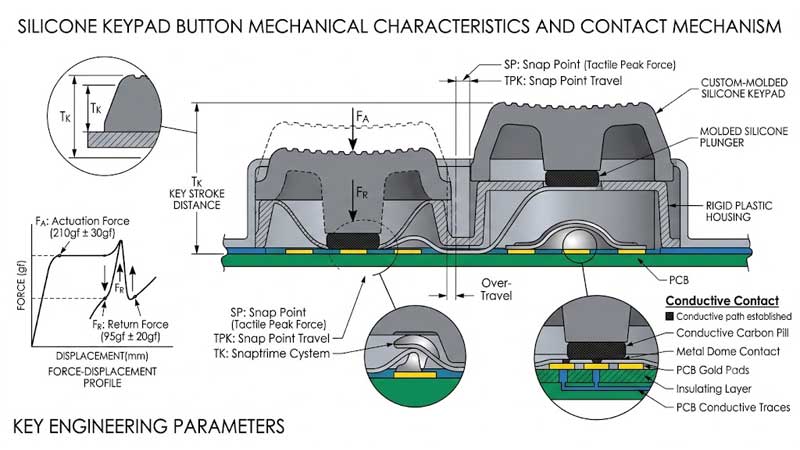
Understanding the Key Parameters of Silicone Keypad Tactile Performance
The tactile response of a silicone keypad is mainly determined by four parameters:
- Actuation Force (F1)
- Return Force (F2)
- Key Stroke (S)
- Snap Ratio
Together, these values define how much force is required to press the button, how clearly the user feels the activation point, and how quickly the button returns.
Actuation Force (F1)
Actuation force, also called peak force, is the maximum force required before the silicone dome collapses.
Before reaching this point, the silicone web gradually deforms and stores elastic energy. Once the collapse point is reached, the force drops quickly and creates the tactile sensation.
The required actuation force depends on:
- Silicone hardness
- Dome size
- Web thickness
- Button structure
For example, industrial equipment and outdoor devices often require higher actuation force to prevent accidental operation, while consumer electronics usually prefer lighter operation for faster input.
A well-designed silicone keypad balances sufficient resistance with comfortable operation.
Return Force (F2)
Return force refers to the force remaining after the silicone dome collapses.
This value affects button recovery speed and repeated pressing performance. If return force is too low, the button may feel slow or unstable during fast operation.
For applications such as industrial control panels, medical equipment, and handheld terminals, consistent return performance is essential because users depend on clear feedback after every press.
Key Stroke (S)
Key stroke is the vertical travel distance from the initial position of the button to the fully pressed position.
The stroke determines how much physical movement the user experiences.
Most silicone keypads use a stroke range between approximately 1.0mm and 2.0mm. Short-stroke designs provide faster response and compact structure, but they leave less space for silicone deformation. As a result, achieving strong tactile feedback becomes more difficult.
Longer stroke designs allow more dome movement and usually provide clearer tactile confirmation, making them suitable for industrial or rugged applications.
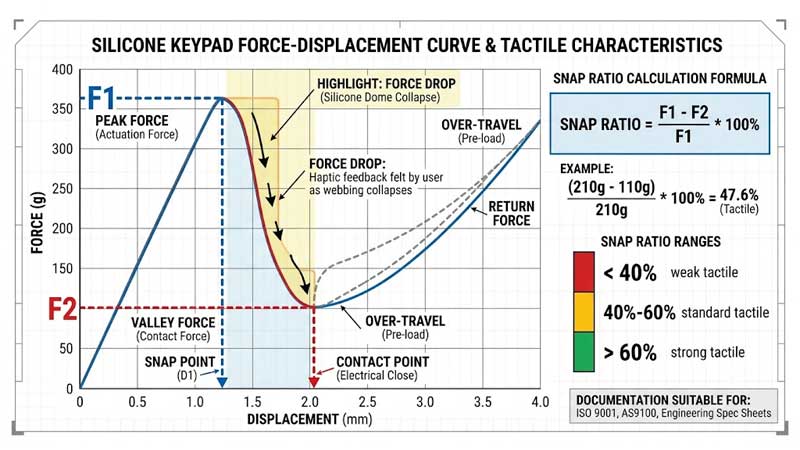
How to Calculate Silicone Keypad Snap Ratio
Snap ratio is one of the most important indicators for evaluating tactile feedback.
It describes how sharply the force decreases after the peak force point.
The formula is:
Snap Ratio (%)=F1-F2/F1
Where:
F1 = Peak Actuation Force
The maximum force before the silicone dome collapses.
F2 = Valley Force
The minimum force after the snap point.
Snap Ratio Calculation Example
Assume:
- F1 = 180g
- F2 = 72g
The snap ratio is:
180-72/180=60%
A 60% snap ratio means the force decreases significantly after activation. Users will feel a clear transition from resistance to release, creating a crisp tactile response.
Generally:
- Below 30%: soft and less noticeable feedback
- 30–50%: balanced tactile feeling
- 50–70%: stronger and sharper feedback
However, a higher snap ratio is not always better. The ideal value depends on the product application, operating environment, and user expectations.
Understanding the Silicone Keypad Force-Stroke Curve
A force-stroke curve, also called a force displacement curve, shows the relationship between pressing force and button travel.
It is one of the most important engineering tools for evaluating silicone keypad performance.
The curve normally includes several key points:
Peak Point (F1)
The peak point represents the maximum resistance before the dome collapse.
At this stage:
- The silicone web begins to deform
- The dome stores energy
- Pressing force increases gradually
The shape of this section is mainly controlled by silicone material and web geometry.
Valley Point (F2)
After the dome collapses, the force drops to the valley point.
This force reduction creates the tactile snap feeling.
A larger difference between F1 and F2 produces stronger tactile feedback.
Contact Force (Fc)
Contact force represents the force required for the conductive pill or metal dome to make electrical contact with the PCB.
During design, engineers must ensure that the mechanical snap point and electrical activation point work together. Poor coordination may result in weak feedback, unreliable switching, or insufficient over-travel.
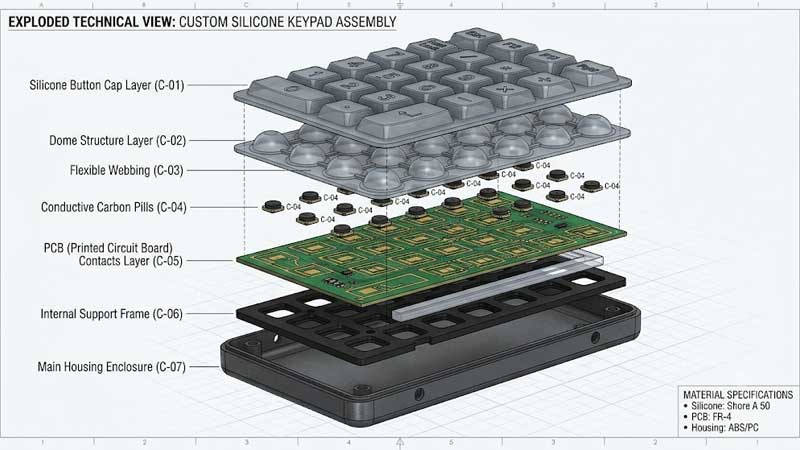
How Silicone Keypad Structure Affects Tactile Performance
The snap ratio and key stroke of a silicone keypad are not determined by a single parameter. They are the result of the interaction between silicone material properties and mechanical structure.
During the design stage, engineers adjust the dome geometry, webbing structure, and silicone hardness to achieve the required tactile response while maintaining durability and manufacturing stability.
How Webbing Geometry Controls Snap Ratio
The silicone webbing around the dome works as a flexible spring structure. When a button is pressed, the web deforms first and then collapses at the snap point.
The geometry of this area directly affects:
- Actuation force
- Snap ratio
- Return speed
- Operating life
Web Thickness
Web thickness is one of the main factors controlling button force.
A thicker web generally increases resistance and creates a stronger support structure. However, excessive thickness can make the button feel stiff and reduce the snap effect.
A thinner web can reduce operating force, but if the structure becomes too flexible, the button may feel soft and provide insufficient tactile feedback.
For this reason, silicone keypad manufacturers usually optimize web thickness based on button size, required force, and lifetime requirements rather than simply increasing or reducing material thickness.
Web Angle and Dome Geometry
The angle and shape of the silicone dome influence how quickly the structure collapses.
A properly designed dome creates a smooth force increase before activation and a clear force drop afterward. This produces the crisp tactile feeling expected from industrial and professional equipment.
If the collapse behavior is too gradual, the button may feel “mushy”. If the collapse is too aggressive, the button may require excessive force or have reduced durability.
The final geometry usually depends on:
- Button diameter
- Dome height
- Stroke requirement
- Target snap ratio
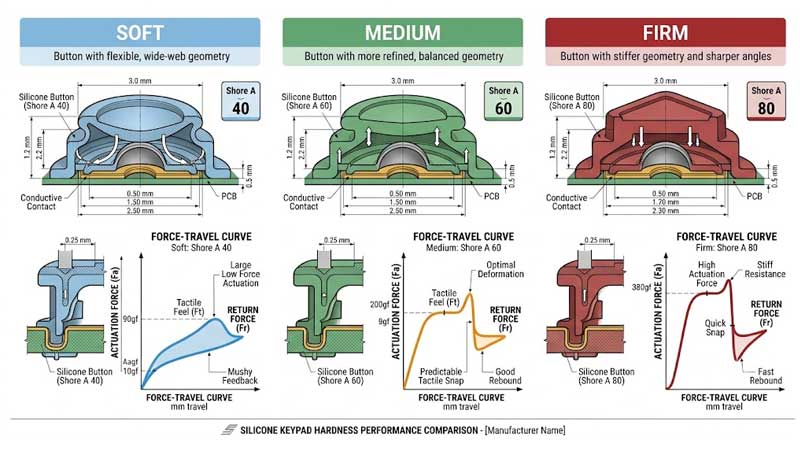
How Silicone Hardness Affects Keypad Feel
Silicone hardness is another important factor in tactile design.
It is usually measured by Shore A hardness. A harder silicone compound generally increases resistance and provides a firmer button feeling, while softer silicone creates a smoother and lighter touch.
Typical ranges:
| Silicone Hardness | General Feeling |
| 30–40 Shore A | Soft and flexible |
| 40–60 Shore A | Balanced tactile response |
| 60–70 Shore A | Firm and strong feedback |
However, silicone hardness alone does not determine the final button feel.
For example, a high-hardness silicone material with poor dome geometry may still feel uncomfortable, while a properly designed softer silicone keypad can provide excellent tactile feedback.
Material selection must always be considered together with:
- Dome structure
- Web thickness
- Button size
- Operating environment
Effect of Button Size and Dome Design
Button dimensions also influence tactile performance.
Larger buttons usually distribute force over a wider area and can provide smoother operation. They are commonly used in industrial control panels, medical devices, and equipment interfaces.
Smaller buttons require more precise structural design because small changes in geometry can significantly affect force consistency.
For compact silicone keypads, engineers need to consider:
- Button diameter
- Spacing between keys
- Dome height
- Contact position
A well-designed structure ensures that different keys on the same keypad provide consistent feedback.
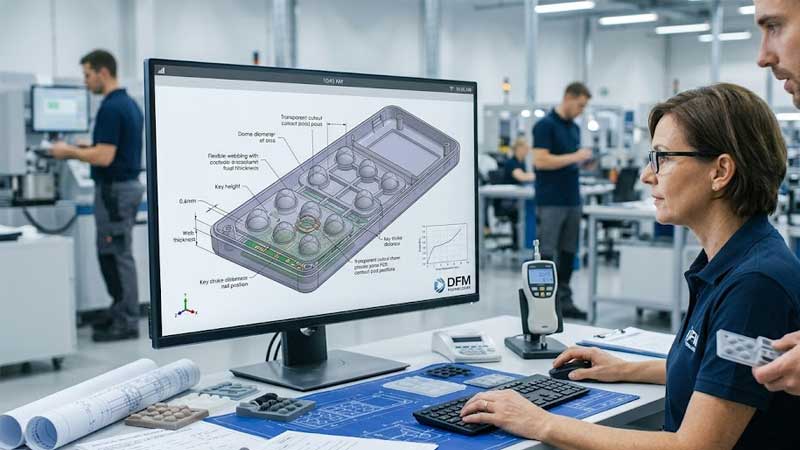
Silicone Keypad DFM Guidelines for Optimal Tactile Feel
Good tactile performance starts before mold production. During the DFM review stage, engineers evaluate whether the design can achieve the required force curve while remaining suitable for manufacturing.
Balance Key Stroke and Snap Ratio
Key stroke and snap ratio are closely related.
Short-stroke designs are attractive because they reduce product thickness, but limited movement space makes it harder to achieve a strong tactile drop.
For example, a stroke below 0.8mm may restrict dome deformation and result in weaker feedback.
A longer stroke, usually around 1.2–2.0mm, provides more room for the silicone structure to collapse and recover. This is often preferred for applications requiring stronger tactile confirmation.
Consider Silicone Material Aging
A silicone keypad must maintain its tactile performance throughout its service life.
After repeated pressing, silicone materials may experience changes in:
- Elastic recovery
- Return force
- Compression set
For high-cycle applications, engineers consider both initial tactile performance and long-term stability.
Material selection, dome design, and molding conditions must work together to maintain consistent force output.
Control Manufacturing Variation
Even a well-designed keypad can experience force variation if production factors are not controlled.
Common causes include:
- Silicone material variation
- Mold tolerance
- Compression molding conditions
- Dimensional changes after curing
During production validation, manufacturers typically check force performance through sample testing and adjust tooling if necessary.
This step helps ensure that mass-produced keypads maintain the same tactile response as approved prototypes.
Recommended Silicone Keypad Force and Stroke Parameters by Application
Different industries require different tactile characteristics. The ideal force and stroke values depend on how the product will be operated.
| Application | Key Stroke | Snap Ratio | Actuation Force | Design Goal |
| Medical Equipment | 1.0–1.5mm | 40–50% | 150–200g | Stable operation and prevent accidental input |
| Automotive Controls | 1.2–2.0mm | 50–65% | 200–350g | Clear feedback during blind operation |
| Rugged Handheld Devices | 1.5–2.5mm | 55–70% | 250–400g | Strong feedback with gloves |
| Consumer Electronics | 0.8–1.2mm | 30–45% | 80–130g | Light touch and fast response |
| Industrial Control Panels | 1.2–2.0mm | 45–65% | 180–300g | Durability and consistent operation |
Selecting the Right Tactile Specification for a Custom Silicone Keypad
Before starting tooling, customers and manufacturers should define the target tactile requirements.
Important considerations include:
Operating environment: Will the keypad be used indoors, outdoors, with gloves, or in high-temperature conditions?
User interaction: Does the application require quick repeated input or strong confirmation after each press?
Product structure: How much space is available for dome movement and PCB integration?
By defining these requirements early, engineers can select the right combination of silicone material, structure, and force parameters.
An experienced silicone keypad manufacturer can help customers optimize these factors during the DFM stage, reducing prototype changes and improving production efficiency.
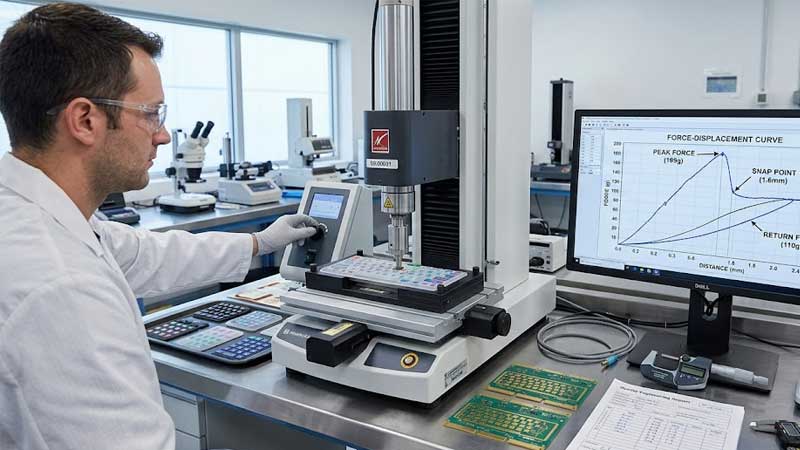
How Silicone Keypad Manufacturers Test Tactile Performance
A silicone keypad design may perform well in CAD simulation, but the actual tactile response needs to be verified through physical testing.
During production, small differences in silicone material, mold dimensions, and molding conditions can affect the final button feel. For this reason, professional silicone keypad manufacturers use force testing equipment to measure whether the keypad meets the required specifications.
A force-stroke test provides measurable data, including:
- Peak actuation force
- Valley force
- Snap ratio
- Key stroke
- Contact force
- Return performance
This allows engineers to compare prototype samples with the target design requirements before mass production.
Silicone Keypad Force-Stroke Testing
A force-stroke test measures the relationship between pressing force and button travel distance.
During the test, a testing probe presses the silicone button at a controlled speed while recording the force change throughout the entire stroke.
The resulting curve shows how the button behaves during operation:
- Initial pressing resistance
- Snap point
- Electrical activation position
- Return movement
For example, if a customer requires a silicone keypad with a 200g actuation force, 60% snap ratio, and 1.5mm stroke, the test result can confirm whether the prototype achieves the expected tactile performance.
Key Parameters Verified During Testing
Actuation Force and Snap Ratio
Actuation force confirms whether the button requires the correct amount of pressure.
If the force is too high, possible causes include:
- Excessive web thickness
- High silicone hardness
- Incorrect dome geometry
If the force is too low, the keypad may feel weak or unstable.
Snap ratio testing helps determine whether the button provides enough tactile confirmation. A properly optimized snap ratio creates a clear transition between pressing resistance and activation.
Stroke and Contact Performance
The actual stroke must match the mechanical design and PCB requirements.
Engineers need to consider the relationship between:
- Silicone dome movement
- Conductive carbon pill position
- PCB contact point
- Housing clearance
If the stroke is insufficient, the keypad may have unreliable electrical contact. If the stroke is excessive, the button may bottom out and reduce user comfort.
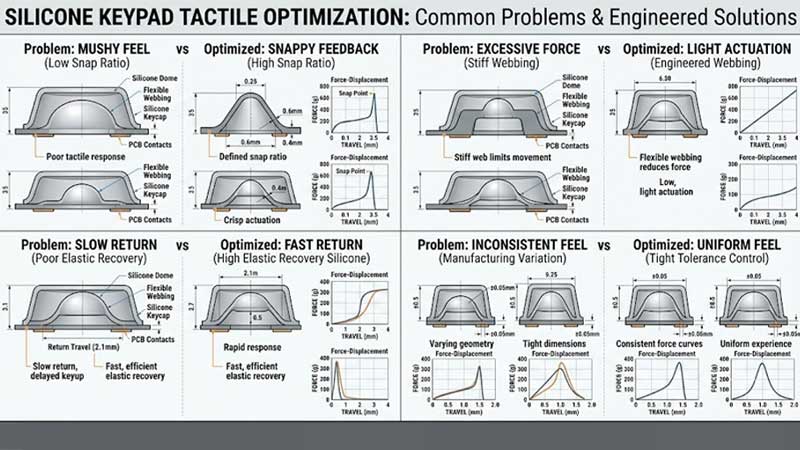
Common Silicone Keypad Tactile Problems and Solutions
Button Feels Too Soft
A soft or unclear button feeling usually indicates insufficient tactile feedback.
Possible causes include:
- Low snap ratio
- Excessively flexible web structure
- Incorrect silicone hardness
- Poor dome geometry
Solutions may include adjusting the web design, modifying dome dimensions, or selecting a different silicone compound.
The goal is not simply to increase force, but to create a more controlled force drop after activation.
Button Requires Too Much Force
High activation force can make operation uncomfortable, especially for products requiring frequent input.
Common causes include:
- Thick silicone web
- Excessive hardness
- Limited stroke space
- Small dome structure
Engineers may optimize the design by adjusting:
- Web thickness
- Dome height
- Silicone hardness
- Button dimensions
A good silicone keypad should provide clear feedback without unnecessary operating effort.
Slow Return or Key Sticking
A button that returns slowly can affect user experience and input reliability.
Possible reasons include:
- Insufficient elastic recovery
- Low return force
- Incorrect housing clearance
- Material aging
Improving the silicone formulation, structure design, and mechanical clearance can help maintain fast and stable recovery.
Different Buttons Have Different Feel
For multi-button keypads, consistency between keys is important.
Variation may result from:
- Uneven silicone thickness
- Mold accuracy issues
- Different button geometries
- Material variation
During production, manufacturers use process control and force testing to ensure each key provides consistent feedback.
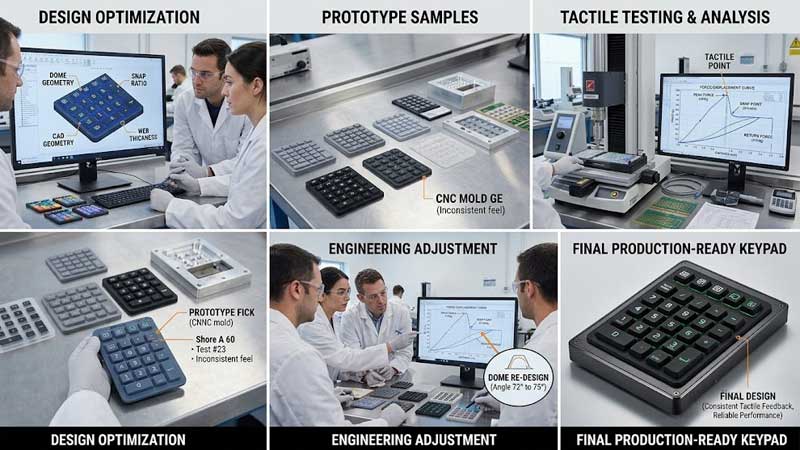
Silicone Keypad Prototype Optimization Process
Tactile performance is usually refined through several development stages.
Define Performance Requirements
Before tooling, engineers confirm:
- Target actuation force
- Required snap ratio
- Key stroke
- Operating environment
- Expected service life
Clear specifications help avoid unnecessary design changes later.
Conduct DFM Review
During DFM analysis, engineers evaluate:
- Dome structure
- Web thickness
- Material selection
- PCB interface
- Housing limitations
This step identifies potential issues before mold manufacturing.
Test and Adjust Prototype Samples
Prototype samples are measured using force-stroke testing equipment.
If the results do not meet requirements, engineers can adjust:
- Silicone hardness
- Dome geometry
- Web structure
- Stroke design
This iterative process helps achieve the required tactile performance before mass production.
Frequently Asked Questions About Silicone Keypad Force and Stroke
What is a good snap ratio for a silicone keypad?
The ideal snap ratio depends on the application.
Generally, a 30–50% snap ratio provides balanced feedback, while 50–70% creates a sharper tactile response.
Industrial and automotive applications usually require stronger feedback, while consumer products may prefer a softer touch.
How is silicone keypad actuation force measured?
Actuation force is measured using a force displacement tester.
The equipment records the relationship between pressing force and travel distance, generating a force-stroke curve that shows the peak force, snap point, and return behavior.
Does silicone hardness affect keypad tactile feel?
Yes. Silicone hardness influences operating force, elasticity, and recovery speed.
However, hardness is only one factor. Dome geometry and web design usually have an equally important impact on the final tactile response.
What is the typical stroke of a silicone keypad?
Most silicone keypads use a stroke between 1.0mm and 2.0mm.
Compact devices may use shorter travel designs, while rugged industrial keypads often require longer stroke distances for stronger feedback.
Can a silicone keypad manufacturer customize the force curve?
Yes. The force curve can be adjusted through changes in:
- Silicone hardness
- Dome geometry
- Web thickness
- Mold design
- Material selection
Early engineering involvement helps achieve the desired tactile performance while reducing tooling modifications.
Improve Silicone Keypad Feel Through Engineering-Based Design
Calculating key stroke and tactile force ratio is an important step in developing a high-quality silicone keypad. However, the final button experience depends on the complete interaction between material, structure, and manufacturing process.
A successful design requires the right balance between:
- Actuation force
- Snap ratio
- Return force
- Key stroke
- Silicone properties
- Mechanical durability
As a custom silicone keypad manufacturer, Silicone Keypad Factory helps customers optimize tactile performance through DFM analysis, prototype evaluation, force-stroke testing, and OEM/ODM production support.
Whether you need a soft-touch keypad for consumer electronics or a high-feedback keypad for industrial equipment, our engineering team can help develop the right solution before tooling begins.
Contact us with your drawings, 3D files, or performance requirements to discuss your custom silicone keypad project.