Designing a reliable custom silicone keypad requires more than creating the button layout and appearance. The internal structure of the silicone rubber keypad determines its tactile response, durability, molding stability, and production cost.
Among all design factors, draft angle and wall thickness are two of the most important DFM considerations. These parameters directly affect how easily the silicone keypad can be molded and released from the tool, while also influencing actuation force, snap ratio, and long-term mechanical performance.
An unsuitable draft angle may cause difficult demolding, tearing, or surface damage. Incorrect wall thickness may result in inconsistent button feel, uneven shrinkage, and reduced service life.
For engineers developing custom silicone keypads, understanding these design guidelines at the early product development stage helps reduce tooling modifications and improve manufacturing efficiency.
For a complete breakdown of silicone keypad design, check out our comprehensive [silicone rubber keypad design guide].
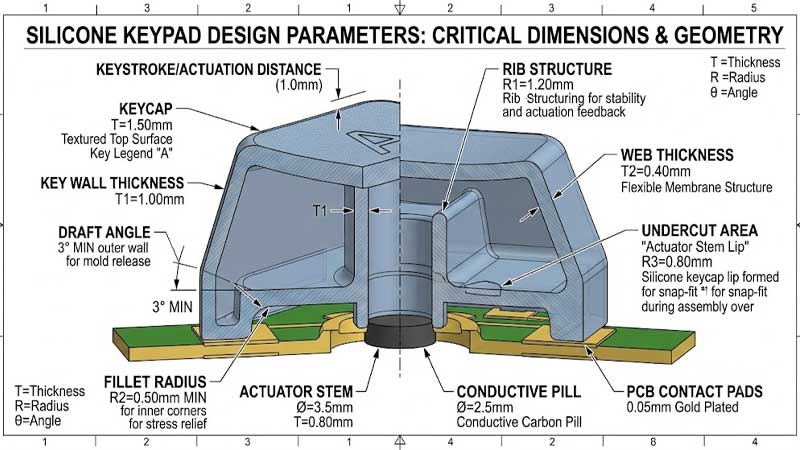
Understanding Key Parameters for Silicone Keypads
Draft Angle in Silicone Keypad Design
Draft angle refers to the angle added to vertical surfaces of a molded feature to help the silicone part release from the mold.
During silicone molding, the material slightly adheres to the mold cavity. Although silicone rubber is flexible, insufficient draft angle increases friction during demolding. This can cause the keypad to stretch, deform, or tear when removed from the mold.
In silicone keypad design, draft angle is mainly determined by:
- Button height
- Wall depth
- Silicone hardness
- Surface texture
- Mold finish
Higher buttons and deeper structures generally require larger draft angles because they create more contact area with the mold surface.
A proper draft angle improves:
- Mold release performance
- Part appearance
- Production consistency
- Mold lifespan
Wall Thickness in Silicone Keypad Design
Wall thickness refers to the thickness of the silicone material forming the key structure, including the keycap, side wall, base layer, and internal webbing.
Unlike plastic parts, silicone keypads rely on elastic deformation to create tactile feedback. Therefore, wall thickness is closely related to button performance.
A thicker structure generally increases rigidity and actuation force, while a thinner structure provides a softer pressing feeling but may reduce mechanical durability.
Incorrect wall thickness can lead to:
- Uneven silicone flow
- Different shrinkage rates
- Poor tactile consistency
- Stress concentration
For this reason, maintaining balanced wall thickness is one of the most important rules in silicone keypad DFM design.
Web Thickness and Tactile Performance
The web structure under each button controls the movement of the key during pressing.
The web thickness affects:
- Actuation force
- Snap response
- Return force
- Fatigue resistance
A thicker web usually requires more force to collapse, creating a firmer tactile feeling. A thinner web provides easier pressing but may reduce the number of operating cycles.
For applications requiring precise tactile feedback, such as industrial controllers, medical devices, and electronic control panels, web thickness should be optimized together with silicone hardness and button geometry.
Rib Design, Fillets, and Undercuts
Additional structures such as ribs and fillets can improve silicone keypad strength and stability.
Ribs help support large areas and prevent deformation, but excessive rib thickness may create uneven material distribution. In general, rib thickness should remain close to or slightly thinner than the surrounding wall thickness.
Sharp corners should be avoided because they create stress concentration areas. Adding fillets allows stress to distribute more evenly and improves fatigue resistance.
Undercuts require special attention in silicone keypad design. Although silicone flexibility allows some undercut structures, excessive undercuts increase demolding difficulty and may require more complex tooling.
Whenever possible, designers should simplify undercuts or redesign them into easier-to-release structures.
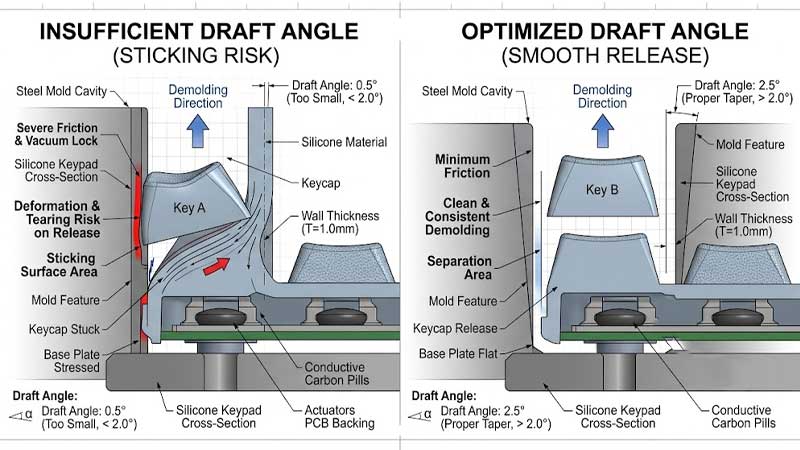
How Draft Angle Affects Silicone Keypad Manufacturing
Demolding Performance
The primary purpose of draft angle is to reduce resistance during mold release.
When the draft angle is insufficient, the silicone keypad may stick to the mold cavity. During removal, excessive stretching force can damage thin areas such as:
- Button walls
- Web structures
- Small decorative features
For low-profile silicone keypads, a small draft angle may be sufficient. However, taller buttons and deeper cavities require additional taper to ensure stable production.
A manufacturer usually evaluates draft angle during the DFM review stage before mold fabrication.
Draft Angle and Flash Risk
Flash is a thin layer of excess silicone formed around the parting line.
Although flash is influenced by many factors, poor structural design can increase the risk. Insufficient draft angle may prevent the part from seating properly during molding and create additional stress on the mold interface.
Optimizing draft angle helps maintain better mold contact and reduces trimming requirements after production.
Silicone Keypad Draft Angle Guidelines
The recommended draft angle depends on button geometry and application requirements.
| Silicone Keypad Feature | Recommended Draft Angle |
| Low-profile button below 5 mm height | Around 1° |
| Standard button height 5–10 mm | 1°–2° |
| Deep cavity or textured surface | 2°–5° |
For most standard silicone keypad designs, approximately 1°–2° draft angle provides a good balance between manufacturability and appearance.
However, several factors may require adjustment.
A textured surface usually needs more draft angle because the texture increases friction during release. Higher silicone hardness may also require additional draft because harder materials deform less easily.
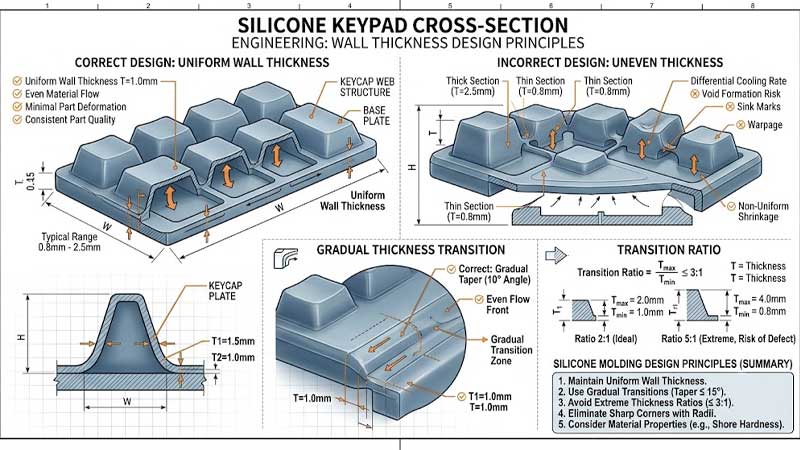
Silicone Keypad Wall Thickness Guidelines
Maintain Uniform Wall Thickness
Uniform wall thickness is a basic principle in silicone keypad design.
Most custom silicone keypads use structural thicknesses approximately between 1.0 mm and 3.8 mm, depending on product size, tactile requirements, and mechanical conditions.
The goal is not to make every area as thick as possible. Instead, the design should provide enough material strength while maintaining proper flexibility.
Excessive thickness may cause:
- Higher material consumption
- Longer curing time
- Increased actuation force
- Poor tactile response
Very thin areas may create:
- Weak structures
- Filling difficulties
- Reduced durability
Wall Thickness Transition Design
Sudden thickness changes should be avoided in silicone keypad structures.
When a thick area connects directly to a thin area, different regions may cure and shrink at different speeds. This can create internal stress and dimensional instability.
A gradual transition is recommended. In many silicone molding applications, maintaining a thickness transition ratio below 3:1 helps improve molding consistency.
Smooth transitions are especially important around:
- Button bases
- Support walls
- Mounting areas
- Web structures
Keycap and Web Thickness Optimization
The keycap thickness influences the overall button strength and user feedback.
A thicker keycap improves rigidity but may reduce flexibility. A thinner keycap provides a softer feeling but requires careful control to prevent deformation.
The web thickness should be optimized according to the required actuation force.
For example:
- Low-force buttons require more flexible web structures.
- Industrial buttons requiring clear feedback may use stronger web support.
- High-cycle applications require balanced stress distribution.
A silicone keypad manufacturer typically adjusts web geometry through prototype testing to achieve the required tactile performance.
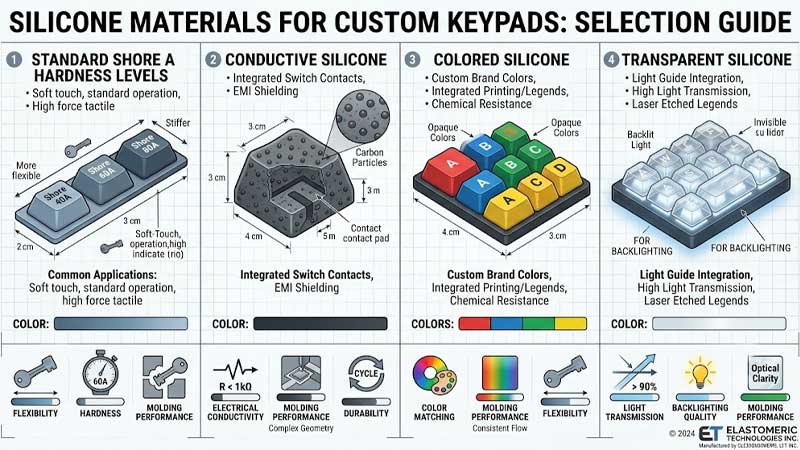
How Silicone Material Affects Draft Angle and Wall Thickness
Material selection influences how design rules should be applied.
Silicone Hardness
Silicone keypad materials commonly range from approximately 30A to 80A Shore hardness.
Softer silicone:
- Requires less pressing force
- Provides smoother touch feeling
- Allows more deformation during operation
Harder silicone:
- Provides stronger support
- Improves wear resistance
- May require more consideration during demolding
Because harder silicone releases less easily from complex structures, draft angle requirements may increase.
Fillers and Additives
Silicone compounds may contain different fillers and additives depending on application requirements.
For example:
- Conductive carbon particles are used for conductive silicone contacts.
- Pigments are added for color matching.
- Optical additives improve light transmission for backlit designs.
These additives can affect material flow, hardness, and shrinkage behavior.
Therefore, material selection should be considered together with wall thickness and mold design.
Common Silicone Keypad Design Mistakes and Solutions
| Design Problem | Main Cause | Improvement |
| Difficult demolding | Insufficient draft angle | Increase draft angle or simplify structure |
| Button feels too stiff | Excessive wall or web thickness | Optimize thickness and silicone hardness |
| Weak tactile response | Incorrect web geometry | Adjust web thickness and button structure |
| Cracking around corners | Sharp edges and stress concentration | Add fillets |
| Uneven dimensions | Large thickness variation | Improve thickness consistency |
Why DFM Review Is Important for Silicone Keypad
A silicone keypad design may look acceptable in CAD but still create manufacturing problems after tooling begins.
A professional DFM review evaluates:
- Draft angle
- Wall thickness distribution
- Web structure
- Fillet design
- Undercut risks
- Assembly requirements
Early optimization helps avoid:
- Mold modification
- Production delays
- Increased tooling costs
- Inconsistent product quality
For custom silicone keypads, manufacturing experience plays an important role in transforming a functional design into a stable mass-production product.
Frequently Asked Questions
What is the recommended draft angle for silicone keypads?
Most silicone keypads use a draft angle between approximately 1° and 2°. Taller buttons, deeper cavities, and textured surfaces may require 2°–5° for easier demolding.
What is the typical wall thickness of a silicone keypad?
The typical structural thickness of a silicone keypad is around 1.0 mm to 3.8 mm. The ideal value depends on button size, tactile requirements, silicone hardness, and durability expectations.
How does wall thickness affect silicone keypad feel?
Wall thickness directly affects actuation force and tactile response. Thicker structures usually create higher pressing force, while thinner structures provide softer feedback.
Why should silicone keypad corners have fillets?
Fillets reduce stress concentration and improve fatigue resistance. Sharp corners can become weak points during repeated button operation.
Can silicone keypads have undercut structures?
Yes, silicone flexibility allows some undercut designs. However, excessive undercuts increase demolding difficulty and tooling complexity. Designers should minimize unnecessary undercuts whenever possible.
Conclusion
Draft angle and wall thickness are fundamental elements of successful silicone keypad design. These parameters influence not only manufacturing efficiency but also the final tactile experience and product reliability.
A well-designed custom silicone keypad should maintain balanced wall thickness, appropriate draft angles, optimized web structures, and smooth transitions between different features.
By applying proper DFM principles during the early design stage, engineers can reduce tooling risks, improve production stability, and develop silicone keypads that deliver consistent performance in real-world applications.