
Graphic Overlays
What Is a Graphic Overlay?
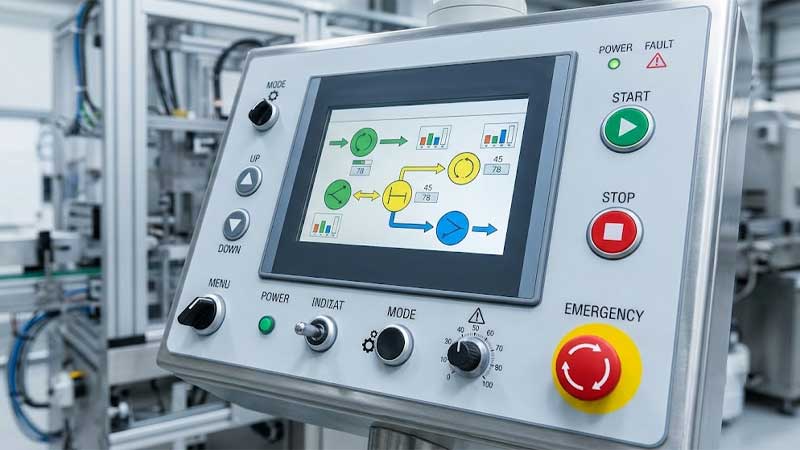
Graphic overlays are precision-printed interface layers used in control panels, instrumentation systems, and human-machine interfaces (HMI). They serve as the primary visual and protective surface between the user and internal electronics.
Unlike simple labels or decorative decals, a professional graphic overlay is an engineered component designed for long-term mechanical durability, chemical and environmental resistance, and precise alignment with functional interface elements.
In modern HMI systems, graphic overlays are often integrated with silicone keypads and membrane switches to form durable, sealed, and user-friendly control solutions for industrial and medical environments.
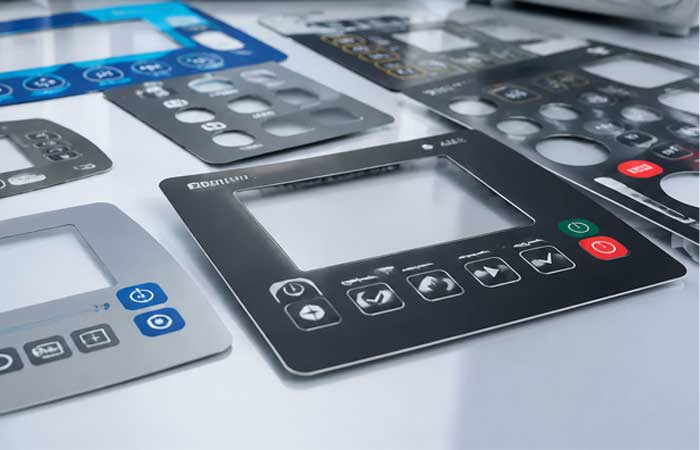
Graphic Overlay Construction & Layer Structure
A typical industrial graphic overlay is not a single film. It is a multi-layer engineered structure:
1. Surface Layer (Hard Coating / Texture Layer)
The surface layer is the outermost protective film of the graphic overlay. It is typically treated with a hard coating to improve resistance against scratches, abrasion, and daily wear. Depending on application needs, it can also be finished with anti-glare or glossy effects to enhance visual clarity or aesthetic appeal. In addition, UV-resistant coatings are often applied to prevent yellowing and degradation when exposed to sunlight or harsh environments, ensuring long-term durability and stable appearance.
2. Graphic Layer (Printed Interface Layer)
The graphic layer is responsible for all visible information on the overlay, including icons, text, symbols, and logos. It is produced using high-precision screen printing or digital printing techniques to achieve clear, durable, and multi-color designs. To further enhance wear resistance, the graphics are typically printed on the reverse side of the surface layer, which protects them from direct abrasion and chemical exposure, helping maintain readability over long-term use.
3. Base Film (PET or PC Substrate)
The base film serves as the structural foundation of the graphic overlay. Made from materials such as PET or polycarbonate (PC), it provides essential dimensional stability while maintaining controlled flexibility. This layer determines the overall durability, mechanical strength, and tactile feel of the overlay, making it suitable for demanding industrial and electronic applications where reliability and precision are critical.
4. Adhesive Layer (Optional)
The adhesive layer is an optional but important component used for secure bonding to various surfaces such as metal, plastic, or glass panels. It commonly utilizes industrial-grade adhesive systems like 3M tapes to ensure strong, long-lasting adhesion. This layer is engineered to withstand temperature changes, humidity, and mechanical stress, allowing the graphic overlay to remain firmly in place throughout its service life.
5. Release Liner
The release liner acts as a protective backing layer that covers and preserves the adhesive before installation. It prevents dust, contamination, and accidental sticking during storage, handling, and transportation. Once the overlay is ready to be applied, the liner is easily removed to expose the adhesive surface, ensuring a clean and efficient installation process.
6. Overall Structure
The graphic overlay is a carefully engineered multi-layer structure that integrates protection, visual communication, and functional adhesion into a single thin film solution. Each layer works together to ensure durability, clarity, and stable performance in demanding environments. From surface protection to printed graphics, structural support, and adhesive bonding, the layered design enables reliable operation in industrial control panels, medical devices, and electronic interfaces where long service life and precision usability are required.
Materials: PET vs Polycarbonate (PC)
PET Graphic Overlays
PET is widely used for industrial applications requiring balance between cost and durability.
Key advantages:
- Excellent dimensional stability
- Strong chemical resistance
- Cost-efficient for OEM production
- High-quality print clarity
Best for:
Industrial equipment, standard control panels, instrumentation devices
Polycarbonate (PC) Graphic Overlays
PC is used for high-impact and premium interface systems.
Key advantages:
- High impact resistance
- Excellent embossing performance
- Superior visual finish options
- Better performance in harsh environments
Best for:
Medical devices, marine systems, high-end industrial controls
Manufacturing & Printing Capabilities
Screen Printing
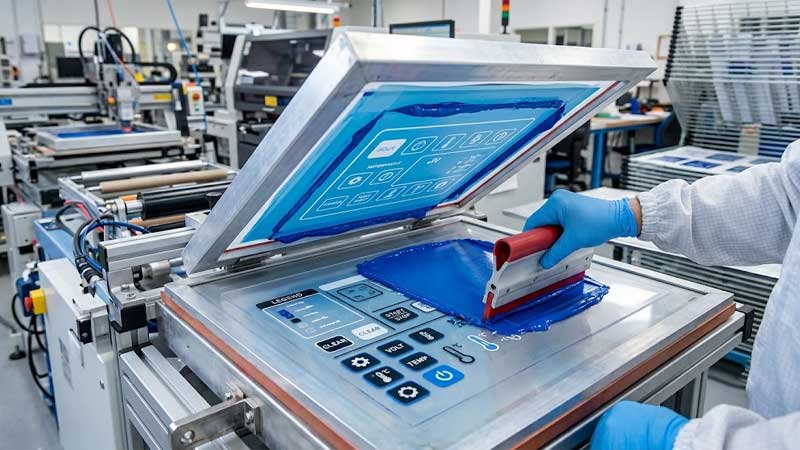
Screen printing is the most widely used and proven method for high-performance graphic overlays in demanding environments. It delivers excellent durability and is especially suitable for long-life industrial applications where resistance to wear is critical. The process allows for thick ink deposition, which significantly improves abrasion resistance and helps maintain graphic integrity even under frequent operation. In addition, screen-printed layers provide stable color performance, ensuring icons and legends remain clear and readable even after prolonged UV exposure or harsh environmental conditions. This makes screen printing the preferred solution for applications that require reliability, consistency, and extended lifecycle performance.
Digital Printing
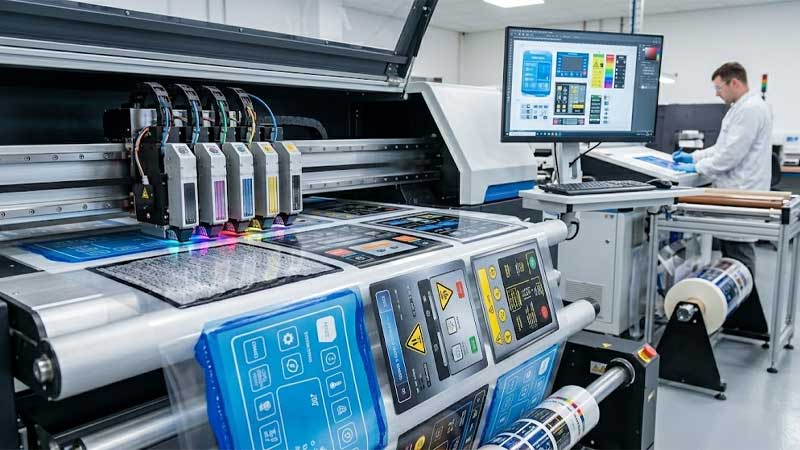
Digital printing is ideal for rapid development cycles and projects that require high flexibility in design variation. Unlike traditional tooling-based methods, digital printing eliminates setup costs, making it highly efficient for prototypes, small batches, and multi-variant product lines. It allows for fast design iteration, enabling engineers and product teams to quickly test different layouts, colors, and interface designs without delay. This method is particularly suitable for customized or evolving product requirements, where speed, adaptability, and cost efficiency are key priorities.
Precision Cutting & Forming
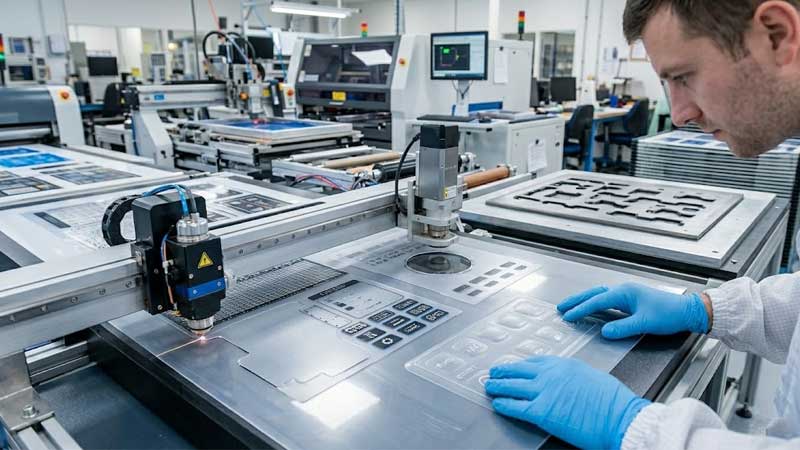
To ensure precise fit and functional integration, we provide multiple engineering-grade cutting and forming processes tailored to different application needs. Die cutting is commonly used for mass production, offering high efficiency and consistent dimensional accuracy for large-volume orders. For applications requiring extremely fine detail or complex geometries, laser cutting delivers superior precision and clean edges. In addition, we support window punching for transparent display or LED indicator areas, ensuring clear visibility without compromising structural integrity. Embossing is also available to create tactile feedback zones, improving user interaction by providing clear physical indicators for buttons and control points.
Integration with Silicone Keypads & HMI Systems
Graphic overlays are commonly integrated into layered interface systems:
With Silicone Keypads
- Overlay defines visual layout
- Silicone provides tactile response
- Combined system improves sealing and usability
With Membrane Switches
- Overlay acts as top sealing layer
- Circuit layer sits underneath
- Enables IP65–IP67 protection systems
This combination is widely used in:
- Industrial automation
- Medical devices
- Marine electronics
- Outdoor control systems
Engineering Design Considerations
Professional graphic overlay design must consider:
Dimensional Accuracy
Dimensional accuracy is a critical factor in ensuring proper alignment across multi-layer HMI systems. During design and production, alignment tolerances are typically controlled within ±0.2–0.5 mm to guarantee precise fitting with underlying components such as keypads, displays, and circuit layers. This level of precision is essential for maintaining consistent assembly quality, preventing misalignment issues, and ensuring smooth user interaction in complex control interfaces.
Environmental Resistance
Graphic overlays are often used in demanding environments, so resistance to environmental stress is a key design consideration. Materials and structures must withstand repeated temperature cycling without deformation or performance degradation. UV exposure stability is also essential to prevent discoloration, fading, or surface deterioration when used in outdoor or high-light conditions. In addition, chemical resistance is required for industrial or medical applications where frequent cleaning with solvents or disinfectants is common, ensuring long-term durability and surface integrity.
Adhesion Performance
Adhesion performance directly affects the reliability and service life of the graphic overlay. Industrial-grade adhesive systems such as 3M are commonly used to provide strong, stable bonding over extended periods. Different substrate materials—including metal, plastic, and glass—require carefully selected adhesive formulations to ensure optimal adhesion strength and long-term stability. Proper adhesive engineering helps prevent edge lifting, bubbling, or detachment, even under temperature fluctuations or mechanical stress.
Optical Design
Optical design plays an important role in both usability and visual performance of graphic overlays. Anti-glare treatments are often applied to improve readability in bright or outdoor environments, reducing reflections and enhancing user visibility. Transparent window areas are precisely designed for LEDs or display screens to ensure clear signal transmission without distortion. In backlit systems, controlled light diffusion is engineered to achieve uniform illumination, improving interface clarity and enhancing the overall user experience in low-light conditions.
Applications
Graphic overlays are used in a wide range of industrial and commercial systems:
- Industrial automation control panels
- Medical diagnostic equipment
- Marine navigation systems
- Agricultural machinery interfaces
- Energy management systems
- Laboratory and testing instruments
Frequently Asked Questions
What is the difference between PET and PC overlays?
PET is cost-effective with strong chemical resistance, while PC offers higher impact resistance and premium finishing options.
Can graphic overlays be waterproof?
Yes. When combined with proper adhesive systems and sealed interface structures, IP-rated protection can be achieved.
Are overlays compatible with silicone keypads?
Yes. They are commonly used together in HMI systems to combine tactile feedback with visual labeling.
What is the most durable printing method?
Screen printing is the most durable option for long-term industrial use.