
Rapid Prototyping for Custom Silicone Rubber Keypads
Develop functional silicone keypad prototypes before mass production to validate key layout, tactile feedback, mechanical performance, and electronic integration. Our silicone rubber keypad prototype service helps engineers and product designers verify designs quickly and reduce development risks before tooling investment.
With experience in custom silicone keypad manufacturing, we support prototype development from initial concept and 3D design review to material selection, molding validation, printing, coating, and functional testing.
- Functional Prototype Development
- Custom Silicone Material Selection
- Fast Design Validation
- OEM Manufacturing Support
What Is a Silicone Keypad Prototype?
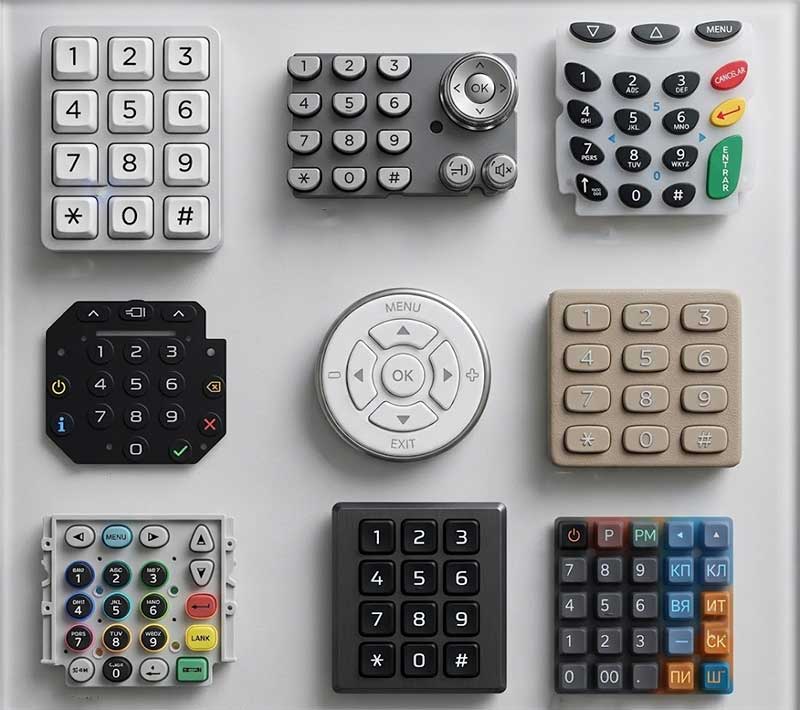
A silicone keypad prototype is an early-stage sample used to verify the design, performance, and manufacturability of a custom silicone rubber keypad before full-scale production.
Unlike simple appearance models, a functional silicone keypad prototype can include actual silicone rubber materials, conductive carbon pills, metal domes, printed legends, backlight structures, and mechanical features similar to the final production part.
During product development, engineers use silicone keypad prototypes to evaluate:
- Key size and spacing
- Button travel distance
- Tactile response
- Operating force
- Electrical switching performance
- Surface appearance
- Assembly compatibility
- User experience
For OEM customers, prototyping provides valuable feedback before creating production molds, helping avoid costly design modifications after mass production begins.
Why Prototype Silicone Rubber Keypads Before Mass Production?
Reduce Tooling Risks
Custom silicone keypads usually require dedicated molds based on the product structure and application requirements. Prototype development allows engineers to identify potential issues before committing to production tooling.
Common problems discovered during prototype validation include:
- Incorrect key dimensions
- Insufficient tactile feedback
- Uneven button force
- Poor LED light transmission
- Interference with housing components
- Difficult assembly conditions
Early testing helps optimize the design and improves first-pass tooling success.
Validate Tactile Performance
The tactile feeling of a silicone keypad depends on multiple factors:
- Silicone hardness
- Webbing structure
- Key height
- Return force
- Actuator design
- Conductive contact structure
A prototype allows customers to physically test whether the keypad provides the required user experience.
For example, industrial equipment may require firm tactile feedback to prevent accidental activation, while consumer electronics may need softer and quieter key operation.
Confirm Product Compatibility
Silicone keypad prototypes help verify integration with:
- PCB circuits
- Plastic housings
- Display modules
- LED backlight systems
- Metal dome switches
- Membrane circuits
This is especially important for compact electronic products where small dimensional changes can affect assembly performance.
Silicone Keypad Prototype Development Process
Design Review and Engineering Analysis
Prototype development begins with reviewing customer requirements, CAD files, product drawings, and application conditions.
Our engineers evaluate key technical factors, including:
- Keypad dimensions and layout
- Button arrangement
- Silicone structure design
- Material requirements
- Mold feasibility
- Assembly conditions
During this stage, potential manufacturing issues are identified before prototype production.
Engineering recommendations may include:
- Optimizing silicone wall thickness
- Improving key support structures
- Adjusting venting design
- Modifying draft angles
- Refining actuator geometry
This early analysis helps create a prototype design that can transition smoothly into mass production.
Silicone Keypad Structure Optimization
The prototype design stage focuses on improving both user experience and manufacturing feasibility.
Key structural factors include:
Key height, diameter, spacing, and shape directly influence operating force and tactile response.
Design considerations include:
- Larger buttons for industrial control equipment
- Low-profile keys for compact electronic devices
- Customized layouts for handheld products
Proper key geometry ensures comfortable operation and reliable performance.
Tactile Response and Webbing Design
The silicone web structure controls key movement and return behavior during operation.
A properly designed silicone web provides:
- Stable key movement
- Consistent operating force
- Fast key return
- Long service life
- Improved user feedback
During prototype validation, web thickness and geometry are adjusted to achieve the required tactile performance.
Incorrect web design may result in:
- Unstable key feeling
- Slow button recovery
- Excessive pressing force
- Reduced durability
Electrical Contact and Switching Validation
For electronic applications, silicone keypad prototypes may integrate different switching structures, including:
- Conductive carbon pills
- Conductive silicone contacts
- Metal dome switches
The electrical design is evaluated to ensure reliable switching performance.
Validation focuses on:
- Contact resistance
- Switching reliability
- Contact alignment
- Electrical durability
This step ensures the prototype accurately represents the final keypad performance before production tooling.
Rapid Prototyping Methods for Silicone Rubber Keypads
01
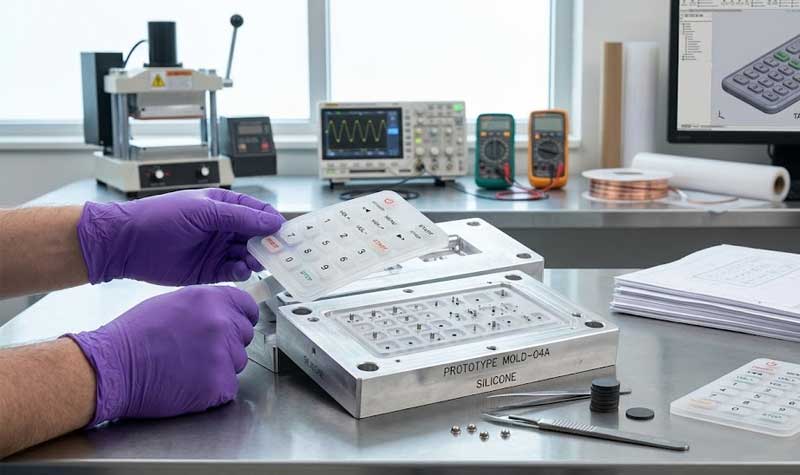
Silicone Prototype Molding
Silicone prototype molding is one of the most common methods for producing functional silicone keypad prototypes.
A simplified prototype mold is created to produce samples using actual silicone rubber materials.
Advantages:
- Real silicone material performance
- Accurate tactile feedback
- Functional testing capability
- Suitable for customer evaluation
This method is recommended when customers need to verify:
- Button feel
- Mechanical durability
- Assembly compatibility
- Appearance quality
It provides a closer representation of final production parts compared with printed models.
02
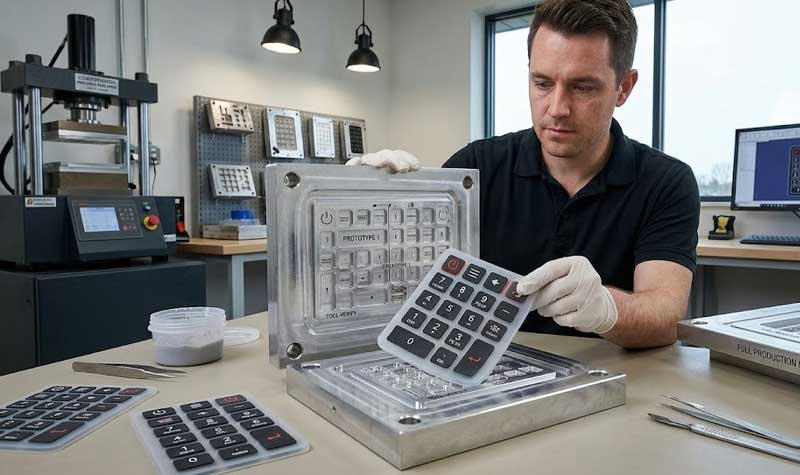
Soft Tooling for Silicone Keypad Prototypes
Soft tooling uses simplified molds or lower-cost tooling approaches to produce prototype quantities before mass production.
It is suitable for:
- Design verification
- Engineering testing
- Small production runs
- Customer approval samples
Compared with full production molds, soft tooling reduces initial investment while providing functional silicone parts.
03
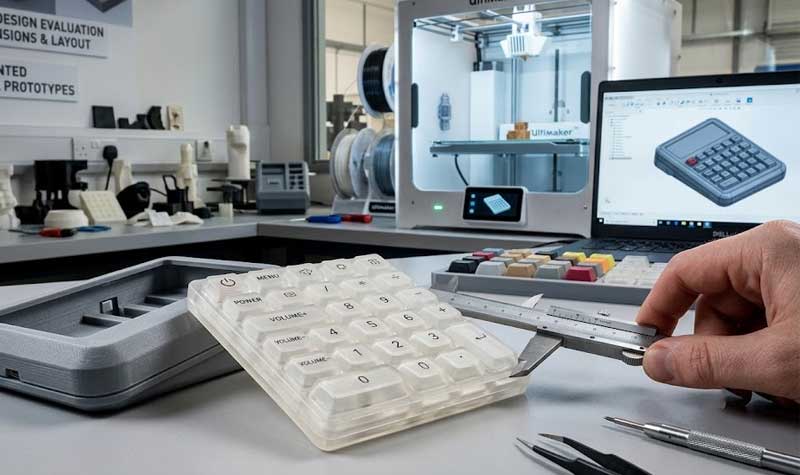
3D Printed Prototype Models
3D printing can be used during the early design stage to evaluate:
- Product dimensions
- Key arrangement
- Housing fit
- Visual appearance
However, traditional 3D printed materials cannot fully replicate silicone rubber characteristics such as:
- Elastic deformation
- Tactile response
- Compression recovery
Therefore, 3D printed models are mainly used for visual and mechanical design verification before silicone prototype production.
04
Prototype Using Production Molds
For projects with finalized designs and short development timelines, customers may choose to proceed directly with production tooling.
This approach allows prototype samples to be produced with:
- Final silicone materials
- Production molding process
- Production surface finishing
- Final printing methods
It provides the highest accuracy but requires higher initial tooling investment.

Materials Used for Silicone Keypad Prototypes
Selecting the right silicone material is essential for achieving the required tactile performance, durability, environmental resistance, and production feasibility. During prototype development, we help customers select silicone materials based on application requirements, including operating environment, button lifespan, electrical requirements, and regulatory standards.
High Consistency Rubber (HCR) Silicone
HCR silicone rubber is commonly used for compression molded silicone keypad prototypes due to its excellent elasticity, stable mechanical performance, wide temperature resistance, and long-term durability. It provides reliable deformation recovery and consistent tactile performance during repeated operation. HCR silicone is suitable for industrial control panels, remote controls, automotive interfaces, and electronic devices that require durable and responsive button performance.
Liquid Silicone Rubber (LSR)
Liquid Silicone Rubber (LSR) is suitable for silicone keypad prototypes that require high precision, complex structures, and consistent production quality. Compared with traditional silicone materials, LSR provides excellent dimensional accuracy, smooth surface quality, and efficient molding capability, making it suitable for automated production environments. LSR prototype development is often selected for projects that require high-volume manufacturing after design validation, especially when tight tolerances and complex keypad structures are required.
Conductive Silicone Materials
For electronic switching applications, conductive silicone materials can be integrated into prototypes to simulate the electrical performance of final production keypads. Common conductive solutions include carbon pills, conductive silicone contacts, and conductive coatings. These materials allow engineers to evaluate electrical switching reliability, contact resistance, signal transmission performance, and button response before mass production. Conductive silicone prototype validation is especially important for products where keypad performance directly affects the reliability of the electronic interface.
Medical Grade and Food Grade Silicone
For specialized applications, silicone keypad prototypes may require materials that meet specific safety and regulatory requirements. Medical grade and food grade silicone materials are commonly considered for applications such as medical equipment interfaces, healthcare devices, and food processing equipment. Material selection focuses on key factors including biocompatibility, chemical resistance, sterilization capability, and compliance with relevant industry standards. Proper material evaluation during the prototype stage helps ensure the final product meets both performance and regulatory expectations.
Silicone Rubber Keypad Prototype Manufacturing Process
A professional prototype process should not only create samples but also provide manufacturing feedback for future mass production.
Requirement Analysis
Before starting silicone keypad prototype development, we review the product application, operating environment, keypad dimensions, electrical requirements, expected service life, and surface appearance requirements. Understanding these factors helps determine the most suitable silicone material, structural design, and prototype method for the project. A detailed requirement analysis at the beginning reduces design changes later and creates a clearer path toward successful mass production.
3D Design and Engineering Review
Customers usually provide 3D CAD files, product drawings, PCB layouts, or reference samples for engineering evaluation. Our engineers analyze key design factors, including mold structure, silicone flow behavior, button deformation, assembly tolerances, and overall manufacturing feasibility. During this stage, potential issues related to structure, dimensions, or production processes can be identified and improved. Early design optimization helps minimize future tooling adjustments and improves the efficiency of the development process.
Prototype Mold Development
After the design is approved, a prototype mold is developed according to the selected production method and testing requirements. Prototype molds are designed to achieve fast sample production, functional verification, and cost-effective development. Depending on the project requirements, prototype molds can support small quantities ranging from dozens of samples to hundreds of units for engineering testing, customer evaluation, and design validation before mass production.
Silicone Molding and Secondary Processing
Prototype samples are manufactured using silicone molding processes that closely represent production methods, allowing customers to evaluate both functional performance and visual appearance. Depending on the keypad design and application requirements, prototype manufacturing may include silicone compression molding, LSR injection molding, conductive contact installation, laser engraving, screen printing, PU coating, and epoxy coating. These processes help verify key factors such as tactile response, electrical performance, surface finish, and product appearance before final production.
Testing and Design Validation
Prototype testing is performed to confirm whether the silicone keypad meets technical and application requirements before moving into mass production. Mechanical validation may include operating force testing, travel distance measurement, return force evaluation, and compression recovery testing to ensure proper tactile performance and durability. Electrical validation focuses on contact resistance, switching reliability, and circuit compatibility for electronic applications. Environmental testing may include temperature resistance, chemical exposure testing, UV resistance, and aging evaluation to confirm long-term reliability under actual operating conditions.
Key Design Considerations for Silicone Keypad Prototypes
Successful silicone keypad prototype development requires balancing user experience, mechanical performance, electrical requirements, and manufacturing feasibility. During the prototype stage, engineers evaluate key design factors to ensure the keypad provides reliable operation and can transition smoothly into mass production.
Tactile Response and Operating Feel
Tactile performance is one of the most important factors in silicone keypad development because it directly affects user interaction and product experience. The pressing feel of a silicone keypad is influenced by multiple factors, including silicone hardness, key geometry, web thickness, button height, and conductive contact design.Different applications require different tactile characteristics. Industrial equipment usually requires stronger feedback and clear button confirmation to prevent accidental operation, while consumer electronics often require smoother, quieter, and more comfortable key operation. Prototype testing allows engineers to adjust the structure and material combination until the required operating feel is achieved.
Silicone Hardness and Material Selection
Silicone hardness directly affects button force, tactile feedback, durability, and overall keypad performance. During prototype development, silicone hardness is selected according to product requirements, button size, operating environment, and expected usage frequency.Softer silicone materials, typically around 30–40 Shore A, provide a softer touch and lower pressing force, making them suitable for applications requiring comfortable operation. Medium hardness silicone materials, around 40–60 Shore A, provide a balanced combination of tactile feedback and durability for many electronic interfaces. Higher hardness silicone materials, around 60–80 Shore A, offer firmer operation and improved structural stability for demanding applications.Selecting the correct silicone hardness during the prototype stage helps achieve consistent performance before moving into production tooling.
Keypad Structure and Mechanical Design
The structural design of a silicone keypad directly affects button movement, operating force, and service life. Important factors include key shape, button dimensions, spacing, and silicone web structure.Different key designs are selected according to application requirements. Round buttons can improve finger positioning, square keys can maximize panel space utilization, and custom-shaped keys or raised tactile indicators can provide better user guidance for specialized equipment.The silicone web works as a flexible hinge that controls key deformation and return movement. Proper web geometry improves key return speed, operating force consistency, and long-term durability. During prototype validation, engineers may adjust web thickness and structure based on tactile testing results to achieve the required performance.
Backlight and Visual Interface Design
For applications requiring operation in low-light environments, silicone keypad prototypes can integrate backlight structures to verify visual performance before mass production.Common backlight solutions include light pipes, transparent silicone areas, laser-etched legends, and LED integration structures. Prototype validation helps evaluate light distribution, symbol visibility, and light leakage control to ensure clear legends and uniform illumination.Backlight testing during the prototype stage is especially important for automotive controls, industrial equipment, and handheld electronic devices where visibility and user experience are critical.
Technical Specifications
| Item | Typical Options |
|---|---|
| Material | HCR Silicone, LSR Silicone, Conductive Silicone |
| Hardness | 20-80 Shore A |
| Molding Process | Compression Molding, LSR Injection Molding |
| Surface Finish | Matte, Glossy, Textured |
| Printing | Screen Printing, Pad Printing, Laser Etching |
| Coating | PU Coating, Epoxy Coating |
| Conductive Options | Carbon Pills, Conductive Silicone |
| Backlight Options | LED Backlighting, Light Guide Structure |
| Prototype Quantity | Low Volume Engineering Samples |
| Testing | Mechanical, Electrical, Environmental Testing |
Applications of Silicone Keypad Prototypes
Silicone keypad prototypes are widely used for product development across industries requiring durable, reliable, and customized user interfaces.
Industrial Control Panels
Automotive Electronics
Medical Device Keypads
IoT & Wearables
Why Choose Us for Silicone Keypad Prototype Development?
From Prototype to Mass Production
A prototype should not only demonstrate appearance. It should provide a reliable path toward production.
Our engineering team considers:
- Mold manufacturability
- Material selection
- Assembly requirements
- Production efficiency
This reduces the risk of redesign when moving from prototype to volume manufacturing.
Manufacturing Experience in Silicone Keypad Development
With practical experience in silicone keypad production, we understand the challenges that often appear during prototype validation.
Examples include:
- Adjusting silicone web structures to achieve consistent tactile force
- Optimizing conductive contact positions to improve switching reliability
- Balancing printing durability and surface appearance requirements
These details help customers develop prototypes that are closer to final production requirements.
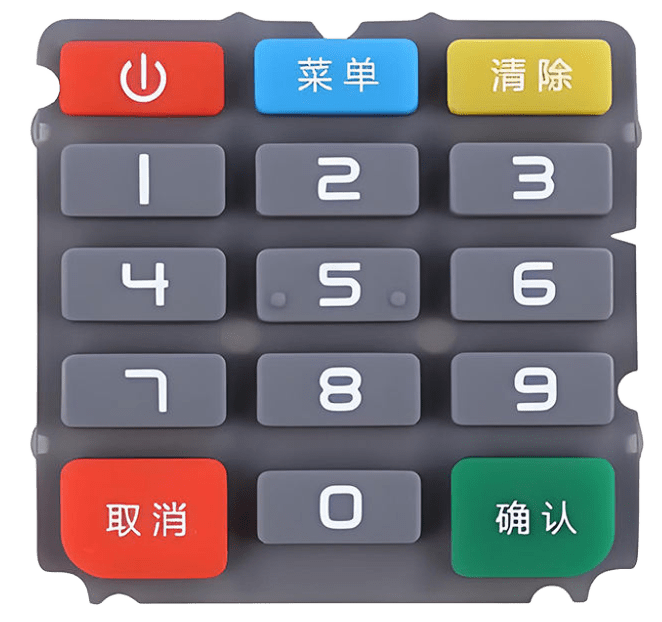
Custom Silicone Keypad Prototype for Your Next Project
Developing a silicone keypad prototype before mass production helps engineers verify performance, reduce risks, and create a reliable product design.From material selection and structural optimization to prototype molding and functional testing, we provide complete support for custom silicone rubber keypad development.Contact us to discuss your silicone keypad prototype requirements and move your concept toward production.
Frequently Asked Questions
How long does it take to make a silicone keypad prototype?
The development time depends on product complexity, prototype method, and testing requirements.
Simple prototype samples may require several weeks, while complex designs involving backlighting, coatings, and electronic integration require additional engineering time.
Can a silicone keypad prototype use the same material as the final product?
Yes. Functional prototypes can use production-grade silicone materials to provide more accurate testing results.
Material selection depends on application requirements and prototype objectives.
What files are needed for silicone keypad prototype development?
Common requirements include:
- 3D CAD files
- Product drawings
- PCB layout
- Keypad specifications
- Surface artwork files
Our engineers can also support design optimization when customers only have initial concepts.
Can prototypes include printing and backlighting?
Yes.
Prototype silicone keypads can include:
- Screen printed legends
- Laser etched symbols
- PU protective coating
- Epoxy coating
- LED backlighting structures
These features help customers evaluate the final user experience.
What is the difference between a silicone keypad prototype and a production sample?
A prototype is mainly used for design verification and engineering testing.
A production sample is produced after tooling and process parameters are finalized and represents the final manufacturing condition.