
Silicone Keypad Testing & Reliability Validation
Why Silicone Keypad Testing Matters
- Increased actuation force
- Reduced tactile feedback
- Slow button recovery
- Silicone web fatigue or cracking
- Conductive contact instability
- Permanent deformation after repeated compression
- Whether the silicone compound provides suitable elasticity
- Whether the keypad structure achieves the required tactile response
- Whether the conductive contact remains stable after repeated operation
- Whether the design can withstand the expected operating environment
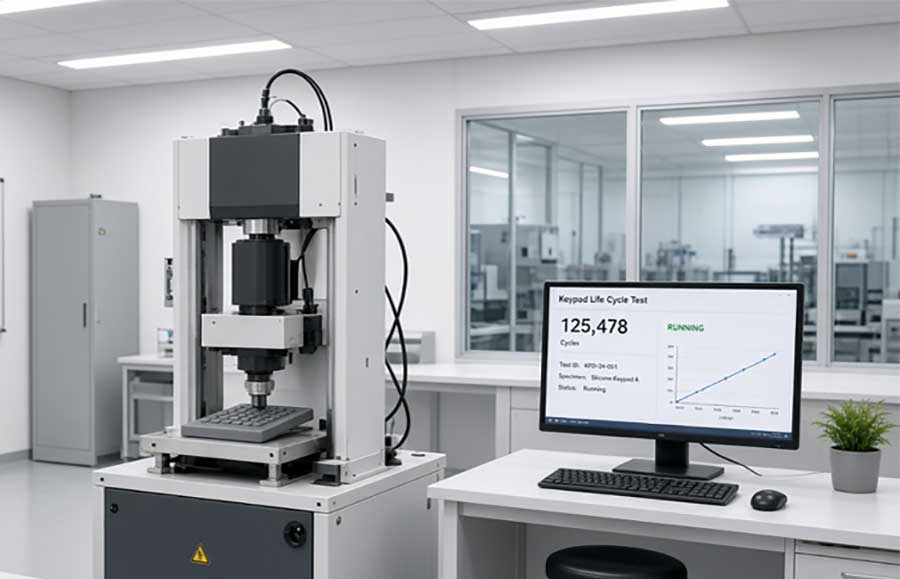
Silicone Keypad Testing Capabilities
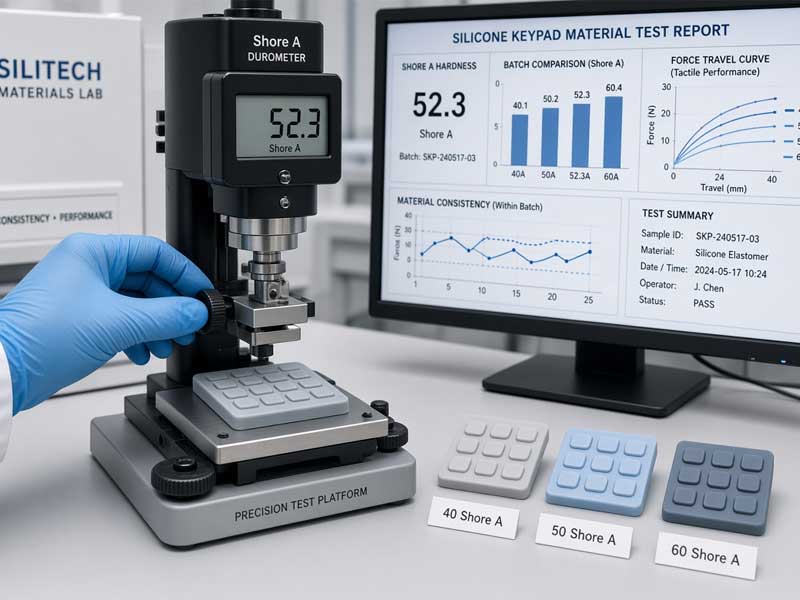
Silicone Hardness Testing
- Shore A hardness measurement
- Material batch comparison
- Hardness variation analysis
- Too soft: slow recovery, unstable tactile feedback
- Too hard: high pressing force, reduced user comfort
Force Travel Testing and Tactile Performance Analysis
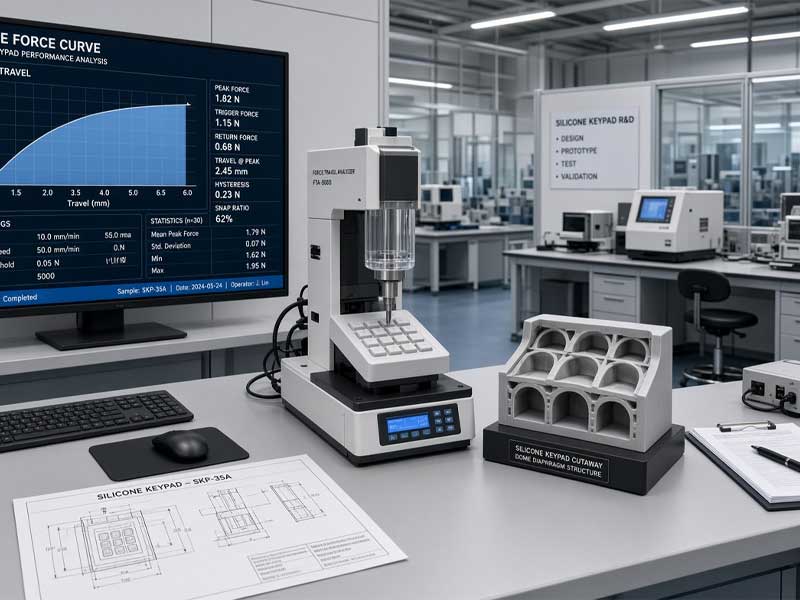
The tactile feeling of a silicone keypad is determined by the relationship between pressing force and displacement. SKF uses force travel testing to analyze key performance parameters, including actuation force, contact force, travel distance, return force, and overall force curve characteristics.
Typical silicone keypad designs may require an actuation force of approximately 80g–500g and a travel distance of around 0.3mm–2.0mm, depending on the application and user expectations. Industrial control panels usually require stronger tactile feedback and higher operating force to provide clear confirmation during operation, while portable electronic devices often focus on lower pressing force and smoother button response.
SKF engineers use force travel data to optimize key structural factors such as silicone web thickness, web angle, button geometry, silicone hardness, and conductive pill positioning. This analysis helps achieve the right balance between tactile feedback, operating comfort, and long-term durability.
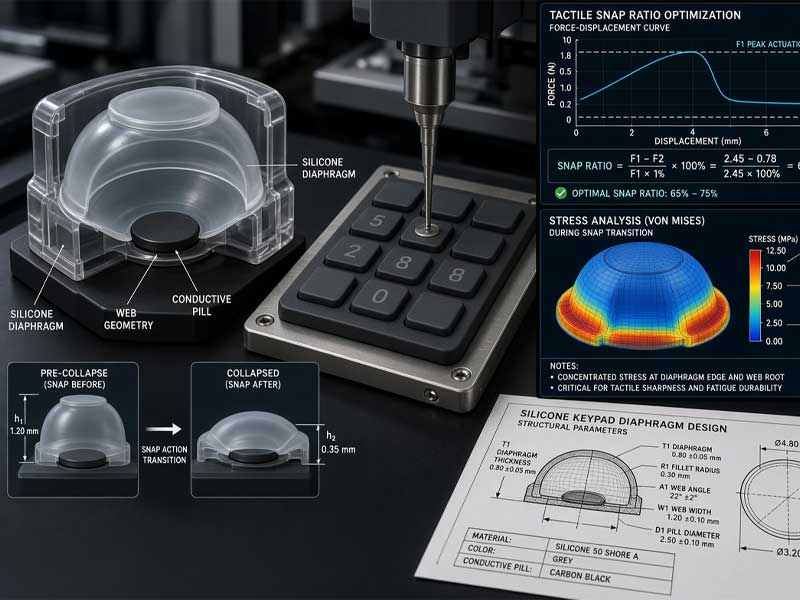
- F1 = Peak actuation force
- F2 = Contact force
- Diaphragm geometry
- Stress concentration areas
- Web design
- Material elasticity
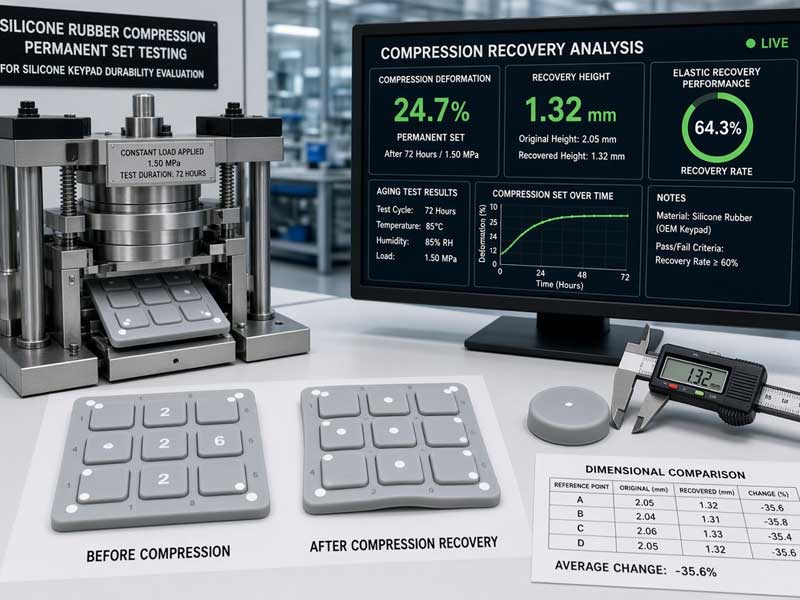
Compression Recovery and Permanent Deformation Testing
- Deformation percentage
- Recovery ability
- Aging behavior
- Slow button return
- Reduced tactile response
- Unstable operation
| Evaluation Item | Testing Purpose |
| Pressing cycles | Verify service life |
| Actuation force change | Detect tactile degradation |
| Return force | Check recovery performance |
| Conductive resistance | Confirm electrical stability |
| Silicone structure | Identify fatigue or cracking |
Conductive Silicone Keypad Testing
Contact Resistance Testing
- Initial contact resistance measurement
- Resistance change after cycling
- Switching stability evaluation
- Conductive pill wear
- Insufficient contact pressure
- PCB contact alignment problems
Electrical Reliability Validation
- Resistance before cycling
- Resistance after hundreds of thousands of presses
- Contact consistency between keys
Environmental Reliability Testing
Temperature Resistance Testing
- Low-temperature exposure: -40°C to -60°C
- High-temperature exposure: 80°C to 150°C+ depending on silicone material
- Hardness changes
- Elastic recovery
- Force variation
- Surface condition
Humidity Resistance Testing
- Silicone stability
- Conductive reliability
- Printing adhesion
- Sealing performance
Chemical Resistance Testing
- Alcohol cleaning solutions
- Oils
- Detergents
- Industrial chemicals
- Appearance
- Hardness
- Mechanical properties
- Electrical performance
Silicone Keypad Testing Equipment
| Equipment | Function |
| Force travel tester | Measures actuation force and tactile response |
| Life cycle tester | Simulates repeated pressing operation |
| Shore hardness tester | Measures silicone hardness |
| Resistance tester | Evaluates conductive performance |
| Environmental chamber | Tests temperature and humidity resistance |
| Measuring equipment | Verifies dimensions and assembly accuracy |
Silicone Keypad Validation Process
Requirement and Design Review
SKF engineers review product drawings, 3D models, silicone material requirements, operating environments, expected lifetime, and tactile performance targets before defining the appropriate validation approach. This review helps identify key testing requirements based on product structure and application conditions.
Customized Testing Plan
Based on product requirements, SKF defines suitable validation items for each silicone keypad project. The testing plan may include mechanical testing, electrical testing, life cycle testing, and environmental testing to verify overall performance and reliability.
Testing and Data Collection
Samples are evaluated under controlled testing conditions to ensure accurate and consistent results. Collected data includes initial performance values, performance changes during testing, and final validation results, providing engineering references for further optimization.
Engineering Analysis and Optimization
Testing results are reviewed to identify potential improvement opportunities during product development. For example, excessive actuation force may be caused by high silicone hardness, thick web structure, or incorrect geometry, which can be optimized through material adjustment, tooling modification, and web structure improvement. Reduced tactile response may result from an unsuitable snap ratio, material fatigue, or stress concentration, requiring adjustments to diaphragm geometry or button structure. Conductive instability may be related to carbon pill wear, contact pressure variation, or alignment issues, which can be improved through conductive pill design optimization and better molding accuracy.
Why Choose SKF for Silicone Keypad Testing?
- Silicone material selection
- Mold design evaluation
- Tactile performance optimization
- Conductive contact design
Frequently Asked Questions
What does silicone keypad testing include?
How many cycles can a silicone keypad be tested for?
How is silicone keypad tactile performance measured?
Can SKF test conductive silicone keypads?
When should silicone keypad testing be performed?