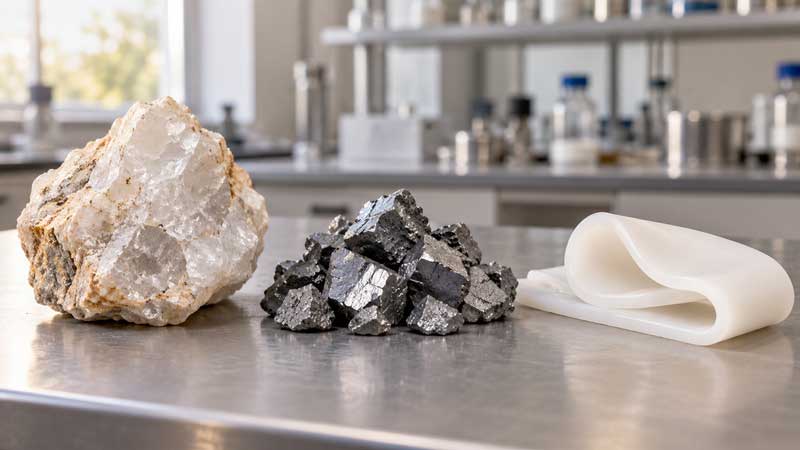
Silicone starts with silica in quartz, but making it takes several chemical conversions. The quartz is reduced to elemental silicon; silicon reacts with methyl chloride; the resulting compounds are separated, converted into siloxanes and joined into polymer chains. This article explains what happens at each stage and why the choice and purity of the intermediate chemicals matter to the silicone ultimately produced.
What has to change for quartz to become silicone?
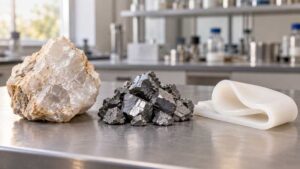
Quartz contains silicon dioxide (SiO₂). Its silicon atoms are tightly bonded to oxygen in a mineral crystal, which is very different from the molecular chains in silicone. Industrial production must first release silicon from that mineral and then give it organic groups that allow controlled reactions. The finished polymer has an alternating silicon–oxygen backbone, often written as –Si–O–Si–, with carbon-containing groups attached to silicon. This combination of an inorganic backbone and organic side groups is central to silicone chemistry.
Silicon itself is a metalloid, not a metal. Silicone is a manufactured polymer, not another name for silicon or silica. For a fuller comparison of these terms, see SKF’s silicon versus silicone guide. “Made from sand” is therefore a useful starting point, but it leaves out the reactions that make the final material possible.
Step 1: Reduce quartz to metallurgical-grade silicon
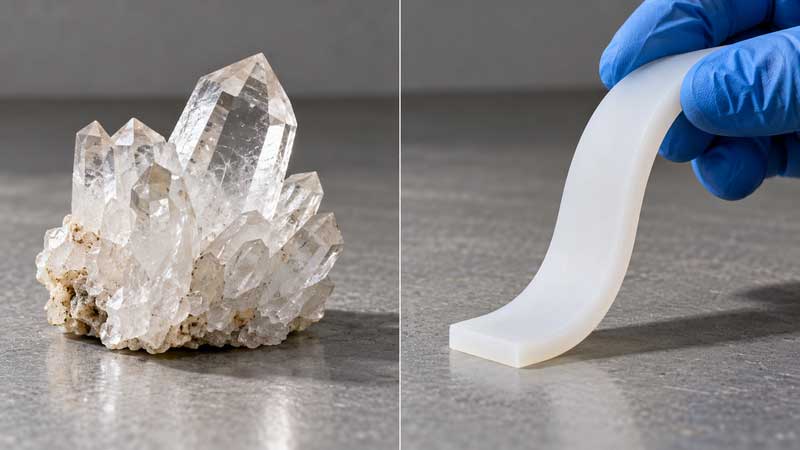
The first industrial stage is carbothermal reduction. Producers feed quartz or quartzite together with carbon-bearing materials into a submerged electric arc furnace. At about 1,500–2,000 °C, carbon removes oxygen from the silica. The simplified overall reaction is SiO₂ + 2C → Si + 2CO. In an actual furnace, several intermediate reactions occur, so this equation describes the net change rather than every reaction inside the bed.
The molten silicon is tapped, refined to control impurities such as aluminum and calcium, and cast. For silicone synthesis it is then ground into powder to provide more reactive surface area. The relevant feedstock is generally metallurgical-grade silicon; making electronic-grade silicon for semiconductor wafers is a separate, much more demanding purification route. This distinction matters because “pure silicon” can misleadingly suggest that chip-grade material is needed.
Step 2: Form methylchlorosilanes
Silicon powder is contacted with methyl chloride (CH₃Cl) in a reactor containing a copper-based catalyst. This is the direct, or Müller–Rochow, process. In the production route described by Elkem’s technical overview, reaction temperatures are about 250–330 °C. The process creates silicon–carbon bonds while leaving reactive chlorine groups on the molecules. Those chlorine groups are what make the next conversion into silicon–oxygen bonds possible.
The reactor does not yield one pure chemical. Its main product is commonly dimethyldichlorosilane, (CH₃)₂SiCl₂, accompanied by other methylchlorosilanes. A simplified representation of the main reaction is Si + 2CH₃Cl → (CH₃)₂SiCl₂; the real outlet is a mixture. Copper catalyst condition, silicon quality and reactor control influence that mixture, which is why this stage affects both yield and downstream polymer structure.
Step 3: Separate the building blocks
Fractional distillation separates the methylchlorosilane mixture before it enters polymer synthesis. Dimethyldichlorosilane boils at about 70 °C, while methyltrichlorosilane boils at about 66 °C. Their close boiling points make careful separation important. Even a small unintended amount of a three-functional component can change the branching of a polymer intended to be mainly linear.
A practical way to understand the chemistry is to count the reactive chlorine groups on each precursor. The groups are replaced during the next stage, so the count helps determine how many connections each unit can make. Elkem’s chlorosilane explanation describes this relationship between precursor functionality and chain architecture.
| Precursor | Reactive sites | Effect on silicone structure |
| Trimethylchlorosilane, (CH₃)₃SiCl | One | Can terminate or cap a growing chain |
| Dimethyldichlorosilane, (CH₃)₂SiCl₂ | Two | Builds long chains or cyclic siloxanes |
| Methyltrichlorosilane, CH₃SiCl₃ | Three | Introduces branching and network-forming sites |
These are precursor roles, not a recipe in fixed proportions. The selected composition depends on the molecular structure being produced. The point for a reader is that silicone properties begin to be designed before any polymer has been made.
Step 4: Convert chlorosilanes into siloxanes
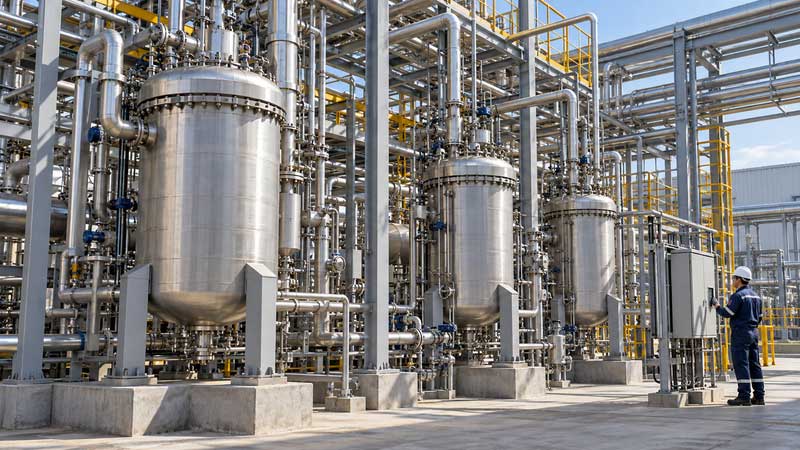
The separated chlorosilanes react with water in a hydrolysis route. For dimethyldichlorosilane, an idealized first change is (CH₃)₂SiCl₂ + 2H₂O → (CH₃)₂Si(OH)₂ + 2HCl. The hydroxyl-bearing units then condense to form Si–O–Si links, releasing water. In practice, the reaction stream contains short linear and cyclic siloxanes rather than a bottle of isolated (CH₃)₂Si(OH)₂ waiting for the next step.
Hydrochloric acid is produced in the water-based route. Industrial plants contain and handle it, and integrated production may recycle chlorine-containing streams. Some processes use alcohol-based conversion instead of simple hydrolysis. These process choices differ, but their shared purpose is to turn reactive chlorosilane precursors into siloxane building blocks. Distillation can then separate siloxane fractions for subsequent polymerization.
Step 5: Grow silicone polymer chains
Siloxanes are joined into longer chains by controlled polymerization. One common silicone polymer is polydimethylsiloxane (PDMS), whose repeating unit is –Si(CH₃)₂–O–. The word “silicone,” however, covers a family of polymers; PDMS is a major example, not the only possible composition. Chain length, chain ends and the identity of side groups are adjusted to obtain the intended molecular structure.
Why does chain length matter? A short chain moves past neighboring chains more readily, while a longer chain has greater viscosity and can provide the basis for an elastic network after crosslinking. End groups can stop chain growth or leave sites for a later reaction. Replacing some methyl groups with other organic or reactive groups changes what the polymer can do. The Silicones Europe polymerization overview separates the creation of siloxanes from the later growth of silicone polymers; they are related steps, but not the same operation.

What controls the quality of the silicone produced?
Three stages carry much of the control burden. Silicon feedstock quality and particle size affect the direct reaction. Chlorosilane separation controls which one-, two- and three-functional units enter the next stage. Polymerization and purification determine chain-length distribution, end groups and the amount of residual low-molecular-weight material. None of these can be inferred from a finished sample’s color or the word “silicone” on a specification.
For a material specification, the meaningful questions depend on its intended use. They may include polymer type, viscosity or molecular-weight range, reactive functionality, volatile content and impurity limits. For a later rubber compound, filler and cure chemistry also matter. The supplier should state which properties are specified for the base polymer and which are measured only after the compound is cured.
When does silicone become an elastic solid?
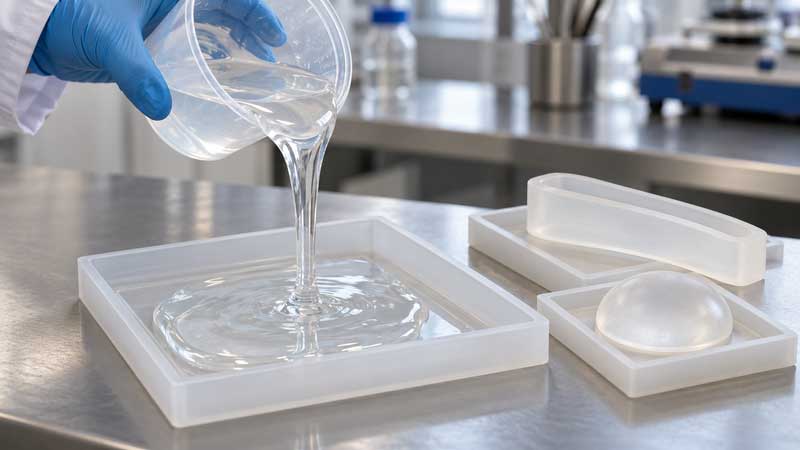
Polymer synthesis creates the silicone base material; it does not automatically create a rubber part. To make an elastic silicone material, manufacturers typically combine suitable polymer chains with reinforcing silica and a crosslinking system. During cure, crosslinks connect the chains into a three-dimensional network. The amount and distribution of those links, together with the filler, influence hardness, tear resistance and recovery after compression. For a broader overview of the material family and its properties, see SKF’s What Is Silicone? guide.
This last distinction prevents a common shortcut in explanations of the process. Polymerization builds the silicone molecules; curing links those molecules to one another. A cured silicone elastomer is a thermoset and cannot be melted back into its uncured state. The details of molding, coatings and individual products belong to their own manufacturing processes, downstream of the silicone chemistry described here.

Conclusion
Making silicone requires more than extracting silicon from quartz. Carbothermal reduction supplies elemental silicon; direct synthesis makes methylchlorosilanes; distillation selects the building blocks; hydrolysis and condensation create siloxanes; and polymerization grows the silicone chains. Understanding these stages makes it easier to ask for the right material specifications and to distinguish a base polymer from a cured silicone compound.
For projects using silicone rubber components, SKF can help translate the required material behavior into a practical compound and manufacturing specification.