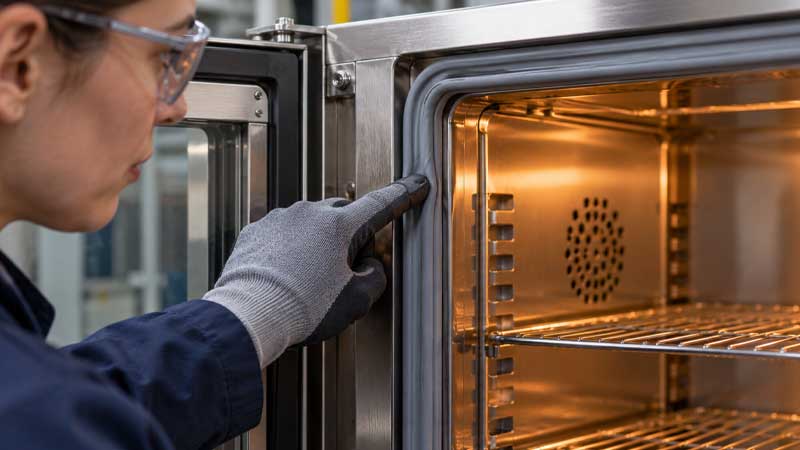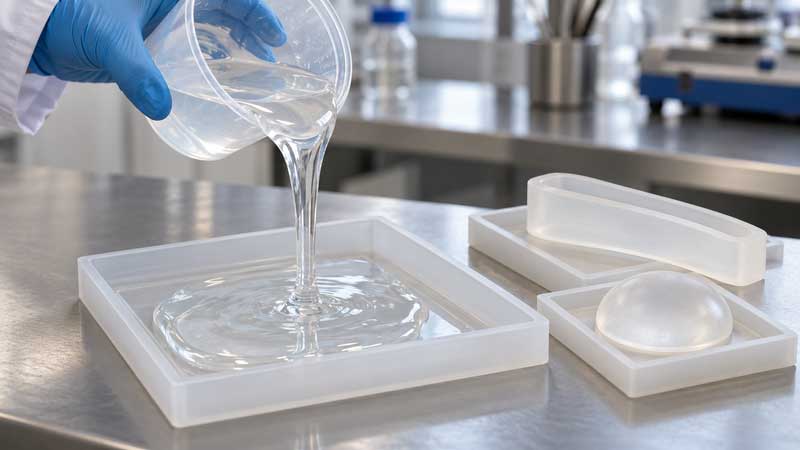
Silicone is a family of synthetic polymers built around repeating silicon–oxygen bonds. Depending on its formulation and degree of crosslinking, it can be a flowing fluid, a soft gel, an elastic rubber or a hard resin. This guide explains how those forms are made, where their useful properties come from, and what the word “silicone” cannot tell you about a particular product.
Silicone, silicon and silica: what is the difference?
Silicon is a chemical element. Silica is silicon dioxide, a mineral found in sand and quartz. Silicone is an industrially manufactured polymer family whose backbone contains alternating silicon and oxygen atoms, with organic groups attached to silicon. Silica can be an upstream raw material, but a finished silicone article is neither elemental silicon nor sand.
A similarly named product, silica gel, is a porous form of silica used as a desiccant. Despite the English name, it is not the silicone polymer discussed here.
The names are easy to confuse, and the distinction matters when reading specifications. A silicon semiconductor wafer and a silicone rubber gasket have very different chemistry and functions. For a fuller side-by-side explanation, see SKF’s silicon versus silicone guide.
What is silicone made from, and how is it made?
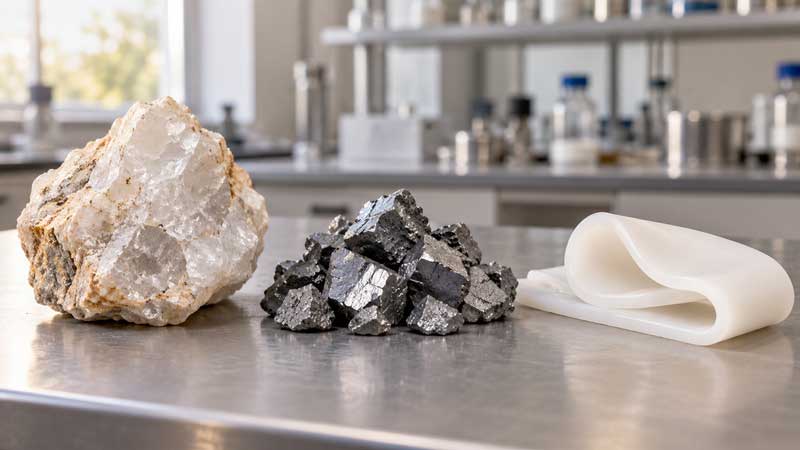
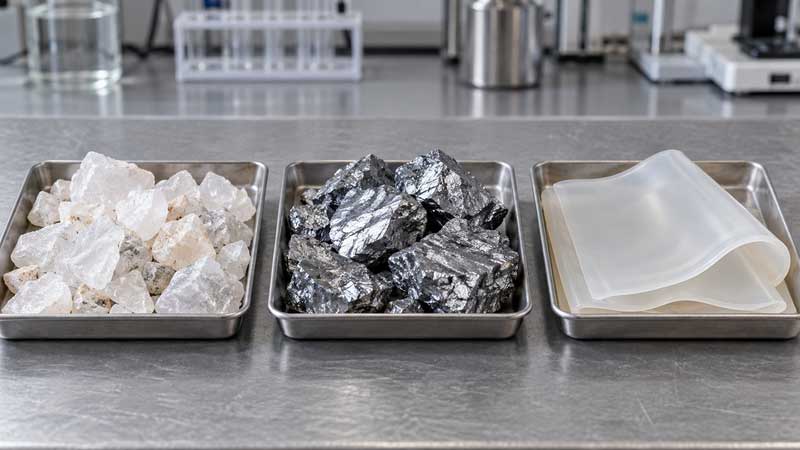
Industrial production starts with silica, which is reduced to silicon metal at high temperature. Silicon reacts with organic feedstocks to produce organosilicon intermediates. After hydrolysis and polymerization, manufacturers obtain chains of siloxane units, commonly including polydimethylsiloxane (PDMS). The organic side groups and chain length help determine whether the base material behaves like a fluid, gel or rubber precursor.
The base polymer is only the beginning of a product formulation. A rubber compound may contain reinforcing silica, pigments, processing aids and a curing system. During cure, crosslinks join polymer chains into a three-dimensional network. The crosslink density, filler package and cure chemistry strongly affect hardness, tear strength, compression set, electrical behavior and processing. Two products labeled “silicone” therefore need not behave alike.
The silicon–oxygen backbone is one reason many silicones tolerate outdoor exposure and temperature changes, while the attached organic groups influence flexibility and interactions with other substances. These are useful structural tendencies, not a substitute for measured properties. A change in filler or cure system can shift a grade’s performance enough to matter more than the shared family name.
This sequence also explains why silicone is synthetic rather than a naturally occurring rubber. The starting mineral is natural, but the polymer structure and finished formulation are created through industrial chemical steps.
What are the main types of silicone?
Silicone names can describe either physical form or manufacturing method. The table separates the main forms before looking more closely at elastomers.
| Form | Typical behavior | Common function |
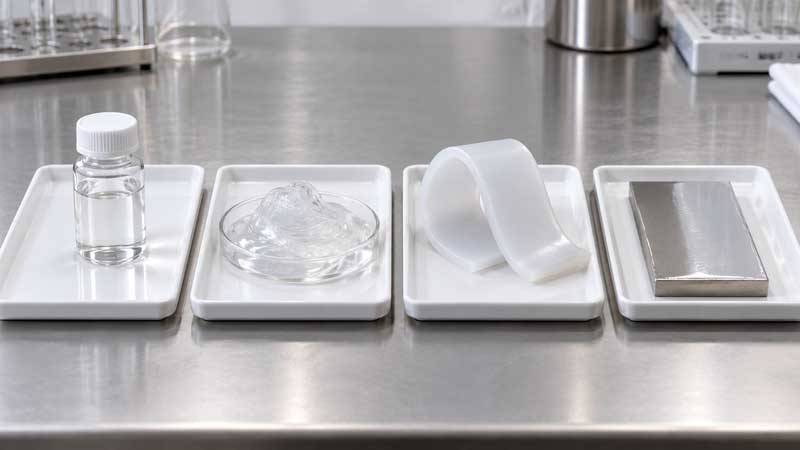
| Silicone fluids and oils | Flowing; viscosity depends on chain length and formulation | Lubrication, damping, release and formulation ingredients |
| Silicone gels | Very soft, lightly crosslinked networks | Encapsulation, cushioning and delicate interfaces |
| Silicone rubber | Crosslinked, elastic solid | Seals, tubing, molded controls and flexible components |
| Silicone resins | More highly crosslinked, often relatively rigid | Coatings, electrical insulation and heat-resistant binders |
| Silicone sealants and adhesives | Dispensed before cure; then form a bonded or sealed joint | Construction joints, electronics assembly and gasketing |
HCR, LSR and RTV silicone rubber
High-consistency rubber (HCR) is a gum-like compound processed by methods such as compression molding or extrusion. Liquid silicone rubber (LSR) is a pumpable, usually two-part material commonly injection molded and heat cured. Room-temperature-vulcanizing (RTV) systems cure at or near room temperature; one-part moisture-cure sealants and two-part casting systems are familiar examples. These labels describe handling and cure routes, not a universal ranking of performance.
A keypad or seal geometry may favor one route because of part volume, tolerance, tooling and material grade. SKF’s silicone compression molding and silicone injection molding pages explain those processes in more detail. Specialty grades, including fluorosilicone and electrically conductive compounds, add properties for defined environments but should be assessed against their own data sheets.
How cure chemistry and part-making affect the result
Addition-cure systems often use a platinum catalyst and are common in LSR; peroxide cure is another route used with some high-consistency compounds. Condensation cure appears in many room-temperature sealants. Each route has its own handling, cure and byproduct considerations. The formulation must be matched to the process and end-use requirements, including any limits on extractables or cure residues.
Compression molding places a measured charge of rubber in a heated tool. Injection molding meters material into a closed mold, often favoring repeatable high-volume production of detailed parts. Extrusion makes continuous profiles such as tubing, while dispensing and casting suit other chemistries and shapes. Post-curing may be specified to complete properties or reduce selected volatiles; it is not automatically required or sufficient for every compliance claim. The finished geometry, gate or flash location, surface treatment and assembly can change performance even when the polymer grade is unchanged.
What properties does silicone rubber have?
The ranges below are broad references for commercially formulated silicone elastomers, not acceptance limits for a design. They are drawn from WACKER’s solid and liquid silicone rubber guide; test method, grade and cure condition must be checked before a number is used in a specification.
| Property | General reference range | Design consideration |
| Operating temperature | Approximately −50 to +250 °C across a broad family of grades; specialty formulations can differ | Select a specific grade for continuous or intermittent exposure, load and service life. |
| Hardness | About Shore A 3–90 | Specify the method and target tolerance; hardness alone does not define key feel or sealing force. |
| Density | About 1.05–1.60 g/cm³ | Fillers and formulation change mass and sometimes other properties. |
| Tensile strength | About 5–11 MPa | Check the relevant test method and geometry; tear resistance is a separate property. |
| Elongation at break | About 100–1100% | Large elongation does not guarantee abrasion or cut resistance. |
| Compression set | About 5–25% in one manufacturer’s 22 h / 175 °C data set | The value changes with temperature, time, compression, grade and post-cure. |
Temperature, flexibility and recovery
The siloxane backbone gives many silicone rubbers useful flexibility over a wider temperature span than numerous general-purpose organic elastomers. Yet a temperature range is not a single “melting point” or a guarantee of function. At elevated temperature, aging can change hardness, elongation and sealing force; at low temperature, flexibility and recovery still depend on formulation. Continuous exposure, brief peaks, mechanical load and the required lifetime all matter.
For seals, gaskets and buttons, compression set describes how much deformation remains after a compressed specimen is released under a defined test. A lower result under a comparable test often supports better long-term elastic recovery, but the test conditions must be compared before two figures are treated as equivalent.
Hardness is another frequently misused shortcut. Shore A is a standardized indentation reading on a test specimen; it is not the force needed to press a molded button. Button force also depends on wall thickness, web profile, contact area and travel. Similarly, a high tensile-strength value does not prove that a thin edge will resist a propagating tear. Test the property that governs the actual failure mode.
Weathering, water and electrical behavior
Many silicone rubbers resist ozone, ultraviolet exposure and moisture well, which helps outdoor seals and controls retain function. Their water-repellent surfaces can shed water, but a hydrophobic material is not automatically a watertight assembly. Seal geometry, compression, joints and enclosure testing determine leakage performance.
Unfilled silicone rubber is commonly an electrical insulator. Conductive fillers can instead make a compound electrically conductive, as in a contact pill or electromagnetic-interference gasket. “Silicone” alone therefore cannot serve as an electrical specification; volume resistivity, dielectric requirements or contact resistance must be defined for the part.
Permeability and chemical exposure
Silicone rubber can let gases pass through more readily than many other elastomers. The same flexible molecular network that supports elasticity does not create a strong universal gas barrier. Specify permeability or leak performance if gas retention is important; do not infer it from water repellency.
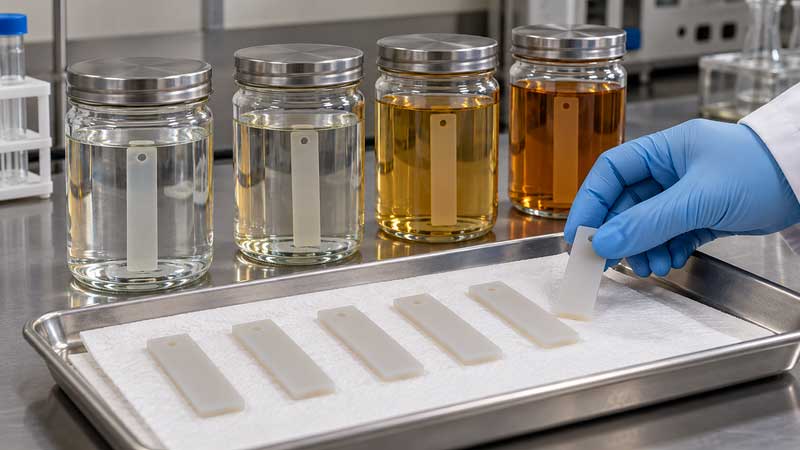
Chemical compatibility depends on the fluid, concentration, temperature and exposure time. Some fuels, oils and nonpolar solvents can cause substantial swelling, while strong acids or alkalis can damage certain grades. Where this matters, compare candidate materials using immersion, dimensional-change and retained-property tests in the actual medium.
The apparent contradiction between good water resistance and high gas permeability is a useful reminder that transport mechanisms differ. Liquid water must enter through a defect or wet a pathway, while individual gas molecules can dissolve in and diffuse across an intact polymer. A sealed product therefore needs separate requirements for liquid ingress, vapor transmission and gas leakage.
Where does silicone fall short?
The most useful material choice starts with possible failure, not a list of advantages. Silicone rubber is often suitable when flexibility, weathering and a broad working-temperature window matter, but it can be a poor default for abrasive contact, sharp edges, a strict gas barrier or prolonged contact with a swelling fluid.
| Potential limitation | Why it matters | Practical check |
| Swelling in selected oils, fuels or solvents | Dimensions and mechanical properties can shift. | Test in the actual medium at the intended temperature and duration. |
| Tear initiation and abrasion | A nick, sharp corner or rubbing surface may shorten life. | Review geometry, tear and abrasion data, or consider another elastomer. |
| High gas permeability | Gas can diffuse through an otherwise intact wall. | Define barrier or leakage limits and test wall thickness and joints. |
| Bonding difficulty | Low surface energy can reduce adhesion to other materials. | Specify surface preparation, primer or compatible adhesive and verify the joint. |
| Grade-specific fire behavior | Silicone is not automatically nonflammable. | Request the applicable flammability rating for the exact compound and thickness. |
| Cost and process fit | Material and tooling economics change with volume and geometry. | Compare the full part and assembly cost against competing materials. |
These are design questions rather than defects in every silicone formulation. A targeted grade, surface treatment or construction can solve some of them, but the solution has to be verified for the finished part.
Is silicone a plastic or a rubber? Does it melt?
Silicone is a polymer family, so “plastic or rubber” is an incomplete either-or question. Silicone rubber is an elastomer: it deforms and recovers after the load is removed. Other silicones are fluids, gels or resins. A cured silicone rubber article is generally a crosslinked thermoset; it will not soften and remelt for ordinary reshaping like a thermoplastic. Sufficient heat can still degrade or burn it.
Material comparisons must be made by application and grade. SKF’s silicone versus rubber and silicone versus TPE articles examine those choices in more detail. A TPE may be reprocessed by melting, while a crosslinked silicone elastomer normally cannot; this processing difference does not decide the best material by itself.
What is silicone used for?
Its uses follow the available forms. A silicone fluid that damps motion is not interchangeable with a molded silicone rubber seal, even though both belong to the same chemical family.
| Application | Typical silicone form | Reason for selection |
| Electronics and electrical equipment | Encapsulants, gels, insulating rubber or filled conductive rubber | Environmental protection, electrical function or flexible interfaces |
| Buildings and infrastructure | Sealants, coatings and rubber profiles | Movement accommodation, weathering and joint sealing |
| Vehicles and industrial equipment | Gaskets, hoses, vibration parts and specialty compounds | Temperature exposure, flexible sealing or fluid-specific performance |
| Healthcare devices | Qualified elastomers, tubing, gels and adhesives | Defined contact, flexibility and processing requirements |
| Food-contact and household goods | Formulated molded rubber and sealants | Cleanability, temperature requirements and product-specific compliance |
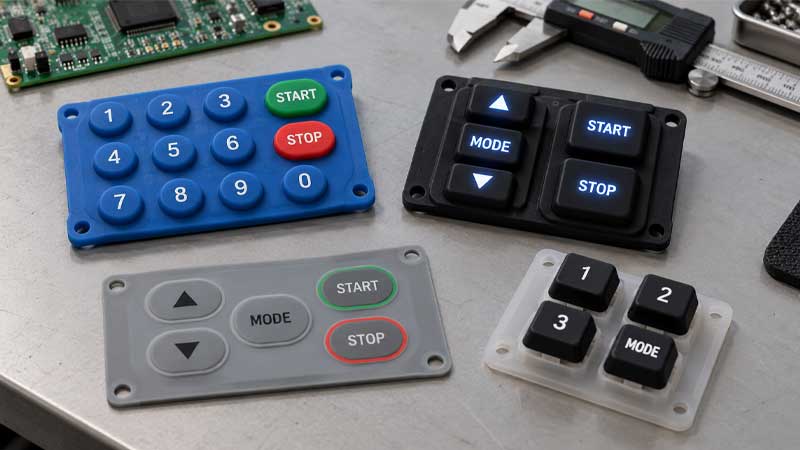
| Human interfaces | Molded buttons and keypads | Tactile response, sealing and repeatable actuation |
The right form depends on function. For example, a silicone keypad combines a molded elastic body with designed web geometry, legends, coatings and potentially conductive contacts. The material family supplies a starting point, while the part design determines force, travel, life and electrical behavior.
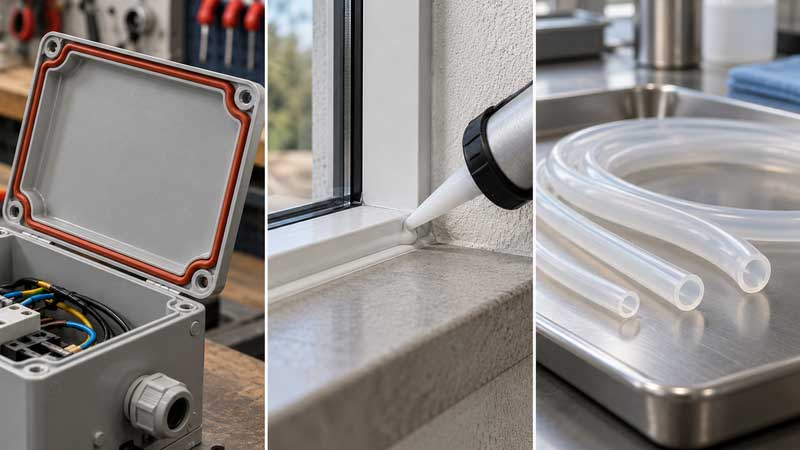
In electronics, a soft gel may protect sensitive components without imposing the same mechanical stress as a rigid potting compound. In construction, a sealant must accommodate joint movement and adhere to the specified substrates. In a vehicle, a gasket must maintain compression under a defined thermal and fluid cycle. These examples illustrate why a list of industries alone is less useful than the combination of form, duty and exposure.
Is silicone safe for food and medical use?
There is no single “safe silicone” certificate that covers every formulation, contact condition and application. For food contact, specify the jurisdiction, type of food, time and temperature of contact, repeated-use conditions and applicable migration or extraction requirements. U.S. 21 CFR §177.2600 is one relevant rule for certain repeated-use rubber articles; citing it does not establish that a particular finished product complies.
For a medical device, biological evaluation considers the finished device, its manufacturing residues, the nature and duration of body contact, and the intended use. The FDA’s biocompatibility guidance does not treat a raw material as universally “medical grade.” A supplier’s material certificate can support evaluation, but it cannot replace testing and documentation appropriate to the final device.
“Food grade,” “medical grade” and “hypoallergenic” should likewise be treated as claims requiring a defined standard and evidence, not inherent properties of every silicone. Pigments, additives, processing aids, adhesives and surface coatings may all become part of the exposure question. Procurement should ask which exact compound and finished configuration were evaluated, under what conditions and by which test method.
The practical request is therefore a specified grade, traceable processing information and evidence that matches the end use. SKF’s silicone compliance guide explains how to organize requirements by application.
Is silicone biodegradable or recyclable?
Conventional cured silicone rubber is not a readily biodegradable material in ordinary disposal conditions. Because its crosslinked network does not remelt like a thermoplastic, routine mechanical recycling into an equivalent molded rubber part is difficult. Grinding for selected secondary uses and chemical recycling routes exist, but availability and recovered quality depend on the collection stream and local facilities.
Manufacturers are piloting chemical routes that convert silicone waste back into useful siloxane feedstocks. That development should not be presented as universal curbside recyclability. For an environmental comparison, examine part life, mass, process energy, replacement frequency and realistic local end-of-life options rather than a single material label.
A durable silicone component may reduce replacement in one application, yet high-temperature feedstock production and difficult end-of-life separation remain relevant impacts. A defensible sustainability claim needs a defined comparison and system boundary. Neither “made from sand” nor “long lasting” alone establishes a lower footprint.
How do you choose a silicone grade?
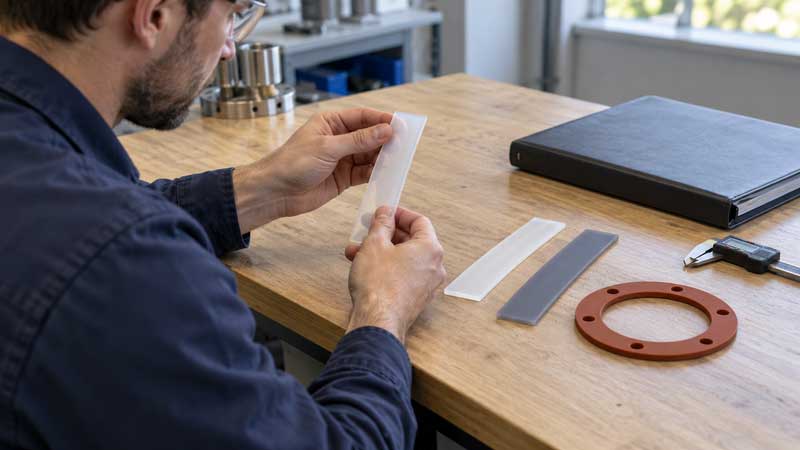
Start with the job of the finished part. Identify its physical form, environment and failure limit before selecting a rubber hardness or a molding process. A material data sheet narrows candidates; prototype and application tests decide whether the complete design works.
Before comparing quotes, write down what the part must do, what can make it fail and how success will be measured. Include the worst credible operating condition, not just nominal temperature or a room-temperature data sheet. Identify whether a requirement belongs to the raw compound, the molded part or the full assembly; each level may need different evidence.
| Requirement to define | Evidence or test to request |
| Temperature, time and load | Grade-specific thermal aging, low-temperature flexibility and retained-property data |
| Contact with fluid or cleaning agent | Immersion, swelling, mass change and retained mechanical properties in the actual medium |
| Sealing and repeated compression | Compression set under relevant conditions and assembly-level leak or ingress test |
| Motion, rubbing or sharp features | Tear, abrasion and cycle tests on representative geometry |
| Electrical behavior | Dielectric data or contact/volume resistance for the specified compound |
| Food or body contact | Jurisdiction- and use-specific compliance records and finished-product evaluation |
| Appearance and processing | Color, transparency, surface finish, tolerance, cure route and post-cure requirements |
For a molded control, turn those requirements into a drawing and test plan: operating environment, target actuation force and travel, tactile life, legend durability, sealing target and contact resistance where applicable. SKF’s silicone keypad design guide covers the geometry and interface decisions that come after the initial material choice.
Frequently asked questions
Is silicone natural?
No. Silicone is synthesized industrially from mineral-derived silicon and organic feedstocks. Its ingredients and processing history vary by product.
Is silicone the same as latex?
No. Silicone rubber is a synthetic siloxane-based elastomer; natural rubber latex comes from a different source and has different chemistry. A finished product may contain other ingredients, so material composition should still be confirmed when a specific sensitivity matters.
Is silicone waterproof?
Many silicone compounds repel liquid water, and silicone sealants can help make an assembly water-resistant. Actual waterproofing depends on joints, compression, adhesion, defects and validation of the finished construction.
How long does silicone last?
There is no universal service life. Temperature, UV exposure, chemicals, compression, motion and the chosen grade determine aging. Use a product-specific accelerated-aging and real-use test plan when lifetime is a requirement.
Conclusion
Silicone names a versatile polymer family, not one fixed material specification. Its fluids, gels, rubbers, resins and sealants serve different functions, and even two silicone rubber grades can differ greatly in hardness, strength, chemical response and recovery. The sound choice is to match a defined grade and finished-part design to the exposure and tests that matter in service.
For silicone keypads and other molded controls, SKF can review the operating environment, actuation targets, sealing needs, surface finish and contact design together with your drawing or prototype requirements.