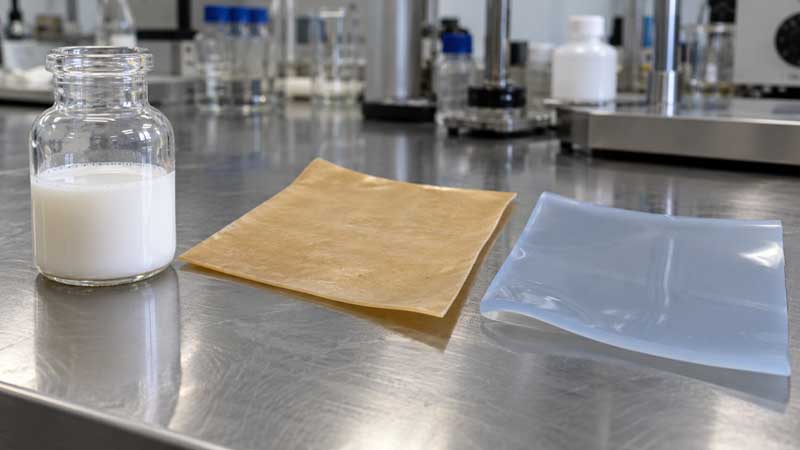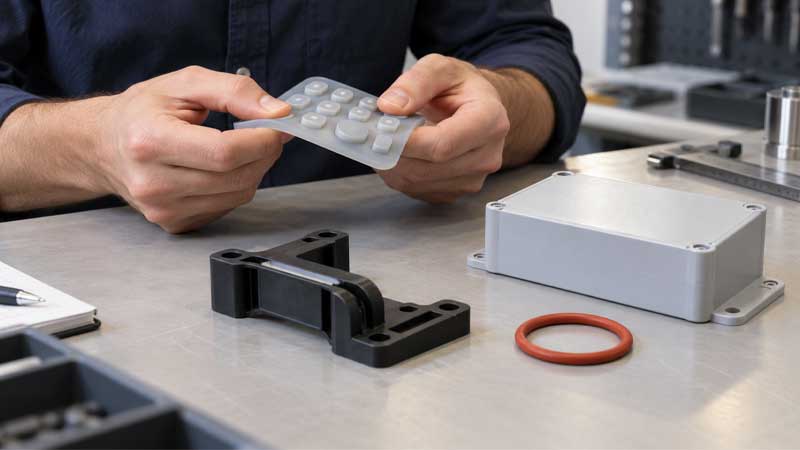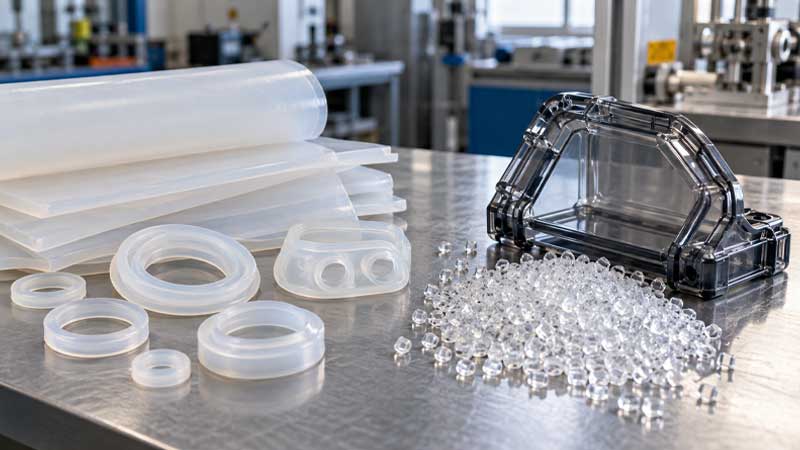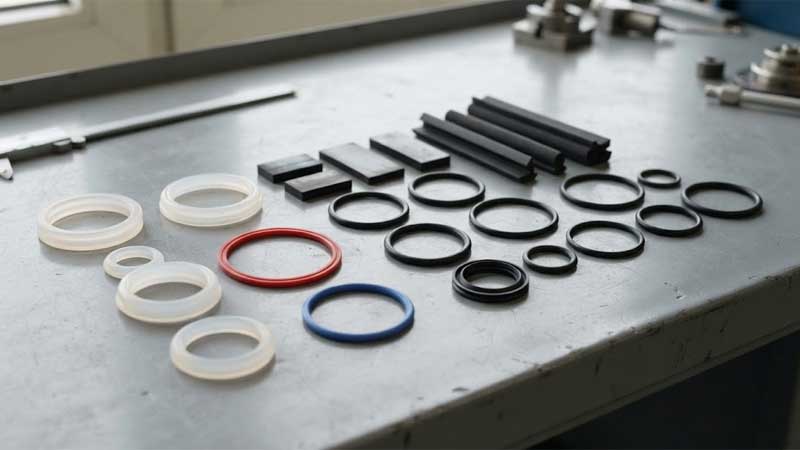
Silicone rubber and other rubber materials differ in temperature resistance, oil compatibility, mechanical strength, and aging behavior. This guide compares silicone rubber with natural rubber, NBR, and EPDM, with practical reference ranges to help you select a material for your product.
What Is the Difference Between Silicone and Rubber?
Rubber is a broad category of elastic materials. It includes natural rubber and several synthetic rubbers, such as nitrile rubber (NBR), ethylene propylene diene monomer (EPDM), and neoprene. Silicone rubber is also an elastomer, but its polymer backbone contains alternating silicon and oxygen atoms. Most conventional rubbers have carbon-based polymer backbones.
This structural difference affects how each material responds to heat, weather, oils, and repeated mechanical stress. However, the polymer structure alone does not determine every property. Fillers, curing systems, hardness, and other formulation choices also influence performance.
For material selection, “silicone vs rubber” is therefore an incomplete comparison. The more useful question is which silicone or rubber compound matches the product’s operating conditions.
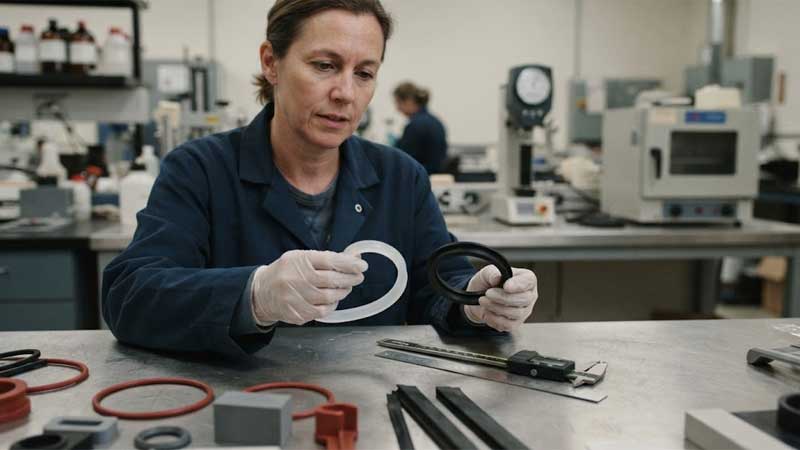
How Do Silicone and Other Rubbers Compare in Performance?
The table below provides general engineering reference ranges and typical performance differences. These values are starting points, not guaranteed operating limits for every compound.
| Property | Silicone Rubber | Natural Rubber (NR) | Nitrile Rubber (NBR) | EPDM |
| Typical service temperature | Approximately −50°C to 200°C | Approximately −40°C to 80°C | Approximately −30°C to 100°C | Approximately −40°C to 150°C |
| Low-temperature flexibility | Often remains flexible below −40°C | Good, depending on grade | Depends on acrylonitrile content and formulation | Good, depending on grade |
| Resistance to petroleum oils | Generally limited | Generally poor | Often good | Generally poor |
| Weather and ozone resistance | Generally excellent | Limited without protection | Often limited unless specially formulated | Generally excellent |
| Abrasion resistance | Often lower than compounds selected for severe wear | Often very good | Good with suitable compounds | Moderate to good, depending on compound |
| Tear resistance | Formulation-dependent; some grades have improved tear strength | Often very good | Depends on grade and compound | Depends on grade and compound |
| Relative material cost | Generally higher than common general-purpose rubbers | Often economical for suitable applications | Depends on grade and market | Often cost-effective for outdoor applications |
Actual service-temperature limits vary by compound, exposure time, mechanical load, and test method. Special grades may operate outside these ranges. Chemical compatibility also depends on the exact fluid, concentration, temperature, and exposure duration.
How Does Temperature Resistance Differ?
Silicone rubber is commonly selected for applications requiring flexibility across a wide temperature range. Many general-purpose silicone compounds have service-temperature ranges around −50°C to 200°C, although some grades have lower or higher limits.
Natural rubber and NBR generally have narrower temperature windows. EPDM can provide good heat and cold resistance, especially in outdoor sealing applications. The correct choice depends on both the minimum and maximum operating temperatures, including short-term temperature peaks.
For example, a silicone keypad used near a heat source may need to retain its shape and tactile response as the equipment warms up. Material selection should account for the temperature at the keypad itself, not only the surrounding air temperature.
Which Material Offers Better Oil and Chemical Resistance?
NBR is often a better choice than standard silicone rubber when a component has prolonged contact with petroleum oils or greases. Its oil resistance depends on acrylonitrile content and the specific compound. For more demanding fuel or chemical exposure, other materials such as FKM may also need consideration.
Standard silicone rubber generally performs poorly in many petroleum oils and hydrocarbon fuels. It can swell or lose mechanical properties. EPDM is usually unsuitable for petroleum-based oils, although it often performs well with water, weather exposure, and many outdoor sealing applications.
No material should be selected based on a broad label such as “chemical-resistant.” Confirm compatibility with the actual fluid, operating temperature, and duration of contact.
How Do Mechanical Strength and Wear Resistance Compare?
Natural rubber is known for its elasticity, resilience, and abrasion resistance. It can be a strong option for tires, vibration mounts, and components exposed to repeated mechanical movement. Suitable NBR and EPDM compounds also offer useful mechanical properties for their intended applications.
Silicone rubber is often chosen for flexibility, thermal stability, and electrical insulation rather than severe abrasion. Its tensile and tear properties vary considerably by formulation. Some reinforced or specially formulated silicone compounds offer improved strength, but the specific grade must be checked.
For components with thin sections, sharp corners, repeated bending, or frequent contact with other surfaces, test the finished part rather than relying only on a general material comparison.
Which Material Is More Cost-Effective?
Silicone rubber often has a higher material cost than common general-purpose rubbers. However, purchase price alone does not determine total cost.
If a component operates in high heat or prolonged outdoor exposure, silicone may reduce replacement frequency when the alternative compound ages too quickly. In applications involving oil contact, heavy abrasion, or ordinary operating temperatures, NBR, natural rubber, or EPDM may provide a better balance of cost and performance.
Compare the expected service conditions, replacement requirements, manufacturing process, and failure consequences before making the final decision.
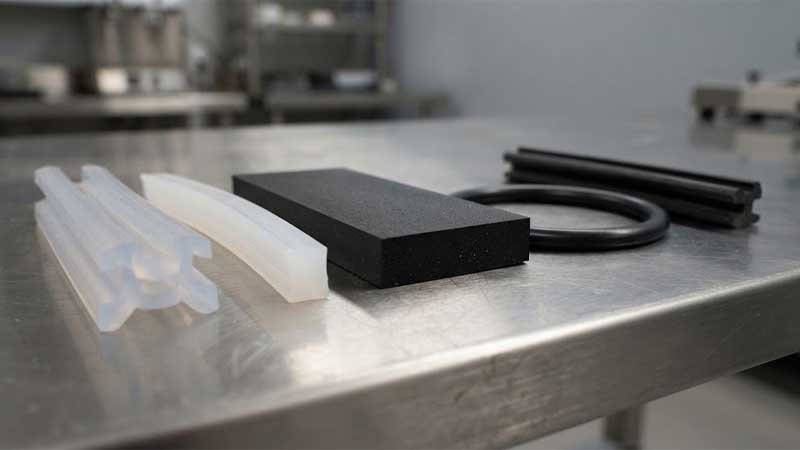
What Are the Common Applications of Different Rubber Materials?
Different rubber materials serve different purposes because they offer different combinations of temperature resistance, elasticity, oil resistance, weathering performance, and mechanical strength. The following examples illustrate common applications, but the final choice depends on the compound and operating conditions.
What Are the Common Applications of Silicone Rubber?
Silicone rubber is commonly used in seals, gaskets, medical and laboratory equipment components, electrical insulation parts, kitchenware, protective covers, and molded keypads. Its broad operating temperature range and good resistance to weathering make it useful for products exposed to heat, cold, or outdoor conditions.
In electronic interfaces, silicone rubber can form flexible buttons with molded tactile features. Conductive contacts, printed graphics, coatings, and button geometry can be incorporated according to the product requirements. However, standard silicone rubber is generally not the first choice for prolonged contact with many petroleum oils or fuels.
Where Is Natural Rubber Commonly Used?
Natural rubber is widely used in tires, vibration mounts, elastic components, conveyor belts, and other products that require resilience and good abrasion resistance. Its ability to recover after deformation makes it useful in applications involving repeated movement or impact.
However, natural rubber generally has limited resistance to ozone, weathering, and petroleum oils. Outdoor or chemical-exposure applications may require protective measures or a different material.
What Are the Typical Applications of NBR?
Nitrile rubber (NBR) is commonly used in oil seals, O-rings, fuel-system components, hoses, gaskets, and other parts that require resistance to petroleum-based oils and greases. Its oil resistance makes it useful in automotive equipment, machinery, and industrial fluid-handling systems.
NBR performance varies with acrylonitrile content and compound formulation. Some grades offer better low-temperature flexibility, while others prioritize oil resistance. The selected grade must match the actual fluid, temperature, and mechanical requirements.
Where Is EPDM Commonly Used?
EPDM is commonly used in automotive weatherstripping, outdoor seals, roofing membranes, water-system components, and suitable hot-water or steam applications. Its good resistance to ozone, weathering, and moisture makes it useful for outdoor and building-related products.
EPDM generally has poor compatibility with petroleum oils and hydrocarbon fuels. For applications involving these fluids, NBR or another compatible material may be more suitable.
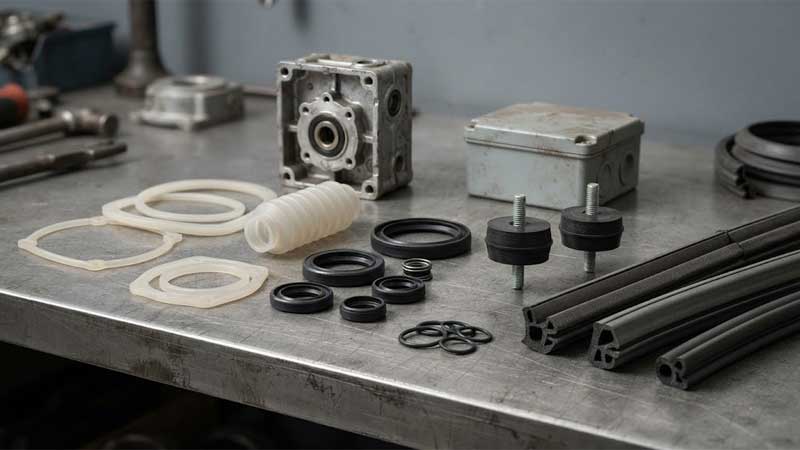
When Should You Choose Silicone or Another Rubber?
The operating environment is usually the best starting point for material selection.
Choose silicone rubber when:
- The component must remain flexible across a wide temperature range.
- Long-term exposure to sunlight, ozone, or outdoor weather is expected.
- Electrical insulation is an important requirement.
- The part needs flexible molded features, such as buttons, protective covers, or seals.
- A suitable silicone grade can meet the required food-contact or medical requirements.
Consider natural rubber when:
- High resilience and abrasion resistance are important.
- The component experiences repeated mechanical loading or vibration.
- Oil and weather exposure are limited or can be controlled.
Consider NBR when:
- The part has regular contact with petroleum oils or greases.
- Oil resistance is more important than strong outdoor weather resistance.
- The selected grade meets the actual temperature and fluid compatibility requirements.
Consider EPDM when:
- Outdoor weathering, ozone, or water exposure is a major concern.
- The application involves suitable hot-water or steam conditions.
- Petroleum oils and fuels are not part of the service environment.
These are initial selection guidelines, not substitutes for checking a specific compound. A different rubber family may be more suitable when fuel resistance, low gas permeability, chemical exposure, or extreme mechanical loading becomes the primary requirement.
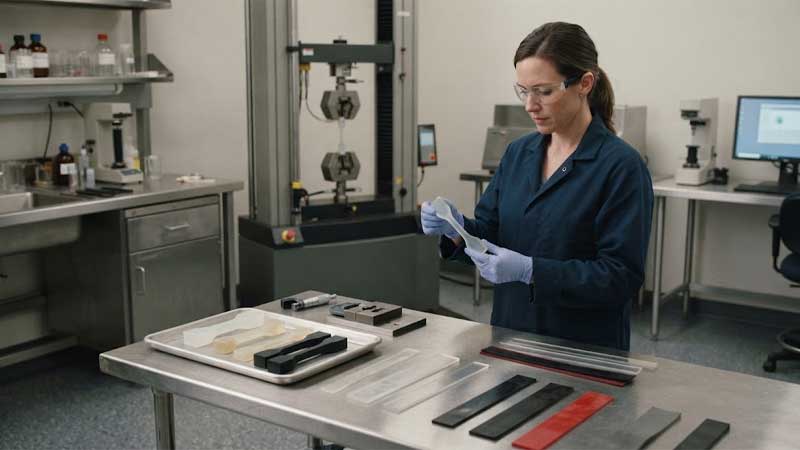
What Affects the Performance and Service Life of Rubber Parts?
The service life of a rubber part depends on more than its material type. Compound formulation, hardness, part geometry, manufacturing quality, and operating conditions all affect how the part performs over time.
How Do Material Formulation and Hardness Affect Performance?
Rubber compounds with the same base polymer can have different mechanical properties because of differences in fillers, curing systems, and other ingredients. Hardness is one useful indicator of material stiffness, but it does not directly determine tensile strength, tear resistance, abrasion resistance, or compression set. Two compounds with the same Shore A hardness may respond differently to the same load.
Material selection should therefore consider the properties required by the finished part. A flexible seal, a wear-resistant component, and a silicone keypad may need different combinations of hardness, elasticity, and tear strength.
How Does Part Design Affect Service Life?
Part geometry determines how forces act on the material. Thin sections, sharp corners, small radii, and uneven loading can create local stress concentrations. These areas may become more susceptible to tearing, cracking, or permanent deformation during repeated use.
For molded rubber parts, the design should account for wall thickness, deformation, mounting conditions, and the space available for movement. For silicone keypads, web thickness and dome geometry also influence actuation force, tactile response, and fatigue behavior.
How Do Temperature and Operating Conditions Affect Aging?
High temperatures can accelerate material aging, while low temperatures may reduce flexibility in some rubber compounds. Contact with oils, cleaning agents, or other chemicals can cause swelling, hardening, softening, or loss of mechanical strength, depending on material compatibility.
Repeated compression can also cause compression set, which occurs when a rubber part does not fully recover its original shape after the load is removed. This can reduce sealing pressure or change a button’s return behavior. Repeated bending and actuation may cause fatigue, especially in areas with high local strain.
The effects depend on temperature, exposure duration, load, and the selected compound. Material data should be checked against the actual operating conditions rather than relying on general descriptions of rubber performance.
How Can You Verify Rubber Part Performance?
Testing should reflect the function and failure risks of the finished part. Hardness testing can confirm material consistency, while tensile and tear tests help evaluate mechanical strength. Compression set testing is relevant for parts that remain compressed, such as seals. Fluid compatibility and aging tests help assess performance under chemical or environmental exposure.
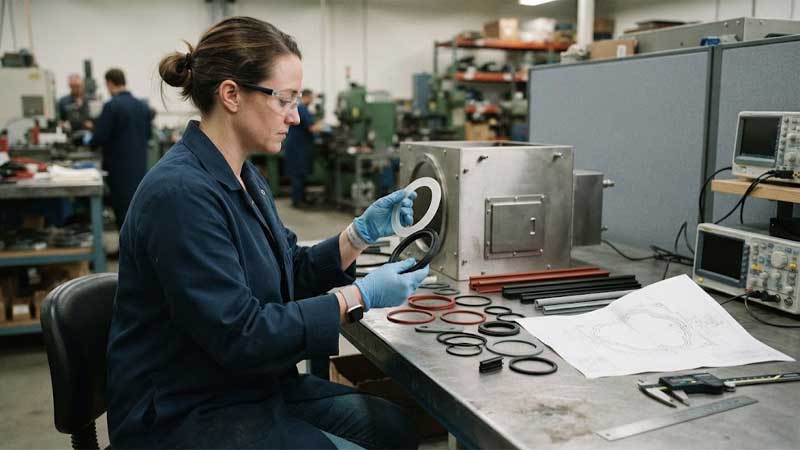
For moving components and silicone keypads, repeated-operation testing can help identify changes in actuation force, return behavior, or visible damage. Where possible, evaluate prototypes under representative temperatures, loads, cleaning procedures, and operating cycles before confirming the material and design.
How Does Material Choice Affect Silicone Keypad Performance?
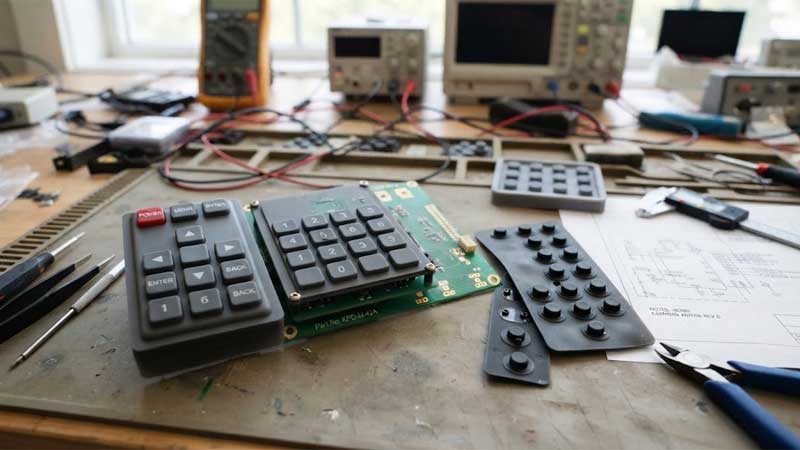
For silicone keypads, the material must support the required mechanical response as well as the operating environment. Selecting a compound based only on temperature resistance or hardness may not deliver the expected button feel.
Hardness, Actuation Force, and Tactile Response
Silicone compounds for molded keypad applications commonly fall within approximately 30–70 Shore A, although the appropriate range depends on the keypad design. Hardness influences deformation, but it does not determine actuation force on its own.
Button geometry, web thickness, dome shape, travel, and the electrical contact design also affect the force-displacement response. A compound change can alter tactile feedback even when the external dimensions remain unchanged.
For this reason, material selection and keypad geometry should be reviewed together. Prototype testing can help confirm actuation force, return behavior, and tactile response before production.
Conductive Contacts and Electrical Requirements
Many silicone keypads use carbon pills or other conductive contact structures to close a PCB circuit. The conductive contact, circuit layout, contact resistance requirement, and expected operating cycles must work as a system.
The bulk silicone compound and the conductive contact serve different functions. A material suitable for the keypad body does not automatically meet the electrical requirements of the contact area. Testing should verify the assembled keypad against the specified circuit and performance requirements.
Surface Finish, Coatings, and Environmental Exposure
Printing, PU coating, epoxy coating, texture, and other surface treatments can affect the finished keypad. Compatibility depends on the silicone compound, surface preparation, coating system, and operating environment.
For example, an outdoor control keypad may need resistance to UV exposure and weathering, while an industrial keypad may require a surface that tolerates frequent cleaning. Coatings should be evaluated for adhesion, wear, graphic retention, and their effect on button movement.
SKF can assess the material, button structure, conductive contacts, and surface requirements together to help match the keypad design to its intended use.
What Should You Check Before Selecting a Rubber Material?
Before selecting a rubber material, define the operating conditions and performance requirements of the finished part.
| Specification | General Reference Range | Design Consideration |
| Service temperature | Silicone rubber: approximately −50°C to 200°C; NR: approximately −40°C to 80°C; NBR: approximately −30°C to 100°C; EPDM: approximately −40°C to 150°C | Confirm the selected compound’s continuous and intermittent temperature limits, exposure duration, and mechanical load |
| Hardness | Common rubber compounds typically range from approximately 30–90 Shore A, depending on material type and application | Select hardness based on flexibility, deformation, sealing pressure, mechanical load, and product geometry |
| Oil and chemical resistance | Material-specific; NBR often suits petroleum oils, while EPDM generally performs poorly with petroleum oils | Identify the exact fluid, concentration, temperature, and contact duration |
| Abrasion and tear resistance | No universal numerical range across all rubber types | Review compound-specific test data and evaluate part geometry, contact surfaces, and mechanical loading |
| Compression set | Compound- and test-condition-dependent | Confirm the test temperature, compression level, duration, and recovery period |
| Electrical properties | Application-specific | Define insulation or contact resistance requirements and verify performance through appropriate testing |
| Surface finish and processing | Application-specific | Confirm color, texture, printing, coating, bonding, cleaning, and wear requirements |
When requesting a material recommendation, provide the operating environment, drawings or dimensions, expected mechanical loads, chemical exposure, electrical requirements, and relevant test specifications. These details help suppliers compare suitable compounds based on actual requirements rather than material names alone.
Frequently Asked Questions
Is silicone considered rubber?
Yes. Silicone rubber is an elastomer and is commonly classified as a type of synthetic rubber. Its silicon-oxygen polymer backbone distinguishes it from conventional carbon-based rubbers such as natural rubber, NBR, and EPDM.
Is silicone rubber more durable than natural rubber?
It depends on the type of durability required. Silicone rubber generally offers better heat, ozone, and weather resistance. Natural rubber often provides better abrasion resistance and resilience in suitable mechanical applications. The operating environment and compound formulation determine which material lasts longer.
Is silicone rubber resistant to oil and chemicals?
Silicone rubber resists some chemicals but is generally not suitable for prolonged contact with many petroleum oils and hydrocarbon fuels. NBR is often a better option for oil exposure. Compatibility should be checked against the specific fluid, temperature, and exposure duration.
What temperature can silicone rubber withstand?
Many common silicone rubber grades have service-temperature ranges of approximately −50°C to 200°C. Some specialized grades can operate outside this range. The manufacturer’s technical data sheet should be used to confirm the continuous and intermittent limits for the selected compound.
Can silicone rubber be used for outdoor products?
Yes. Silicone rubber generally has good resistance to UV radiation, ozone, and weathering. However, the finished component still needs to meet its mechanical, chemical, and design requirements. Outdoor performance should be verified under the intended conditions.
Conclusion
Silicone rubber is often a strong choice for wide temperature ranges, weather exposure, electrical insulation, and molded components that need to retain flexibility. Natural rubber can be better for some high-wear and dynamic applications, NBR is often preferred for petroleum-oil contact, and EPDM is widely used where weather and ozone resistance are important.
The right material is the one that meets the actual operating requirements, not simply the one with the broadest list of advantages. Compare specific compound data, consider the geometry and expected loading, and validate the finished part under representative conditions.
For a custom silicone keypad, SKF can review the operating environment, tactile requirements, conductive contacts, and surface finish to help determine whether the proposed silicone compound and keypad design fit the application.