Modern vehicles are becoming more digital with smart cockpits and advanced infotainment systems. However, physical controls remain essential for frequently used functions such as climate, audio, and safety operations.
Automotive silicone keypads provide reliable tactile feedback that touchscreens cannot fully replace. Drivers can operate buttons by touch without looking away from the road, improving safety and usability.
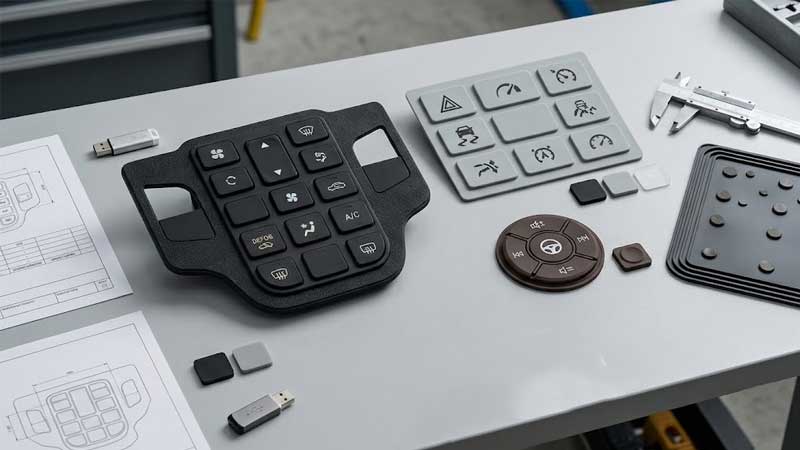
With excellent resistance to temperature, UV, vibration, moisture, and chemicals, silicone rubber keypads are widely used in HVAC panels, steering wheel controls, dashboard switches, smart key fobs, and EV interfaces. Features such as LED backlighting, laser-etched symbols, conductive contacts, and waterproof sealing further expand their application possibilities.
This guide covers the applications, benefits, and design considerations of automotive silicone keypads.
Common Applications of Silicone Keypads in the Automotive Industry
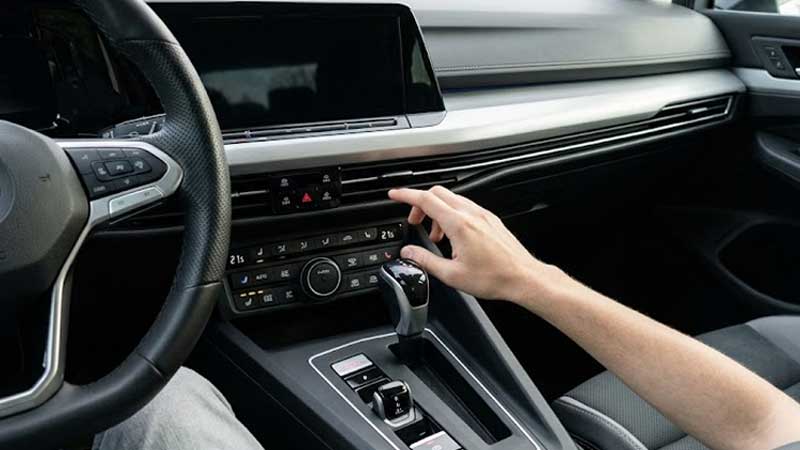
HVAC Control Panels
HVAC controls are one of the most common automotive silicone keypad applications. Drivers frequently adjust temperature, fan speed, airflow direction, and defrost functions while driving.
Silicone keypads provide precise tactile feedback and can be customized with laser-etched legends and LED backlighting for nighttime visibility. Their resistance to heat, humidity, and UV exposure ensures long-term reliability inside vehicle cabins.
Steering Wheel Controls
Steering wheel buttons require accurate operation because drivers use them while keeping their hands on the wheel.
Silicone keypads provide consistent actuation force, quick return response, and compact designs suitable for multifunction steering wheels. They are commonly used for audio control, phone functions, voice assistants, and cruise control systems.
Dashboard and Center Console Controls
Dashboard and center console switches combine functional requirements with interior design considerations.
Automotive silicone keypads can be customized with:
- Matte or glossy finishes
- Laser engraving
- Metallic coatings
- Colored backlighting
- Custom icons and symbols
Typical applications include infotainment shortcuts, parking assistance, camera activation, and drive mode selection.
Smart Key Fobs
Vehicle key fobs require compact, durable, and weather-resistant button solutions.
Silicone keypads protect internal electronics while providing comfortable operation. Conductive carbon pills integrated into the keypad create reliable electrical contact with the PCB for functions such as locking, unlocking, trunk release, and remote start.
Electric Vehicle Applications
The growth of EVs has created new opportunities for silicone keypad applications.
Common uses include:
- Charging port release buttons
- Battery control interfaces
- Smart cockpit controls
- Ambient lighting switches
- Driver assistance functions
Because EV components may face outdoor exposure, waterproof sealing, UV resistance, and temperature stability are important design requirements. Silicone rubber performs well in these conditions due to its excellent environmental durability.
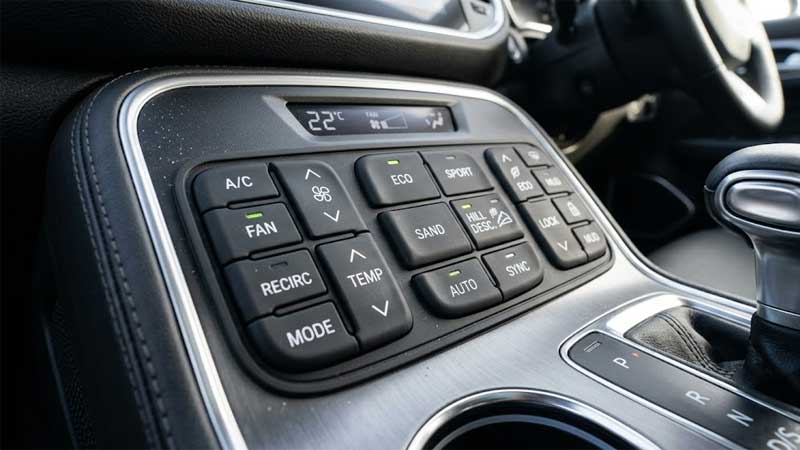
Key Advantages of Silicone Keypads for Automotive Applications
Automotive manufacturers require control components that can deliver reliable performance under frequent operation and harsh environmental conditions. Silicone keypads combine tactile performance, durability, environmental resistance, and design flexibility, making them suitable for a wide range of automotive HMI applications.
Superior Tactile Feedback
One of the main advantages of silicone keypads is their clear and consistent tactile response.
Unlike touchscreens, silicone buttons provide physical feedback when pressed, allowing drivers to confirm inputs without looking away from the road. This improves safety and usability for frequently used controls such as HVAC panels, steering wheel buttons, and cruise control switches.
The soft and responsive feel of silicone keypads also enhances the overall user experience, from premium passenger vehicles to commercial transportation systems.
Long Service Life and Reliability
Automotive controls must withstand years of repeated operation. Silicone rubber offers excellent fatigue resistance and can typically support 1–5 million actuations depending on the application and design requirements.
Compared with mechanical switches, silicone keypads have fewer moving parts, reducing wear points and improving long-term reliability.
Their simple one-piece structure also helps maintain stable performance in applications exposed to vibration and continuous use.
Excellent Environmental Resistance
Vehicles operate under constantly changing environmental conditions, including extreme temperatures, sunlight, moisture, dust, and chemical exposure.
Automotive-grade silicone maintains flexibility and performance across a wide temperature range while resisting:
- UV radiation
- Humidity
- Vibration
- Cleaning chemicals
- Automotive fluids
This makes silicone keypads suitable for passenger vehicles, commercial trucks, construction equipment, agricultural machinery, and EV applications.
Waterproof and Dust Protection
Silicone rubber naturally provides excellent sealing performance due to its elasticity and flexible structure.
When integrated into a keypad assembly, silicone can help protect internal electronics from:
- Water
- Dust
- Contaminants
- Daily environmental exposure
This makes silicone keypads especially suitable for automotive controls that require reliable operation in demanding conditions.
Flexible Design and Customization
Silicone keypads offer extensive customization options to meet different automotive styling and functional requirements.
Manufacturers can customize:
- Button shapes and sizes
- Colors and surface textures
- Matte or glossy finishes
- Laser-etched legends
- LED backlighting
- Conductive contacts
- Protective coatings
- OEM logos
These options allow automotive brands to achieve both functional performance and premium interior design.
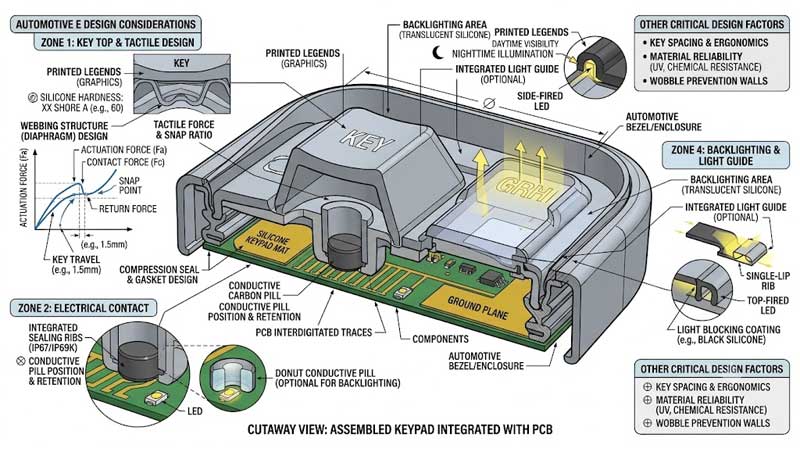
Design Considerations for Automotive Silicone Keypads
Designing an automotive silicone keypad requires careful consideration of tactile performance, electrical reliability, environmental protection, and manufacturing efficiency.
Tactile Force and Button Feel
Tactile performance is one of the most important design factors for automotive silicone keypads.
Engineers adjust multiple parameters to achieve the desired button response, including:
- Silicone hardness (Shore A)
- Web thickness
- Key travel
- Actuation force
- Return force
- Snap ratio
A well-designed keypad should provide clear feedback while maintaining comfortable operating force.
For example:
- Steering wheel buttons usually require lighter actuation for quick thumb operation.
- Dashboard controls may use firmer feedback to provide stronger confirmation.
Consistent tactile performance across all buttons is essential for a high-quality user experience.
Conductive Carbon Pill Design
The conductive carbon pill directly affects the electrical reliability of a silicone keypad.
Engineers must evaluate:
- Pill diameter
- Material composition
- Contact resistance
- PCB pad design
- Alignment accuracy
A properly designed carbon pill ensures stable electrical contact under vibration and repeated operation.
For applications requiring higher conductivity or lower resistance, specialized conductive silicone materials can be considered.
Backlighting Design
Backlit controls are widely used in modern automotive interiors, especially for nighttime operation.
A typical backlit silicone keypad process includes:
- Molding the silicone keypad
- Applying an opaque coating
- Printing graphics
- Laser etching symbols
- Installing LED light sources
To achieve uniform illumination, designers must optimize:
- LED positioning
- Silicone light transmission
- Coating thickness
- Light diffusion
- Symbol size
Poor optical design may result in uneven brightness or unwanted light leakage.
Waterproof and Dustproof Design
Although silicone provides natural sealing capability, the keypad structure must be properly designed to achieve reliable protection.
Engineers consider features such as:
- Peripheral sealing ribs
- Waterproof lips
- Compression membranes
- Integrated gaskets
The correct sealing design helps protect PCB components while maintaining smooth button operation.
Surface Finish and Wear Resistance
Automotive buttons are touched thousands of times throughout their service life. Surface treatment plays an important role in maintaining appearance and durability.
Common solutions include:
- PU coating
- Scratch-resistant coating
- UV-resistant coating
- Matte surface treatment
- Soft-touch coating
These treatments improve abrasion resistance while enhancing the perceived quality of vehicle interiors.
Design for Manufacturing (DFM)
A successful automotive silicone keypad must not only perform well but also be efficient to manufacture.
During DFM review, engineers evaluate:
- Wall thickness
- Mold release angles
- Venting design
- Flash control
- Material shrinkage
- Assembly tolerance
Early DFM optimization reduces tooling risks, improves production yield, and helps control manufacturing costs.
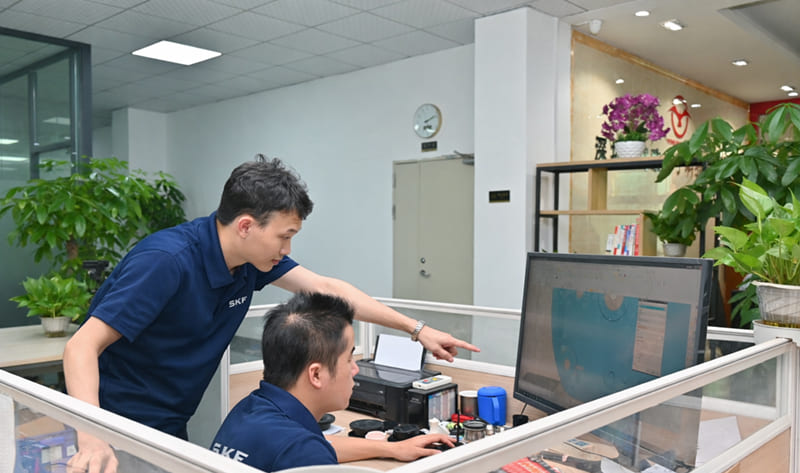
During automotive keypad development, SKF engineers evaluate tactile force, web structure, carbon pill positioning, and sealing design during the DFM stage to reduce tooling risks before mass production.
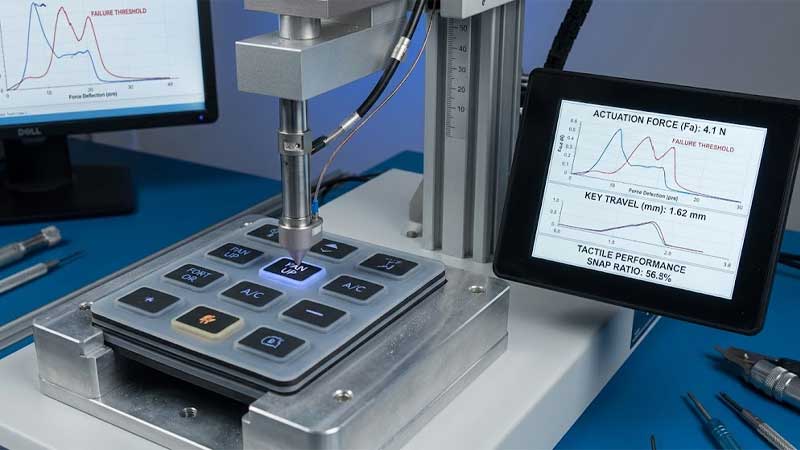
Automotive Silicone Keypad Testing and Reliability Validation
Automotive components must maintain reliable performance under years of temperature changes, vibration, chemical exposure, and repeated operation. Before mass production, silicone keypads usually undergo a series of reliability tests to verify mechanical durability, environmental resistance, and electrical performance.
Mechanical Life Testing
Life cycle testing evaluates long-term mechanical performance by measuring key parameters such as actuation force, key travel, snap ratio, electrical continuity, and surface wear. Automotive silicone keypads are commonly designed for 1 to 5 million operating cycles, depending on application requirements.
Temperature and Environmental Testing
Automotive silicone keypads are tested under harsh conditions, including high and low temperature exposure, thermal cycling, humidity, and condensation. These tests ensure the silicone material maintains its elasticity, sealing performance, and tactile feel throughout the vehicle lifespan.
UV and Chemical Resistance Testing
Vehicle interiors are exposed to sunlight, cleaning agents, skin oils, and other chemicals. Testing evaluates changes in color, surface appearance, hardness, coating adhesion, and mechanical properties to ensure the keypad maintains both appearance and functionality over long-term use.
Electrical Performance Testing
Electrical testing verifies stable signal transmission by checking contact resistance, conductivity stability, signal consistency, and carbon pill performance. Reliable electrical performance ensures each button press is accurately detected by the vehicle control system.
Automotive Standards
Depending on customer requirements, automotive silicone keypad projects may need to comply with standards such as IATF 16949, ISO 16750, ISO 20653, RoHS, and REACH. OEM customers may also define additional validation requirements for durability, appearance, and environmental performance.
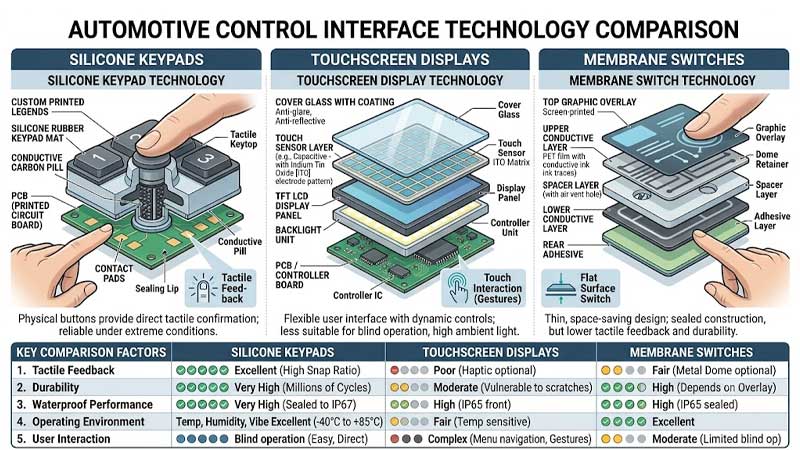
Silicone Keypads vs. Touchscreens vs. Membrane Switches
Modern automotive interiors use multiple input technologies depending on function, cost, and user experience requirements. While touchscreens provide flexible interfaces, silicone keypads remain important for frequently used controls that require immediate tactile feedback.
Silicone Keypads
Silicone keypads are ideal for functions that require physical confirmation and reliable operation.
Advantages include:
- Clear tactile feedback
- Long service life
- Excellent temperature resistance
- Waterproof sealing capability
- Flexible design options
- Integration with backlighting and conductive contacts
Typical applications include:
- HVAC controls
- Steering wheel buttons
- Dashboard switches
- Seat controls
- Smart key fobs
- EV charging buttons
Their combination of durability and customization makes silicone keypads suitable for both standard vehicles and premium automotive interiors.
Membrane Switches
Membrane switches offer a thin and lightweight structure with relatively low manufacturing costs.
They are suitable for applications where space is limited and tactile performance is less critical.
Common applications include:
- Secondary control panels
- Diagnostic equipment
- Rear-seat systems
- Auxiliary automotive devices
However, compared with silicone keypads, membrane switches generally provide less tactile feedback and may have limitations in harsh environments or high-cycle applications.
Touchscreens
Touchscreens provide excellent design flexibility and support software-based interfaces.
Advantages include:
- Dynamic menus
- Easy software updates
- Reduced physical components
- Large display integration
However, touchscreens also have limitations:
- Require visual attention during operation
- Less convenient when wearing gloves
- Can suffer from fingerprints and glare
- Lack physical feedback
For this reason, many automotive manufacturers now use a hybrid HMI design that combines touchscreens with silicone keypads.
Touchscreens handle complex functions, while silicone buttons remain for frequently used controls such as climate adjustment, volume, hazard lights, and steering wheel functions.
Custom Automotive Silicone Keypads for OEM Projects
Automotive silicone keypads are rarely standard products. Most OEM projects require customization based on vehicle design, electronic requirements, and user experience goals.
An experienced silicone keypad manufacturer works with automotive customers from product design and prototype development through mass production.
Material Selection
Different silicone materials can be selected according to performance requirements:
- High-consistency rubber (HCR)
- Liquid silicone rubber (LSR)
- Conductive silicone
- Flame-retardant silicone
- High-temperature silicone
- Low-compression-set silicone
Material selection affects flexibility, durability, temperature resistance, and production performance.
Appearance and Surface Design
Automotive silicone keypads can be customized to match interior styling requirements.
Options include:
- Custom colors
- OEM color matching
- Matte or glossy finishes
- Surface textures
- Laser-etched icons
- Printed graphics
- Metallic coatings
- Soft-touch coatings
- Brand logos
These options help manufacturers achieve consistent visual quality across the vehicle interior.
Functional Features
Additional functions can be integrated into silicone keypad designs, including:
- LED backlighting
- Transparent light windows
- Conductive carbon pills
- Metal dome integration
- Multi-level buttons
- Waterproof sealing structures
- EMI shielding
- Multi-color printing
- Dual-shot molding
These features improve usability, reliability, and product differentiation.
Frequently Asked Questions
Why are silicone keypads used in automobiles?
Silicone keypads provide tactile feedback, durability, environmental resistance, and customization flexibility. These advantages make them suitable for HVAC controls, steering wheel buttons, dashboard switches, and other frequently used vehicle interfaces.
Are silicone keypads better than touchscreens?
Both technologies serve different purposes. Touchscreens offer flexible software interfaces, while silicone keypads provide physical feedback and easier operation without visual attention. Many modern vehicles combine both technologies.
How long do automotive silicone keypads last?
A properly designed automotive silicone keypad can typically withstand 1–5 million operating cycles depending on structure, material selection, and application requirements.
Can silicone keypads be waterproof?
Yes. Silicone keypads can incorporate sealing ribs, gaskets, and integrated membranes to protect electronic components from moisture, dust, and contaminants.
Can silicone keypads support LED backlighting?
Yes. Through laser etching and light-transmitting silicone structures, silicone keypads can provide clear and uniform backlit symbols for nighttime operation.
What standards apply to automotive silicone keypads?
Automotive silicone keypad projects may need to meet standards such as IATF 16949, ISO 16750, ISO 20653, RoHS, and REACH. Specific requirements depend on the vehicle manufacturer and application.
Can automotive silicone keypads be fully customized?
Yes. Manufacturers can customize the shape, size, hardness, button force, colors, printing, surface finishes, backlighting, conductive contacts, and waterproof structures to meet different design and performance needs.
What should you look for in an automotive silicone keypad supplier?
A reliable supplier should have automotive project experience, precision tooling capability, DFM support, prototype development, quality control systems, testing capability, and stable mass production capacity to ensure consistent product performance.
Conclusion
Silicone keypads are an ideal solution for automotive HMI systems due to their tactile feedback, durability, and design flexibility.
Compared with touchscreens and membrane switches, they provide a more reliable user experience for frequently used vehicle controls while supporting features such as backlighting, conductive contacts, and waterproof designs.
At Silicone Keypad Factory (SKF), we provide custom automotive silicone keypad solutions, including design optimization, prototyping, tooling, surface decoration, reliability testing, and mass production. Our engineering team works closely with OEM customers to develop durable and reliable keypad solutions for automotive applications.