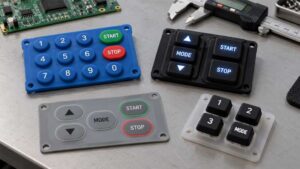
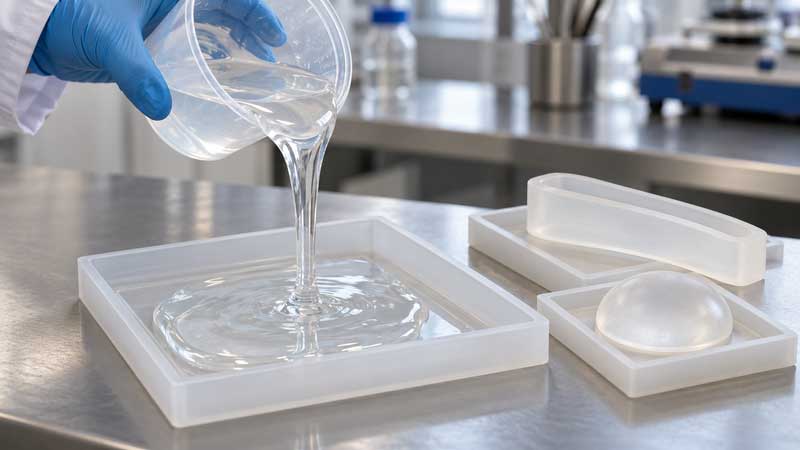
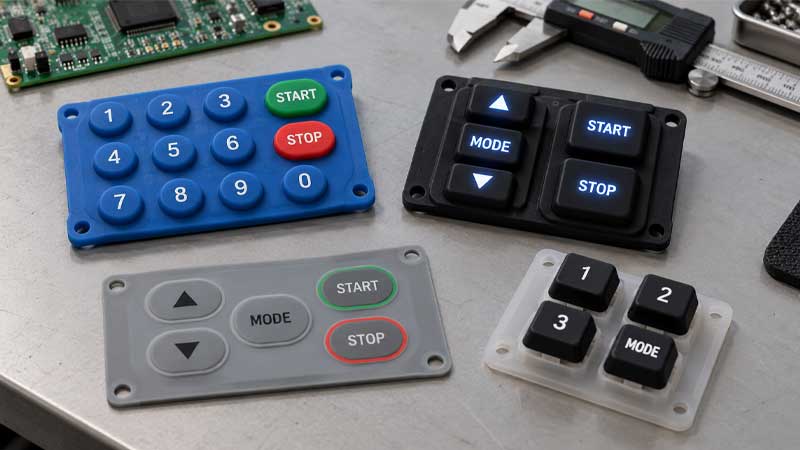
Silicone rubber and membrane keypads are common electronic interface options for appliances. They have specific strengths, such as environmental and wear resistance, as well as design flexibility.
Users focus on an intuitive layout, feedback, reliable control, operational precision, and efficiency. Based on your requirements and the features of these two physical buttons, select the optimal keypad for your appliance interface.
Types of Interfaces in Appliances
Although diverse appliances differ in functionality, most of them rely on electronics to create specific interfaces and interactive connections between humans and machines. Generally, appliances
Electronic Interfaces with Interactive Display
Displays and touchscreens are the two main types of electronic interfaces, and your appliance relies on a touch panel for operation. The display offers a flexible layout and icon design, excellent readability, simple operation with a touch, and a smooth surface that is easy to wipe.
However, accidental activation and soft development costs are disadvantages of electronic interfaces.
Mechanical Interfaces: Silicone Keypad, Membrane Switch, and Other Physical Buttons
Mechanical interface technology has reached maturity with physical control elements, such as silicone rubber keypads, membrane switches, rotary knobs, and other physical buttons, as its key components.
This simple design is cost-effective and resistant to environmental elements and heavy use.
Hybrid Interfaces with Electronic and Mechanical
Most appliance interfaces use a hybrid design that combines intuitive mechanical operation with information presentation. This design allows for more precise operation, a lower risk of accidental activation, and sufficient strength for heavy-use applications.
What challenges does that user interface in appliances face?
Water Flashes
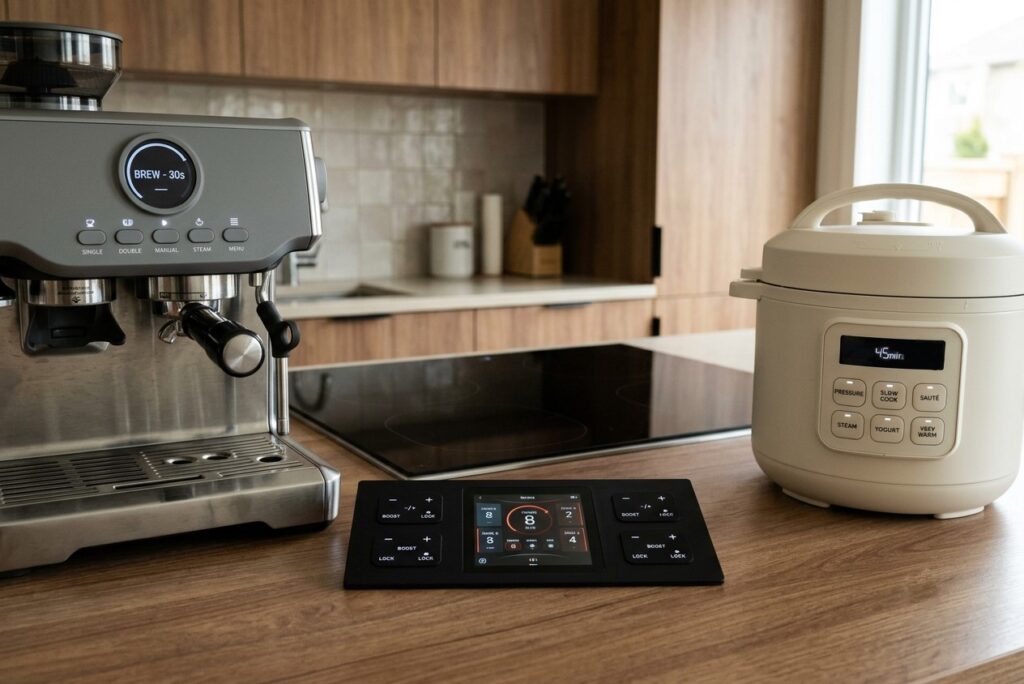
Coffee makers, washing machines, electric kettles, rice cookers, and other appliances are typically exposed to liquid during operation. User interfaces may be exposed to water flashes, and moisture ingress into electronics may result in component damage or appliance failure.
Therefore, a waterproof design is essential for appliance interfaces to prevent sensitive components from coming into contact with liquid.
Contaminations
Stain resistance, ease of cleaning, and maintenance are also crucial for appliances that see heavy use. Smooth, flat user interfaces are easier to wipe with a cloth because they do not have gaps between keys or the bezel where the cloth could get stuck. Furthermore, if stains enter the internal structure of appliances through the user interface, it will affect the performance of the physical buttons and contacts.
Mechanical Wear from Heavy Use
The high-frequency operation of appliances leads to unavoidable friction, mechanical wear, and scratches on the interface. Therefore, the wear resistance and stiffness of the interface affect its ability to maintain structural integrity.
Haptic Feedback and Accidental Activation Prevention
Mechanical interfaces provide appliances with rapid haptic feedback through tactile silicone keypads or snap domes, which prevent accidental activation.
Integration with Multi-Function & Operation Efficiency
Appliances generally integrate multiple functions into their design, including electronic parts and physical buttons that perform distinct tasks.
Conversely, appliance user interfaces tend to enhance operational efficiency while balancing specific functionality.
Compact Layout and Limited Area in Appliance Interfaces
In terms of appliances, a space-saving user interface can simplify operation, enhance design, and reduce costs. There is no need for an initial investment to develop a new system, such as a touchscreen, which would incur extra costs and an extended lead time.
The multifunctionality of an appliance also means integration with programs and functionality in user interfaces, which enhances workflow and usability. Designing an interface properly in a compact or limited area of an appliance requires high flexibility in the design of physical buttons, which can be achieved with silicone rubber keypads.
Accelerated User Interface in Appliances with Engineered Rubber Keypad Approach
Long-Term Mechanical Strength withstanding Frequent Presses
Have you seen membrane keypads damaged by heavy use and insufficient durability, which exposes the internal tactile switch and circuit board? This can threaten the lifetime of the equipment and the safety of the operator.
Customizable silicone rubber keypads offer higher hardness (up to 70 Shore A), superior stiffness, and increased mechanical strength for heavy use in appliances.
Reliable Activation with Decreased Mistakes
Although some appliances have integrated displays and touchscreens, silicone rubber keypads still play an irreplaceable role. Like an automotive control panel, appliances with physical buttons reduce accidental touches, enhance activation precision, and provide safe operation.
For example, if a touchscreen malfunctions due to stains, water residue, or prolonged use, certain functions may be inaccessible, and it may be impossible to control the power by touching the screen. If the operator, another person, or your pet is at risk due to abnormal appliance operation, a touchscreen without physical buttons may be unable to turn off the appliance.
Therefore, although touchscreens offer a convenient way to interact with devices, many designers and manufacturers of appliance user interfaces still incorporate physical buttons.
Low-Profile Design in Appliance Interfaces
To match your specific appearance needs and appliances, the interfaces can be engineered with a low-profile design to create a subtle, unobtrusive interactive interface.
Simple and uncluttered looks, neutral color palettes, and clean lines and symbols on silicone keypads or decorative buttons are beneficial for low-profile designs, especially for high-end modules.
Comparison Between Silicone Rubber Keypads and Membrane Keypads in Appliance Interfaces
| Features | Silicone Rubber Keypads | Membrane Keypads |
|---|---|---|
| Travel Distance (/Stroke) | 1.0~3.5mm | ≤0.5mm |
| Tactile Feedback | Outstanding response | Moderate, limited feedback with polydomes |
| Compatibility in Compact Layout in Interfaces | Excellent | Excellent |
| Accidental Touches or Repeated Activations | Avoidable | Easier |
| Elastic Deformation | Excellent | Limited |
| Design Flexibility | High | Limited |
| Waterproof | Yes | Yes |
| Wear Resistance of Keys | Outstanding | Moderate |
| Tactile Feedback | Crisp and rapid response | Moderate, rely on metal domes |
| Environmental Resistance | Superior | Good |
| Ease of Wiping and Cleaning | Moderate | Great |
| In-Mold Decoration | Available | Flexible |
| Durability | Excellent | Good |
| Preference | High-end applicance interface, tacitle feedback, durable graphics, high design flexibility | Dead-front illumination, ease of cleaning with flat surface, moderate tactile response |
When to Choose Silicone Keypads in Appliance Interfaces?

In-Mold Decoration with Cost-Effectiveness and Product Iteration
By utilizing in-mold decoration (IMD) technology, silicone rubber keypads can be formed and improved as a cost-effective option that supports design flaws and product iteration. Rather than incurring the higher expense of creating a new mold, IMD offers highly flexible design options for functions and appearance to meet your requirements for appliance user interfaces.
Durable Legends and Graphics
Laser-etched silicone keypads are processed in the printing stage, eliminating the need for extra hardcoats and providing superior durability and wear resistance for graphics and legends.
Temperature Resistance
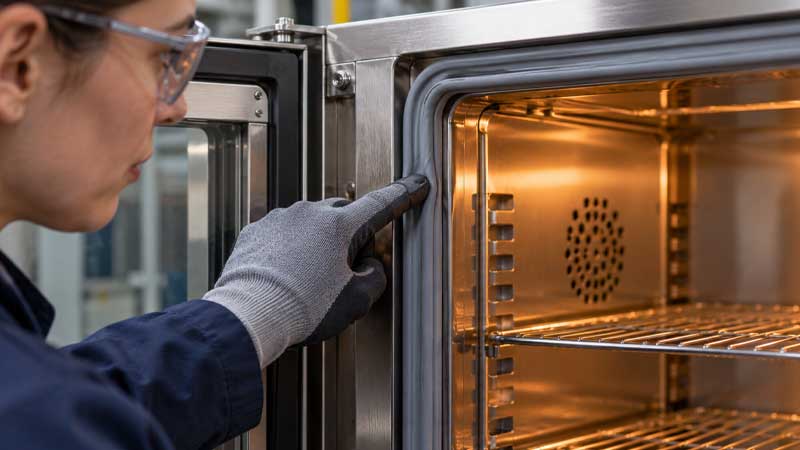
Some appliances, such as ovens, microwave ovens, air fryers, and other cooking appliances, are exposed to high heat from steam or accidental drops of heated food, which can damage user interfaces.
In these situations, silicone rubber with superior temperature resistance and stability in high-heat or cold environments is optimal for use as physical buttons, as it retains flexibility and elasticity for long-term operation.
Rapid Tactile Feedback for Advanced Interface in Appliances
Tactile feedback is common and essential in appliance user interfaces, accelerating operational efficiency and the user experience. Elastomer keypads can be embedded in advanced appliance interfaces with rapid tactile response.
When to Choose Membrane Keypads in Appliance Interfaces?
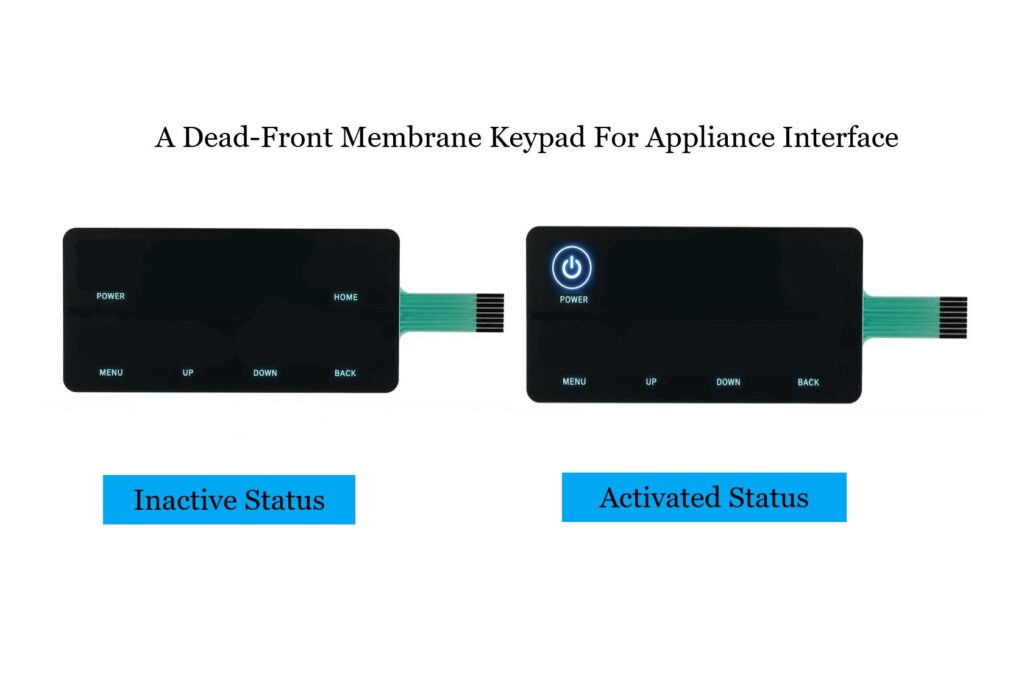
Subtle Backlight Options with Dead-Front: Not Limited In LEDs and Indicators
Rubber keypads are typically embedded with LED components and backlighting windows or blocks for backlit user interfaces. However, membrane keypads can be engineered with a dead-front backlighting option that provides subtle illumination.
This special membrane keypad can hide inactive buttons and backlight an active button, which integrates with an opaque overlay. This dead-front masking layer has low transmission (3-5%) and is located under the hardcoat or anti-glare top layer and the printed graphics layer, which is the third layer in a dead-front membrane switch.
However, a dead-front panel on a membrane keypad is more susceptible to scratches and smudges than a stiff elastomer keypad on appliance interfaces.
Slim Construction and Moderate Tactile Feedback
If you need a slim mechanical interface with moderate tactile feedback, a membrane keypad is optimal for appliances with space limitations, such as smart home control panels, coffee machines, slow cookers, stand mixers, blenders, and steam irons.
Flexible Decoration Interfaces
Membrane keypads can be customized to achieve a hard, smooth, glossy, glass-like, or premium decorative appearance. This offers high design flexibility for appliance interfaces.
FAQs
What benefits do silicone keypads bring to appliances?
Superior tactile feedback, rapid responsiveness, eliminated accidental actuation, custom snap ratio, durability of legends, environmental resistance, and reliability for long-term operation.
Which one has higher resistance against severe conditions?
Silicone rubber keypads enable withstanding repeated mechanical stress, extreme thermal changes, high humidity, and detergents, maintaining tactility and functions.
Which electronic interface is preferred for waterproof and stain-resistant performance in appliances?
Both of them are available. But rubber keypads can be selected for a reinforced protection level for advanced appliances.
Can elastomer keypads support diverse backlit requirements?
Yes, laser etching, light guide, customizable color and brightness in LED components, and consistent graphics offer improved backlighting for the interface.
Is it visible in daylight with a silicone membrane switch in an appliance interface with a dead front effect?
Yes, the graphics can be observed during the day and be illuminated in dark or low-light conditions.
Final Thoughts
In terms of tactile feedback, durability, environmental resistance, wear resistance, and compatibility with backlighting and laser-etched graphics, a rubber keypad is preferred for heavy use.
The selection between a silicone rubber or membrane keypad depends on your appliance’s functional requirements, including stiffness, strength, operating conditions, and the desired user experience.