The visual keyboard on your touchscreen offers real-time response and feedback through display and vibration effects. However, physical buttons, such as silicone rubber keypads, still provide physical confirmation and a satisfying user experience in control panels, industrial control consoles, medical electronics, consumer electronics, and heavy-use vehicles or machinery.
In terms of operational precision, user experience, and tactile feedback, silicone rubber keypads remain a reliable choice for your device or instrument project. The following section will discuss the benefits of feedback and the factors that influence it, as well as how to select the appropriate feedback based on specific applications.
How Tactility is Reached in Rubber Keypads
What Is Tactile Feedback?
Tactile feedback refers to the physical response of electronics to operators. It offers an audible click or vibration when a silicone button is pressed and a keystroke is completed. Tactility technology is used in remotes, coffee maker control panels, washing machine control panels, and game controllers, among other devices.
How is tactile feedback achieved in silicone rubber keypads?
The tactile feedback of silicone rubber keypads is determined by different electronic components acting as actuators in switch activation. These components include metal domes, carbon pills, and polydomes (polyester domes), as well as tactile switches. Metal domes, tactile switches, and carbon pills are the most common types of actuators used in rubber keypads.
What factors affect the tactility of rubber keypads?
The specifications involving actuation force, travel (or stroke), hardness, and snap ratio affect the tactile response of rubber keypads. These specifications are also essential to elastomer keypad design in order to meet specific requirements and application settings. These factors are confirmed and well-designed before sample creation and subsequent production.
- Actuation Force: It determines how much force or pressure is required for activation.
- Travel Distance (Stroke): It affects the responsiveness of tactile feedback to a certain extent.
- Snap Ratio: This impacts the sharpness of the tactile response.
Comparison between Different Actuators in Keypads
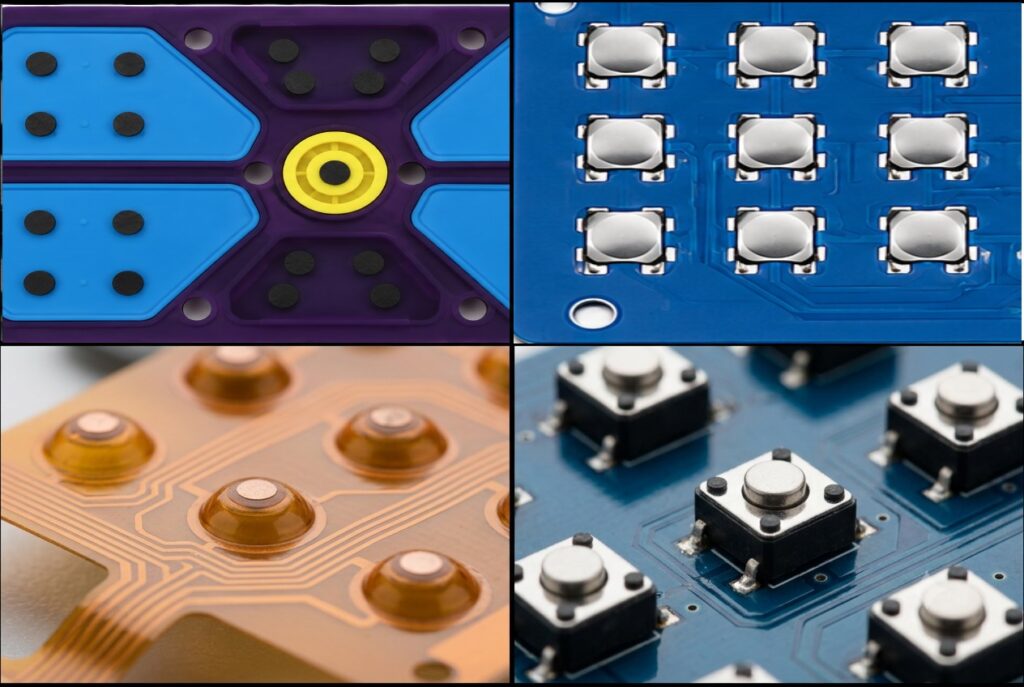
| Tactility Factors | Carbon Pills | Metal Domes | Tactile Switch | Polydomes |
|---|---|---|---|---|
| Actuation Force | 0.5~3.0N | 0.5~20N | 0.6~12N | 0.5~2N |
| Travel Distance | Longer | Shorter | Short | Moderate |
| Snap Ratio | Higher | Moderate | Moderate | Medium to low |
| Audio Feedback | Lower | High | Moderate | Low |
Higher or Lower Actuation Force for Specific Applications
As the table mentioned, the actuation force of the tactile switch and the metal dome is relatively higher than those of the carbon pill and the polydome.
Low-force silicone rubber keypads with carbon pills are optimal for frequent operation and ergonomic input devices. Conversely, high-force rubber keypads are ideal for critical buttons, such as the “Stop” or “Emergency” buttons, which should not be easily activated by mistake.
Travel Distance: Tactile Responsiveness
Travel distance, or what we say is “stroke,” impacts how far a button moves before completing a keystroke. Usually, a rubber keypad with carbon pills has longer travel with the longer movement of the button to make a connection between the electrical contact and the PCB.
Thus, if you select short travel contacts like metal domes in your elastomer keypads, you can receive a rapid and instant tactile response from the rapid collapsing and rebounding of tactile domes.
Snap Ratio: Rebound of Silicone Buttons
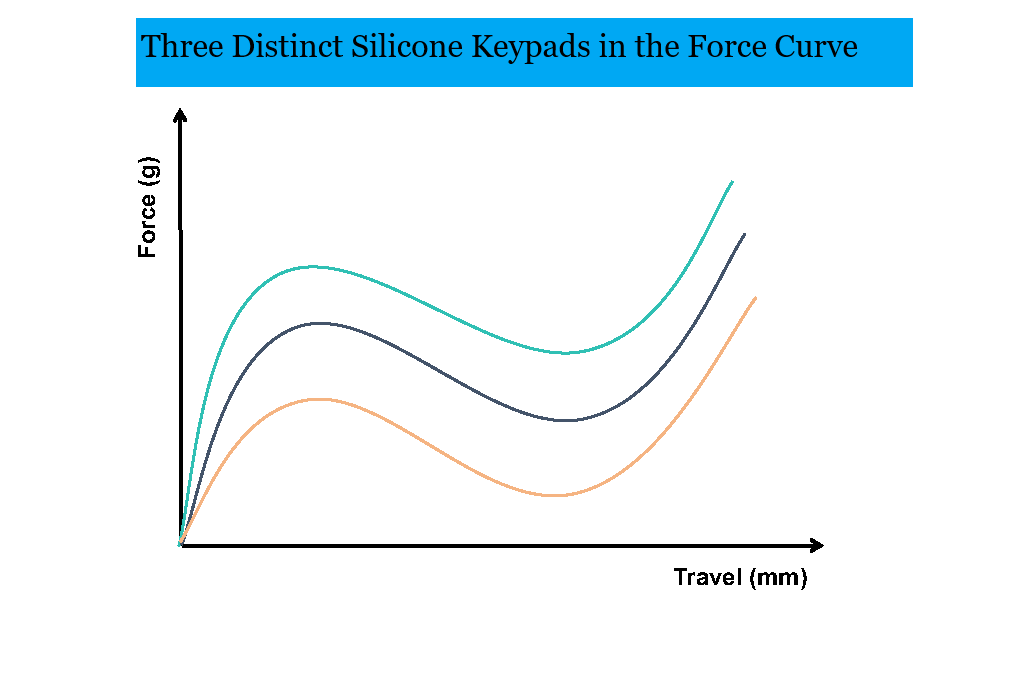
The snap ratio (which is expressed in N/mm or g/mm) measures the relationship between actuation force and travel distance. Snap Ratio = (Actuation Force – Contact Force)/Actuation Force * 100%, which is the formula for snap ratio.
Maybe you have seen the force curve of rubber keypads, which demonstrates a steep or gentle curve of changing force and travel. A steep curve shows sharp clicks with high feedback, whereas a gentle one refers to smooth clicks and gentle rebound when you’re pressing a silicone button of an elastomer keypad.
Typically, a ~40~60% snap ratio is optimal for a silicone rubber keypad with the balance of excellent tactile response and pleasant operation experience.
Audio Feedback: Different Click Sounds
Audio feedback aims to measure tactile and auditory feedback, which is expressed in dB (decibel). It demonstrates how much sound a silicone button creates when being forced. The relationship between A and B is directly proportional, which means higher actuation force corresponds to higher audio feedback, and vice versa.
Benefits of Tactile Feedback In Elastomer Keypads
Tactile Response in Place of Dual or Multi-Press
Though some GUIs or systems are typically designed to feature a distinct visual change when a virtual button is pressed, thereby emphasizing its activated state, these minute changes make it difficult to guarantee that we haven’t triggered a specific process two or more times.
In medical or industrial settings, uncertainty of whether I’ve pressed this button is unwanted and unacceptable; otherwise, sudden downtime or hazards will happen in these high-stakes ambiances.
Operation Security & Precision
Maybe you’re familiar with small touchscreens in controllers or cellphones, but physical buttons are applied in diverse machines and instruments as a reliable choice. Gloved operation, eyes-free press, and input precision are linked to user experience and interactive security.
Whatever you’re operating, medical monitoring devices, industrial control panels, or some electronics, frequently and repeatedly checking legends or other information increases the recognition load of operators and the risk of operation mistakes or some hazards.
Our silicone rubber keypads are engineered with resilient mechanical strength and optional tactile response, as well as textured silicone buttons individually.
Enhanced User Experience in Vibration & Impact Ambience
Besides, operators can perform precise keystrokes in shaking environments or while the operator’s field of view is unstable, like in construction settings, heavy-duty agricultural tractors, mining haul trucks, concrete machinery, or bulldozers.
In terms of these unstable conditions, although the layout of the control console is designed with proper key spacing and functional zoning, low-frequency shaking still affects user experience during operation. Tactile feedback effectively deals with visual distortion due to visual blurring from intense vibration or impacts, offering a noticeable and reliable ‘click’ response.
How Should I Customize Tactile Feedback in a Rubber Keypad for Specific Applications?
Industrial Settings with Unique Tactile Response
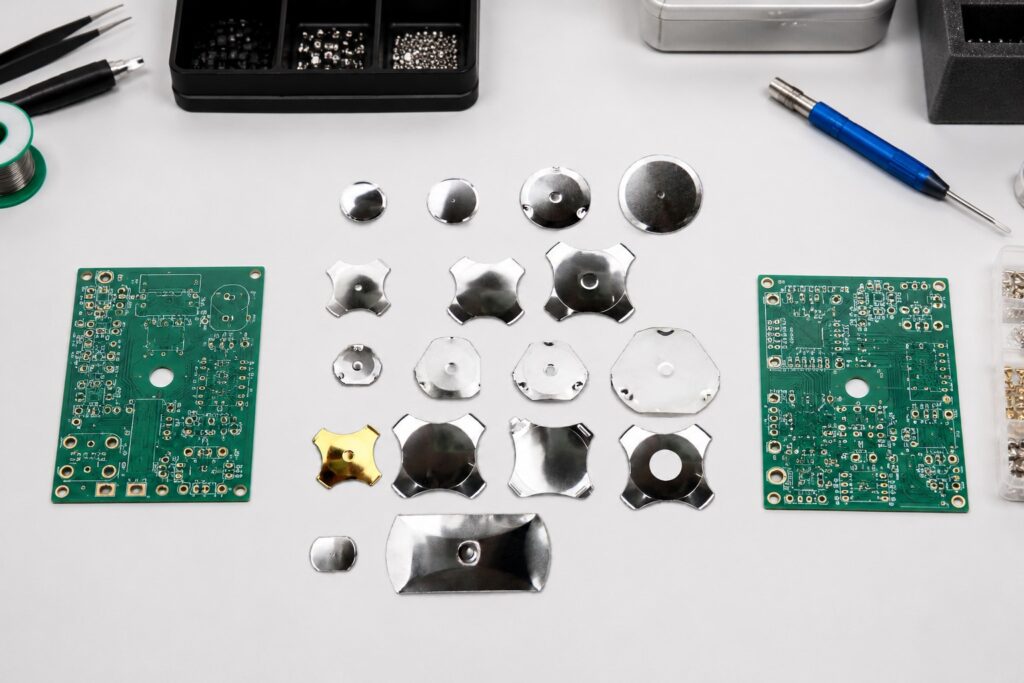
In terms of industrial settings, construction, tactile and audio feedback demands, and rebound of silicone buttons of rubber keypads should be taken into consideration.
- If your rubber keypad with limited construction requires a pleasant click tactile response and high audio feedback, metal domes and tactile switches are suitable.
- In terms of thin structure, metal domes are optimal for front-mounted rubber keypads in industrial control panels or instruments, offering high actuation force and enhanced operation precision.
Ergonomics Design with Accelerated User Experience

“Ergonomic design” refers to shapes, design, and compatibility with the hands of humans; ease of cleaning and maintenance; operation precision; and mechanical strength against heavy use in rubber keypads.
- If you require ease of cleaning and disinfection in medical, food processing, catering, public transportation user interface, or retail self-service settings, overmolded silicone rubber keypads with superior environmental sealing and metal domes enable you to meet your hygiene requirements.
- If you are more concerned about lifetime for long-term operation and tactile response, a metal dome is optimal for tactility in elastomer keypads, which can achieve 1 million actuations.
- What if I want a long stroke in keypads? Tactile switches or carbon pills can deal with it.
- In terms of low noise operation with low audio feedback, carbon pills are also a better choice.
Backlit silicone rubber keypads integrated with LED assemblies
Backlit silicone rubber keypads achieve illumination by LED assemblies that occupy a certain amount of space and affect the overall design of the silicone button.
- To create a functional backlit silicone keypad module with circuits, tactile switches can be integrated into your keypads with high force, mounted alongside LED assemblies, and have optional housing.
- For multiple LEDs mounting in elastomer keypads, metal domes and carbon pills are both suitable.
FAQs
Do buttons using tactile switches always offer faster tactile responsiveness than metal domes?
No, silicone rubber keypads generally have a more rapid tactile responsiveness than membrane keypads. And a rubber keypad with metal domes will respond quicker than a membrane keypad with a tactile switch, which depends on keypad construction and limited space inside.
What is the difference between capacitive feedback and tactile feedback?
Capacitive feedback, featured with high sensitivity, refers to detecting conductive objects and changes in the electric field. At the same time, tactile feedback relies on mechanical actuators, offering mechanical, tactile, and audio responses.
Is a silicone keypad suitable for gloved operation?
Yes, silicone keypads as well as membrane keypads support gloved operation; at the same time, some types of touchscreens can be operated by gloves. Besides, rubber keypads also offer superior robustness and operation precision in severe environments for your project.
Is the “40~60%” range of snap ratio always best for rubber keypads?
Typically, this range ensures crisp tactile feedback for recognition. An excessive ratio results in finger fatigue due to high actuation force, whereas a lower ratio easily leads to accidental touches. But SKF still offers other custom rubber keypads with your desired snap ratio.
How does SKF customize a non-conductive silicone keypad with desired tactile feedback?
In spite of the construction design of the silicone keypad, the sizes and shapes of metal domes are processed based on your tactility needs.
Final Thoughts
SKF offers custom silicone rubber keypads with your desired tactile feedback to meet your specific applications, ergonomics, hygiene, and heavy-use demand for your elastomer project.