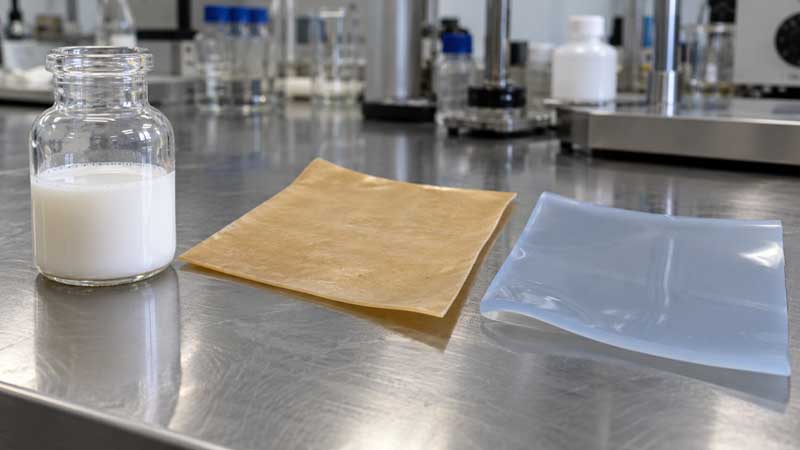
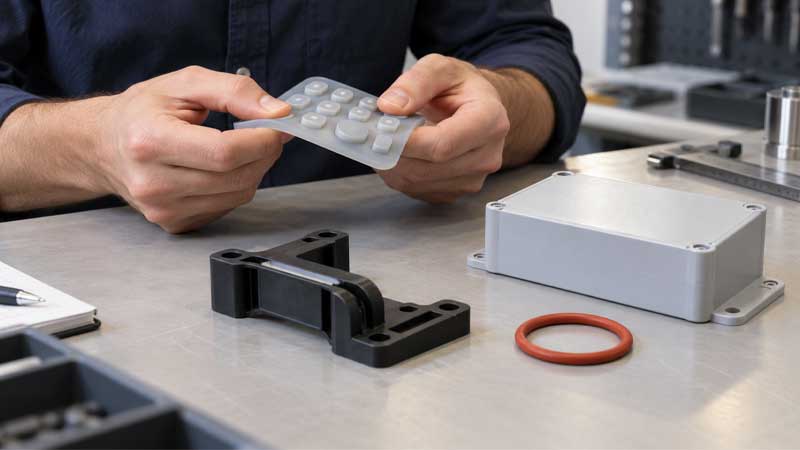
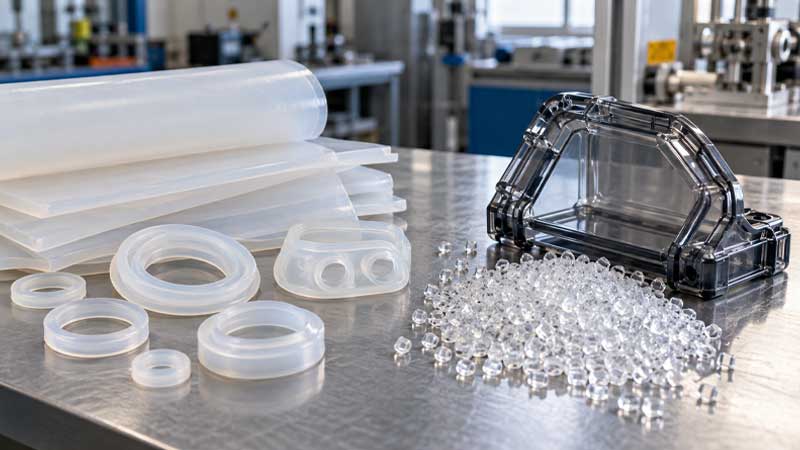
Silicone rubber keypads work through controlled elastic deformation. When a user presses a key, the silicone structure does not simply compress like a soft rubber block. Instead, the internal web and diaphragm structure deform in a controlled way to create key travel, tactile feedback, and electrical contact.
The deformation behavior of a silicone keypad directly affects actuation force, tactile response, durability, and long-term reliability. A well-designed keypad should provide consistent feedback during millions of press cycles while maintaining stable electrical performance.
For silicone keypad manufacturers, deformation control starts during the design stage. Engineers evaluate factors such as silicone hardness, web geometry, diaphragm thickness, conductive pill position, and stress distribution during DFM review to reduce tooling risks and improve product reliability before mass production.
How Silicone Rubber Keypads Deform During Pressing
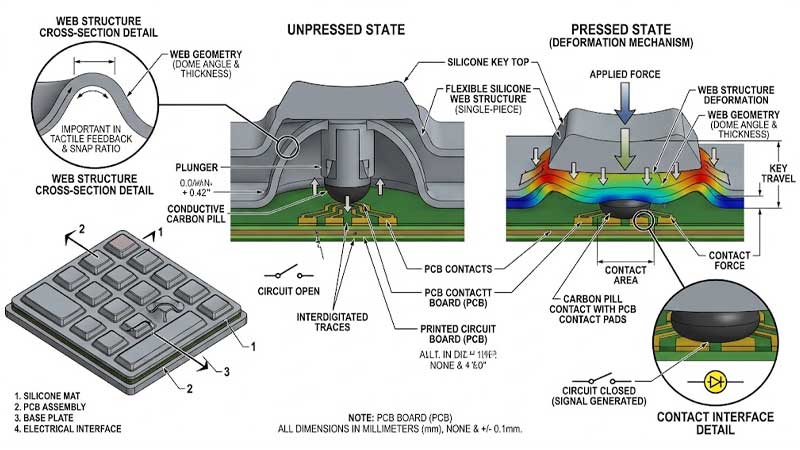
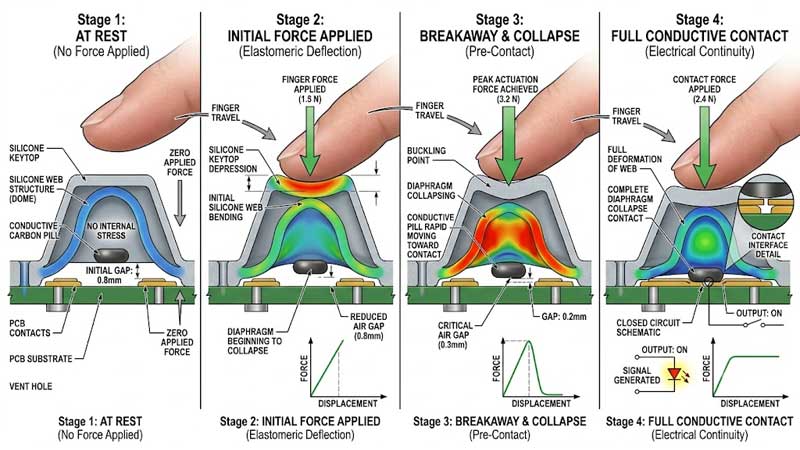
A silicone rubber keypad mainly relies on the deformation of its silicone web structure. The web acts as an elastic support between the key top and the keypad base. When pressure is applied, the web bends and collapses, allowing the conductive pill underneath the key to move toward the PCB contact.
The deformation process typically includes four stages:
- Initial elastic deformation
- Web buckling and snap-through
- Electrical contact closure
- Elastic recovery after release
Each stage influences the final button feel and performance.
Stage 1: Initial Elastic Deformation
When a user starts pressing a silicone key, the applied force first causes the silicone web to bend and stretch slightly. At this stage, the deformation is mainly elastic, meaning the silicone material returns to its original shape after releasing the pressure.
The force gradually increases as the web resists the movement. The initial force curve is influenced by several design factors:
- Silicone hardness
- Web thickness
- Key size
- Diaphragm geometry
- Silicone material formulation
A softer silicone compound usually produces a lower actuation force and smoother feeling. A harder silicone compound provides stronger resistance and a more defined tactile response.
However, silicone hardness alone does not determine keypad performance. Two keypads made from the same Shore A hardness silicone can have completely different pressing experiences because web geometry controls how the material deforms.
Stage 2: Web Buckling and Snap-Through Deformation
The most important deformation stage occurs when the silicone web reaches its designed collapse point.
As pressure increases, the web structure becomes unstable and suddenly bends downward. This rapid change creates the characteristic “snap” feeling of a silicone keypad.
The relationship between peak force and contact force is commonly described by the snap ratio:
Snap Ratio = (F1 – F2) / F1
Where:
- F1 = Actuation Force, the maximum force required to collapse the web
- F2 = Contact Force, the force when the conductive pill approaches or reaches the PCB contact point
A higher snap ratio produces a sharper tactile response. This design is often preferred for industrial controls, gaming devices, and equipment requiring clear feedback.
However, excessive snap performance can create higher stress concentration around the diaphragm edge and web root. During long-term cycling, these areas may become fatigue points. Therefore, engineers must balance tactile sharpness with mechanical durability.
Stage 3: Full Compression and Electrical Contact
After the web collapses, the key continues moving downward until the conductive pill contacts the PCB.
At this stage, the mechanical deformation is converted into an electrical switching action.
Proper design must consider:
- Contact travel distance
- Over-travel allowance
- Bottoming force
- Conductive pill alignment
Insufficient travel may cause unstable contact, while excessive compression can increase stress on the silicone structure and reduce service life.
During silicone keypad development, manufacturers typically review conductive pill positioning and key travel during the DFM stage. Small dimensional variations in the mold can affect contact reliability, especially for multi-key assemblies with tight spacing requirements.
Stage 4: Elastic Recovery After Release
When the pressing force is removed, the stored elastic energy inside the silicone structure pushes the key back to its original position.
A good silicone keypad should recover quickly and consistently after every press.
Recovery performance depends on:
- Silicone elasticity
- Compression set resistance
- Web structure design
- Material curing quality
Compression set is an important factor in long-term keypad reliability. After repeated compression, silicone may gradually lose its ability to return completely to its original shape. This can result in:
- Slow key return
- Reduced key height
- Poor tactile consistency
Selecting suitable silicone material and controlling molding parameters are essential to maintaining recovery performance over the product lifetime.
Key Factors Affecting Silicone Keypad Deformation
Silicone Hardness and Material Properties
Silicone hardness directly affects how much force is required to deform the keypad structure.
Lower hardness silicone generally provides a softer touch feeling, lower actuation force, and easier deformation during pressing.
In contrast, higher hardness silicone creates stronger resistance, higher tactile force, and a more defined feedback response.
However, the optimal silicone hardness depends on the complete keypad design system rather than the material property alone. Engineers need to evaluate hardness together with web geometry, key dimensions, tactile requirements, and expected operating life to achieve the right balance between pressing comfort, feedback consistency, and long-term durability.
Web Thickness and Geometry
The silicone web is the primary deformation area of a keypad.
A thinner web usually reduces actuation force because less material needs to bend. However, excessive thinning can create high stress concentration and reduce fatigue life.
A thicker web improves mechanical strength but may increase pressing force and reduce tactile sensitivity.
During product development, manufacturers analyze web thickness consistency because uneven thickness caused by tooling or molding issues can lead to inconsistent deformation between keys.
Web Angle and Diaphragm Design
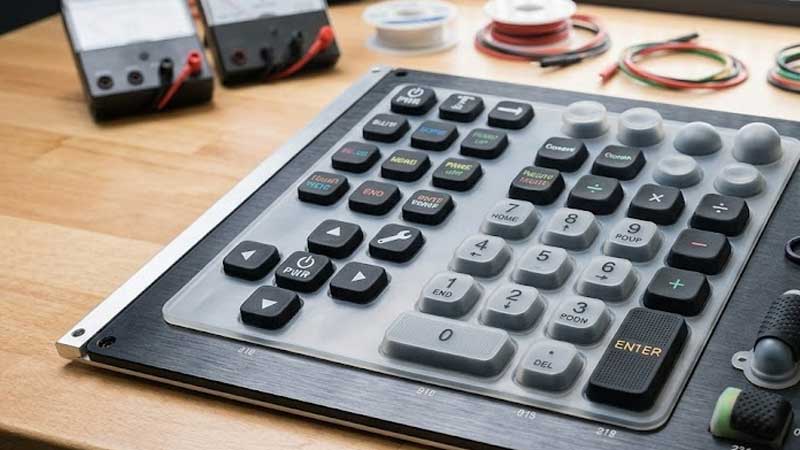
The angle and shape of the silicone diaphragm strongly influence the force-stroke curve of a keypad. By adjusting factors such as web angle, diaphragm thickness, dome radius, and support structure, engineers can control key performance characteristics including actuation force, key stroke, snap ratio, and return speed.
This is why silicone keypad design cannot rely only on material selection. The mechanical geometry of the web and diaphragm determines how the silicone structure behaves under pressure and plays a critical role in achieving the desired tactile response, durability, and operating consistency.
Key Size and Shape
Different key designs create different deformation patterns.
Large keys usually distribute stress over a wider area and require careful support design to prevent uneven pressing.
Small keys may experience higher local stress because deformation is concentrated in a smaller region.
Special shapes, such as long rectangular keys or oversized buttons, often require customized web structures to maintain consistent tactile performance.
Stress Distribution During Silicone Keypad Deformation
During pressing, stress is not evenly distributed throughout the silicone structure.
The highest stress areas usually appear around:
- Web root areas
- Diaphragm edges
- Sharp corners
- Thickness transition zones
Repeated loading in these areas may cause:
- Micro cracks
- Silicone tearing
- Reduced operating life
To improve reliability, engineers often optimize the transition radius, web thickness profile, and material properties during the design stage.
For complex silicone keypad structures, simulation analysis such as FEA (Finite Element Analysis) can help evaluate deformation behavior and identify potential stress concentration areas before tooling production.

Common Silicone Keypad Deformation Problems and Solutions
High Actuation Force
Possible causes: High actuation force is usually caused by excessive silicone hardness, an overly thick web structure, or an improper diaphragm design. These factors increase the resistance during deformation and require more force from the user to collapse the silicone web.
Solutions: To reduce actuation force, engineers can adjust silicone hardness, optimize web thickness, and modify the dome geometry. During the design stage, these parameters are evaluated together because changing one factor may affect tactile response, key travel, and product durability.
Weak Tactile Feedback
Possible causes: Weak tactile feedback often occurs when the snap ratio is too low, the silicone web does not provide sufficient collapse behavior, or the force curve is not properly optimized. In this condition, users may feel a soft or unclear pressing response because the transition from peak force to contact force is not noticeable enough.
Solutions: Improving tactile feedback requires optimization of the web angle, diaphragm structure, and snap ratio balance. Engineers adjust the deformation behavior of the silicone structure to create a clearer tactile response while avoiding excessive stress concentration that may reduce product lifetime.
Slow Key Return
Possible causes: Slow key return is commonly related to poor compression set resistance, excessive deformation, or unsuitable silicone material selection. When silicone cannot recover its original shape effectively after repeated compression, the key may return slowly or fail to maintain consistent travel distance.
Solutions: Manufacturers can improve recovery performance by selecting suitable silicone compounds, reducing permanent deformation, and optimizing the elastic recovery structure. Material properties and structural design must work together to maintain reliable operation over long-term use.
Silicone Cracking After Repeated Pressing
Possible causes: Silicone cracking after repeated pressing is usually caused by stress concentration, sharp geometry transitions, or excessive snap force. These issues create repeated mechanical stress in specific areas, especially around the web root, diaphragm edge, and thin transition zones.
Solutions: To improve fatigue resistance, engineers can increase corner radius, optimize the web structure, and reduce localized stress. During DFM review, manufacturers typically analyze stress distribution and deformation behavior to identify potential failure points before tooling production.
How Silicone Keypad Manufacturers Optimize Deformation Performance
Material Selection and Formulation Control
Silicone material selection plays an important role in controlling keypad deformation behavior. Manufacturers evaluate factors such as Shore hardness, tear strength, compression set resistance, and temperature requirements when selecting silicone formulations.
The selected silicone compound must provide the right balance between flexibility, tactile performance, recovery ability, and long-term durability. A material that is too soft may reduce tactile feedback, while a material that is too hard may increase actuation force and stress on the silicone structure.
Mold Design and Manufacturing Control
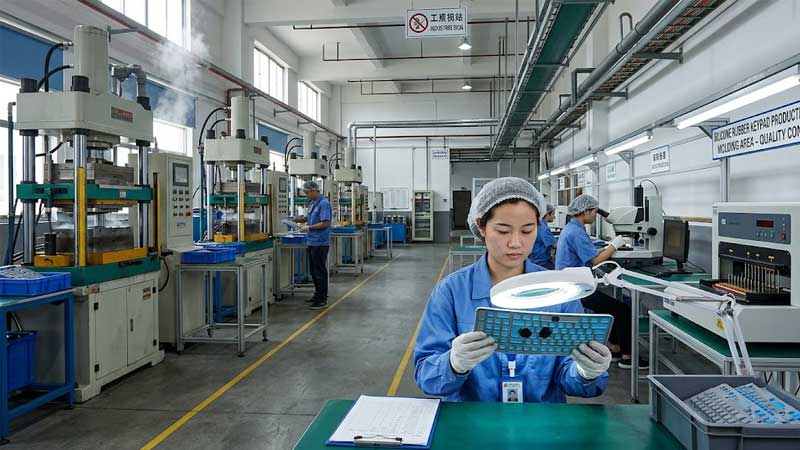
Mold design directly affects deformation consistency across silicone keypads. During silicone keypad production, engineers evaluate mold cavity accuracy, web thickness control, flash prevention, and venting design to ensure stable molding quality.
Proper mold design helps each key achieve consistent deformation behavior. For example, uneven silicone filling during compression molding can create thickness variations in thin web areas, resulting in different tactile responses between individual keys.
Tactile and Reliability Testing
Before mass production, silicone keypads undergo mechanical testing to verify deformation performance and long-term reliability. Engineers typically evaluate force-stroke curves, actuation force, snap ratio, life cycle durability, and compression recovery performance.
These tests help confirm that the keypad maintains consistent tactile feedback and electrical performance after repeated operation. For custom silicone keypad projects, manufacturers often use test results to fine-tune web geometry, material hardness, and structural design before final production.
Conclusion
Silicone rubber keypad deformation is determined by the interaction between material properties, structural geometry, and manufacturing accuracy. The silicone web, diaphragm design, silicone hardness, and stress distribution all influence how a keypad feels and performs under pressure.
A reliable silicone keypad design requires a balance between tactile response, actuation force, recovery performance, and long-term durability. Through DFM analysis, mold optimization, material selection, and mechanical validation, silicone keypad manufacturers can achieve consistent deformation behavior and ensure stable performance throughout the product lifecycle.