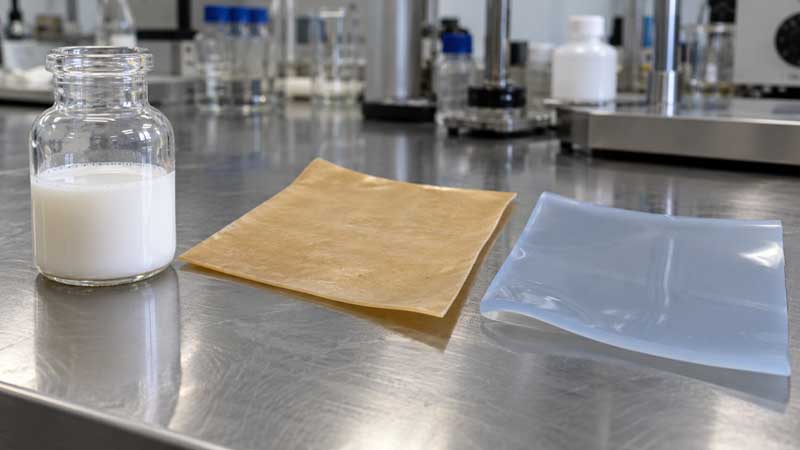
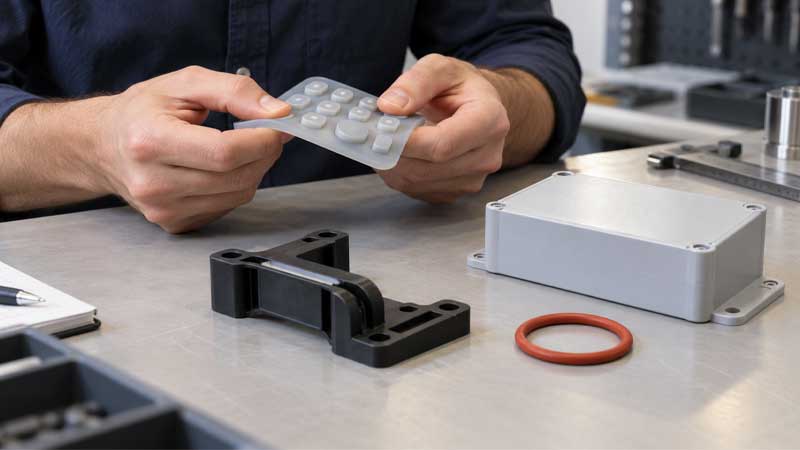
POS terminals are used repeatedly in environments where buttons must remain responsive, clean, and reliable. Retail counters, restaurants, payment kiosks, fuel stations, and portable payment devices can expose keypads to moisture, dust, cleaning chemicals, temperature changes, and intensive daily operation.
For OEM and ODM projects, silicone keypad design affects much more than button appearance. Material hardness, conductive contact design, web geometry, key travel, actuation force, sealing structure, printing, backlighting, and mold design all influence the final performance.
This guide explains the main engineering considerations for custom POS terminal silicone keypads, from material selection and molding to tactile performance, electrical contact, sealing, durability testing, customization, and production validation.
Material Selection for POS Silicone Keypads
Material selection should match the terminal’s operating environment, tactile requirements, service life, and production volume.
LSR and HCR Silicone
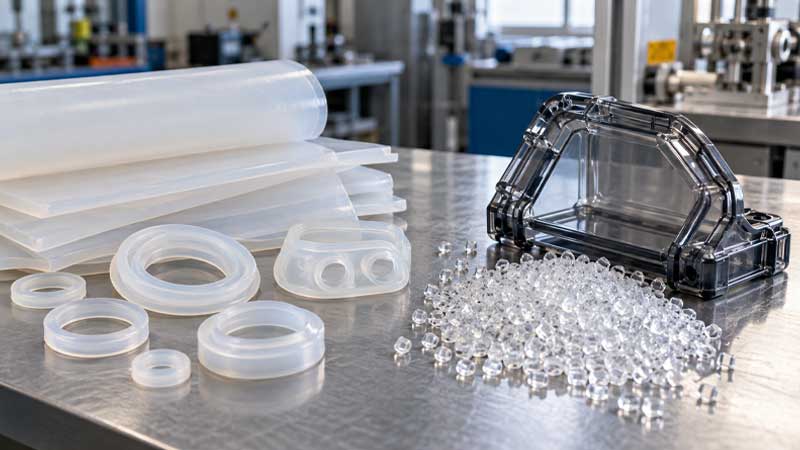
Liquid silicone rubber (LSR) is well suited to high-volume production, complex geometries, thin sections, and applications requiring consistent dimensions. LSR injection molding also supports automated production.
High-consistency rubber (HCR) is commonly used in compression molding. It provides good flexibility for custom silicone keypads and can be practical for moderate production volumes and conventional keypad structures.
SKF engineers select the molding process based on keypad geometry, annual volume, tolerance requirements, tooling investment, and secondary processes.
Silicone Hardness and Fillers
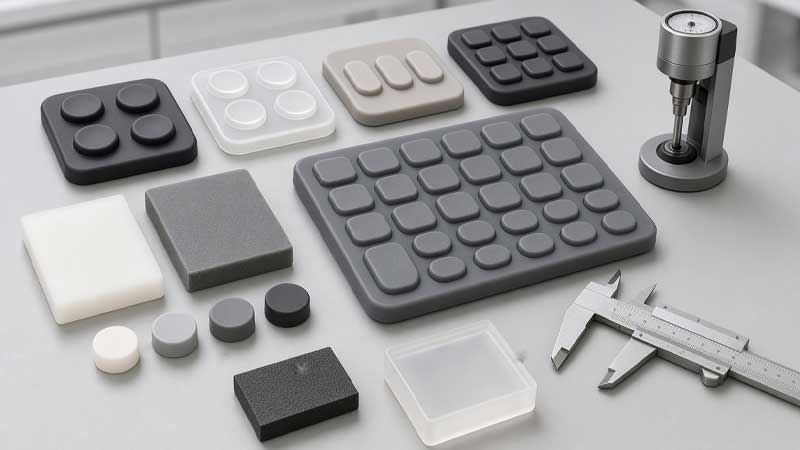
Silicone hardness directly affects keypad feel. Many keypad designs use approximately Shore A 30–80, although the correct hardness depends on the complete tactile structure.
Softer silicone can create a lighter, more cushioned feel. Harder silicone can provide greater structural stability. Hardness should be evaluated together with web thickness, web angle, key travel, and actuation force.
Functional fillers can provide additional properties. Conductive carbon materials can be used for conductive pills or conductive silicone. Nickel-graphite compounds may support EMI shielding. Other additives can provide specific color, flame-resistance, or environmental performance.
Fillers can also affect tensile strength, tear strength, compression set, conductivity, and molding behavior, so material selection should consider the entire specification.
Silicone Keypad Manufacturing Processes
Compression Molding
Compression molding remains a practical process for many custom silicone keypads. Silicone material is placed into a heated mold and compressed until vulcanization is complete.
It can provide flexible tooling options and works well for many medium-volume projects. Material placement, mold temperature, pressure, venting, flash, and shrinkage must be controlled carefully to maintain consistent dimensions and appearance.
LSR Injection Molding
LSR injection molding uses two-component liquid silicone that is mixed and injected into a heated mold. It is suitable for high-volume production and complex keypad structures.
Tooling requires careful control of gates, runners, venting, cavity balance, and mold temperature. Thin silicone webs require particular attention because small process changes can affect tactile force and fatigue life.
Choosing the Right Process
| Process | Main Advantage | Main Consideration |
| Compression molding | Flexible tooling and suitable for many volumes | More manual material handling |
| LSR injection molding | High automation and production consistency | Higher tooling investment |
| Transfer molding | Useful for selected silicone structures | Strongly dependent on geometry |
There is no universal best process. SKF engineers review the 3D model, production volume, tolerance requirements, tactile structure, and secondary operations before recommending a process.
Tactile Design and Key Mechanics
Tactile feedback is critical for POS terminals because users often operate the keypad quickly and repeatedly. The goal is to provide clear activation without excessive operating force.
Keycap Geometry
Flat, concave, convex, domed, and textured keycaps can be used for different applications. A slightly concave surface can guide the fingertip toward the center of the key. Rounded edges and textures can improve comfort and grip.
Keycap geometry also affects how force is transferred to the silicone web.
Silicone Web Design
The silicone web controls key return and strongly influences actuation force. Web thickness, angle, radius, and transition geometry all affect tactile response.
A thicker web generally creates a firmer response. A thinner web can reduce actuation force but may increase fatigue risk if the geometry creates excessive stress.
SKF engineers review the diaphragm structure during DFM because small changes in web geometry can significantly affect both tactile performance and service life.
Key Travel and Actuation Force
Many silicone keypad designs use approximately 0.8–1.5 mm key travel, while actuation force may range from about 60–300 gf, depending on the application.
POS terminals normally require a balance between low operating fatigue and clear feedback. The final force should be confirmed through prototype testing rather than selected from a generic range.
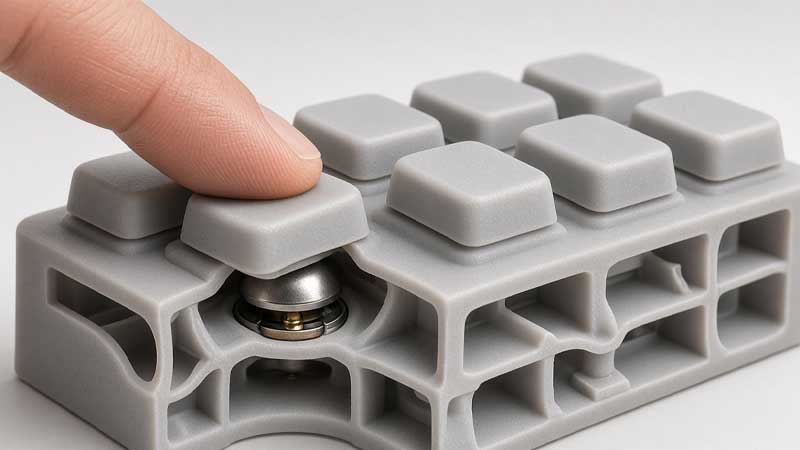
Metal Dome Integration
Metal domes can provide a sharper snap response than silicone alone. The silicone keypad can position and guide the dome while the dome provides the switching action.
Dome size, preload, travel, and PCB contact position must be coordinated. SKF engineers check dome alignment and silicone geometry during prototype validation to avoid excessive force or inconsistent activation.
Conductive Contact and PCB Integration
The conductive system converts a mechanical key press into an electrical signal.
Conductive Carbon Ink
Conductive carbon ink can be screen printed onto the bottom of the silicone keypad. It is cost-effective and flexible for many designs.
Its resistance is normally higher than that of a dedicated conductive pill. The acceptable resistance should therefore be defined according to the PCB circuit and customer specification.
Ink adhesion, contact pressure, PCB surface condition, and contamination also affect long-term switching reliability.
Conductive Carbon Pills
Conductive carbon pills provide a durable contact surface and are widely used in silicone keypads.
Pill diameter, thickness, position, and contact area should match the PCB pattern. SKF engineers check conductive pill positioning during DFM because small alignment errors can cause unstable switching.
EMI Shielding
Conductive silicone compounds and conductive coatings can support EMI shielding. Nickel-graphite materials are one possible option.
The shielding structure must connect correctly to the grounding system. Conductive silicone alone does not guarantee FCC, CE, or other EMC compliance.
Sealing and Protection
POS terminals can encounter spilled liquids, dust, fingerprints, and cleaning agents. The keypad therefore plays an important role in protecting the user interface.
Waterproof and Dustproof Design
A properly designed silicone keypad can form a flexible barrier around the buttons. When integrated correctly with the enclosure and PCB assembly, the complete product can be designed toward IP65 or IP67 protection.
The final IP rating applies to the complete product. Housing seams, connectors, display areas, cable openings, and other interfaces must also be validated.
Adhesive and Positioning
Adhesive can secure the silicone keypad to the housing or PCB. Selection should consider temperature, humidity, cleaning chemicals, surface energy, and long-term peel and shear strength.
Silicone surfaces must be properly cleaned and prepared. Contamination or release-agent residue can cause adhesive failure.
EMI and ESD Protection
Where EMI or ESD protection is required, conductive silicone, conductive printing, grounding paths, or shielding layers can be incorporated into the assembly.
The complete electrical system must be tested at product level to verify EMC performance.
Durability and Reliability Testing
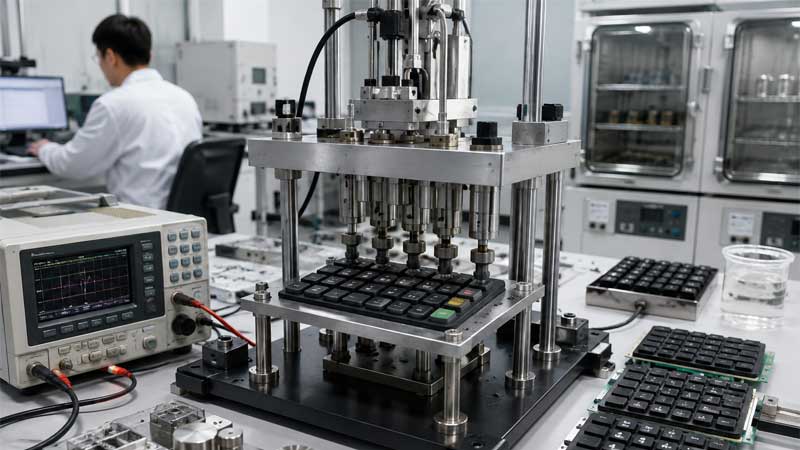
POS keypads may receive hundreds or thousands of operations each day. Reliability testing should reproduce both mechanical use and environmental exposure.
Life Cycle Testing
A common target is 500,000–1,000,000 or more operating cycles, depending on the application.
Testing should evaluate more than whether the key still works. Actuation force, key travel, tactile response, contact resistance, return behavior, web fatigue, and graphic condition should also be checked.
A keypad that still switches electrically but has lost its intended tactile response may not meet the customer’s requirements.
Environmental and Chemical Testing
Testing may include high- and low-temperature exposure, temperature cycling, and high-humidity aging. For demanding applications, a range such as –40°C to +125°C may be evaluated when appropriate to the actual operating environment.
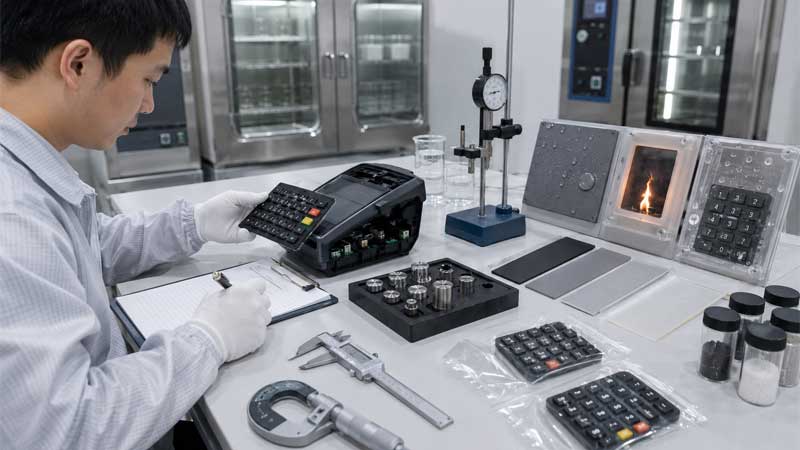
POS terminals are also frequently cleaned with alcohol-based cleaners, detergents, and disinfectants. The most useful chemical testing uses the customer’s actual cleaning agents and procedures.
Conductive and Graphic Testing
Contact resistance should be measured before and after life-cycle and environmental testing. Contact bounce and switching stability can also be evaluated where required.
Printed legends should withstand repeated handling and cleaning. Screen printing, pad printing, coatings, and laser marking should be tested for abrasion and chemical resistance.
SKF engineers can validate graphic durability using actual cleaning chemicals when the application has strict marking requirements.
Ergonomics and Keypad Layout
Good keypad ergonomics improve operating speed and reduce accidental activation.
Key Spacing and Clearance
Key spacing should consider fingertip size, keycap geometry, operating posture, and the risk of accidental activation.
Around 2.0 mm or more can serve as an initial reference for many designs, but the final spacing should be confirmed through prototype evaluation.
A housing clearance of around 0.3 mm or more may help reduce interference. The actual value depends on molding tolerance, thermal expansion, key travel, and assembly accuracy.
Functional Grouping
Numeric, navigation, confirmation, cancellation, and function keys can be separated through position, color, size, texture, or backlighting.
Critical functions should not rely only on color. Shape and tactile differences can provide additional identification.
Anti-Slip and Backlight Design
Concave surfaces, raised edges, micro-textures, and surface coatings can improve fingertip control, especially on portable POS terminals.
Backlit silicone keypads can use translucent or transparent silicone windows with controlled coating layers. LED position, silicone wall thickness, coating thickness, and optical distance affect brightness uniformity.
SKF engineers evaluate the light path during prototype development to reduce hot spots and light leakage.

Customization Options
Custom POS silicone keypads can be adapted to the terminal’s functional and visual requirements.
Colors and Graphics
Silicone can be produced in different colors for branding and functional grouping. UV-resistant formulations may be considered for products exposed to strong light.
Screen printing, pad printing, spray coating, and laser etching are common marking options. Screen printing works well for many standard legends, while laser marking can provide durable symbols when the coating and silicone structure are designed for the process.
Backlit Legends
Transparent silicone sections can be combined with coating layers and LEDs to create illuminated legends.
A common structure uses a light-colored base with a dark blocking layer. Laser processing then opens the required characters.
Coating thickness must be controlled carefully. Excessive coating reduces light transmission, while insufficient coverage can create unwanted light leakage.
Multi-Hardness and Surface Coatings
Different silicone hardness levels can be combined in selected designs to create different tactile responses. Frequently used numeric keys, for example, can have a different tactile profile from navigation keys.
PU coatings, protective films, and other surface treatments can improve abrasion resistance, grip, or chemical resistance. Because coatings can change tactile feel, the finished keypad should be tested after coating.
Cost, Prototyping, and Development
Tooling is often a major initial cost in a custom silicone keypad project.
The main cost factors include keypad geometry, cavity count, silicone material, conductive contacts, backlighting, multi-color or multi-hardness structures, coatings, marking, assembly requirements, annual volume, and dimensional tolerances.
Conductive materials such as silver or nickel-based compounds can increase material costs. Multi-cavity tooling may require more initial investment but can reduce unit cost at higher production volumes.
Prototypes should be used to verify key spacing, enclosure fit, tactile force, travel, conductive contact, and backlight performance before production tooling.
The most important prototype checks are features that are expensive to change later, especially web geometry, conductive pill position, housing clearance, key layout, and light-window design.
Standards and Compliance
IP Protection
IEC 60529 provides the basis for IP ratings such as IP65 and IP67. The rating applies to the complete enclosure or assembly, so the silicone keypad should be validated as part of the finished terminal.
Flame and Environmental Requirements
UL 94 classifications may apply to certain electronic products. The required classification depends on the final product and certification program.
RoHS and REACH are also common considerations for electronic products sold internationally. Material declarations and supplier documentation should be reviewed during development.
ISO 9001 provides a common quality-management framework, while additional requirements may apply to specific industries or customers.
Common Problems and Solutions
Key Activation Failure
Possible causes include conductive ink wear, contaminated PCB contacts, incorrect conductive pill positioning, insufficient contact pressure, or assembly problems.
SKF engineers review conductive geometry during DFM and prototype testing. If conductive printing cannot provide the required service life, conductive pills may offer a more durable solution.
Web Fatigue
Repeated operation can create stress concentration around the silicone web. Excessive deformation, sharp transitions, unsuitable thickness, high actuation force, or unsuitable hardness can contribute to fatigue.
Improving transition radii, adjusting web thickness, reducing stress concentration, and selecting suitable high-strength silicone can improve durability.
Graphic Wear
Frequent cleaning can damage printed graphics. Protective coatings can improve abrasion resistance, while laser marking may be preferable for some high-use legends.
Adhesive Failure
Adhesive separation may result from contamination, poor surface preparation, unsuitable adhesive, temperature exposure, or insufficient bonding area.
SKF reviews the adhesive interface and environmental conditions during assembly design.
Warpage and Dimensional Variation
Silicone shrinkage, uneven cooling, inconsistent material distribution, and improper demolding can affect dimensions.
Mold compensation should be verified with actual trial parts rather than relying only on theoretical shrinkage values.
POS Silicone Keypad Development Process
A controlled development process reduces tooling changes and production risks.
Requirement review → 3D design → DFM review → prototype → functional validation → mold design → tooling → first trial → production validation → mass production
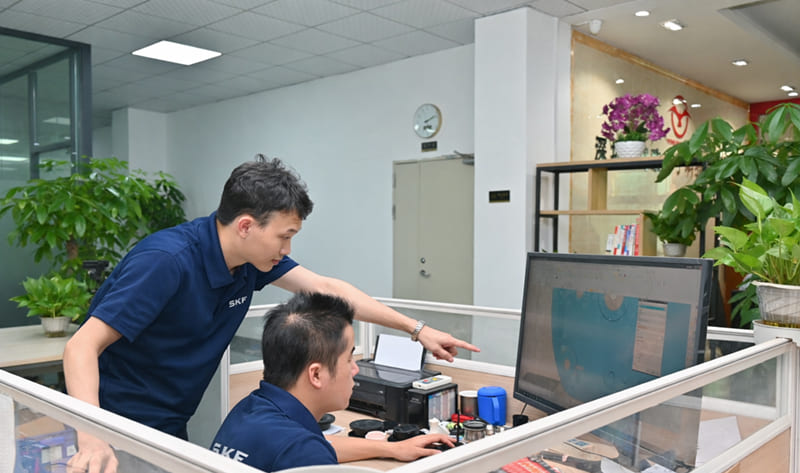
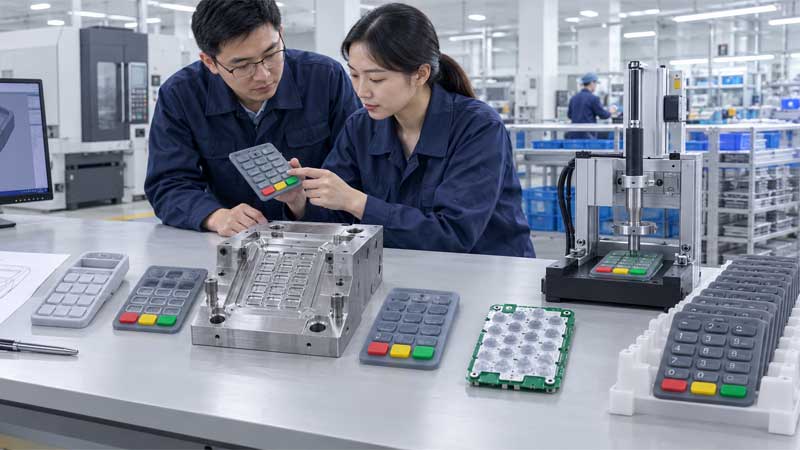
During the initial review, SKF engineers examine drawings, 3D models, PCB layout, operating conditions, lifetime requirements, tactile specifications, electrical requirements, and cosmetic targets.
The DFM review covers web geometry, draft, wall thickness, parting lines, flash locations, conductive pill placement, key travel, housing clearance, adhesive areas, and mold venting.
Prototype parts are then used to verify layout, enclosure fit, tactile force, travel, electrical contact, and user operation. Backlit designs should also be checked for brightness uniformity and light leakage.
After design approval, the mold is developed. First-shot parts are inspected for dimensions, flash, appearance, tactile performance, and electrical function. After mold and process optimization, the final keypad undergoes the agreed reliability and validation tests before mass production.
FAQ
What are the advantages of silicone keypads for POS terminals?
Silicone keypads can combine tactile feedback, sealing, custom graphics, colors, conductive contacts, and backlighting in one flexible interface. They are suitable for repeated operation and customized enclosure designs.
How does a silicone keypad create an electrical signal?
A conductive carbon pill, conductive ink, or another conductive contact is placed under the key. When pressed, the conductive element contacts the PCB and closes the circuit.
Is LSR better than compression-molded silicone?
Neither process is universally better. LSR injection molding can be advantageous for high-volume and complex designs, while compression molding can offer flexible tooling and cost advantages. The choice depends on geometry, volume, tolerance, and production requirements.
How long can a POS silicone keypad last?
Many designs target hundreds of thousands to more than one million operations. Actual life depends on silicone material, web geometry, actuation force, conductive structure, and operating environment.
Can silicone POS keypads be waterproof?
Yes. A silicone keypad can help seal the button area, but the final IP rating depends on the complete terminal enclosure and must be validated at product level.
Can POS silicone keypads include backlighting?
Yes. Transparent or translucent silicone sections can be combined with coating layers and LEDs to create illuminated legends or key zones. Optical design should be validated for brightness uniformity and light leakage.
Can silicone keypads provide EMI shielding?
Conductive silicone, conductive coatings, and grounding structures can support EMI shielding. The complete POS terminal still requires system-level EMC testing.
What information should an OEM provide?
Useful information includes the 3D model or drawing, PCB layout, key dimensions, tactile force and travel, operating temperature, cleaning chemicals, lifetime target, IP requirement, graphics, colors, conductive method, backlighting requirements, production volume, and applicable standards.
Conclusion
Custom POS terminal silicone keypad design requires coordination between material selection, web geometry, conductive contacts, molding, sealing, ergonomics, graphics, and reliability testing.
The most important decisions should be made before tooling. Silicone hardness alone does not determine tactile performance. Key travel, web structure, actuation force, conductive contact position, housing clearance, and mold accuracy must be considered together.
For high-use POS equipment, SKF engineers recommend combining DFM review, prototype testing, tooling validation, and reliability testing. This approach helps reduce production risks while delivering reliable switching, consistent tactile feedback, durable graphics, and long-term keypad performance.