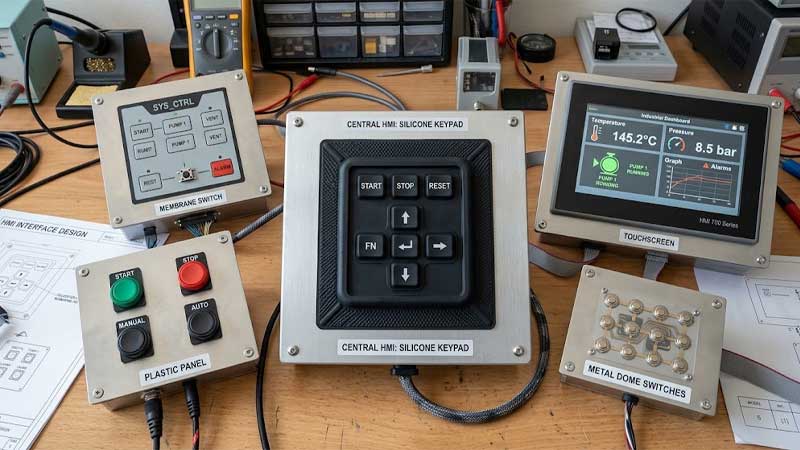
Choosing the right keypad technology affects how users interact with equipment, how well the interface performs in demanding environments, and how easily the product can be manufactured. Silicone keypads compete with membrane keypads, plastic buttons, metal dome switches, and touchscreens, but each technology serves different design priorities.
Silicone keypads are often selected for physical tactile feedback, raised keys, glove-friendly operation, environmental protection, and flexible mechanical customization. Membrane keypads focus on thin, flat interfaces. Plastic buttons provide rigid structures and extensive cosmetic options. Metal domes deliver crisp tactile feedback in compact designs, while touchscreens provide dynamic graphical interfaces.
The right choice depends on the application rather than on one technology being universally better. The following comparison examines the main differences and explains when silicone keypads make the most sense.
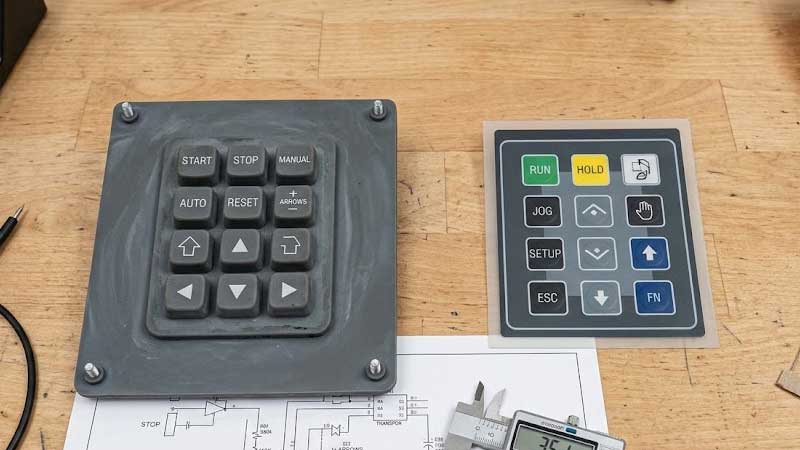
Silicone Keypads vs. Membrane Keypads
Silicone and membrane keypads are common choices for electronic control interfaces, but their physical structures create different user experiences.
Tactile Feedback
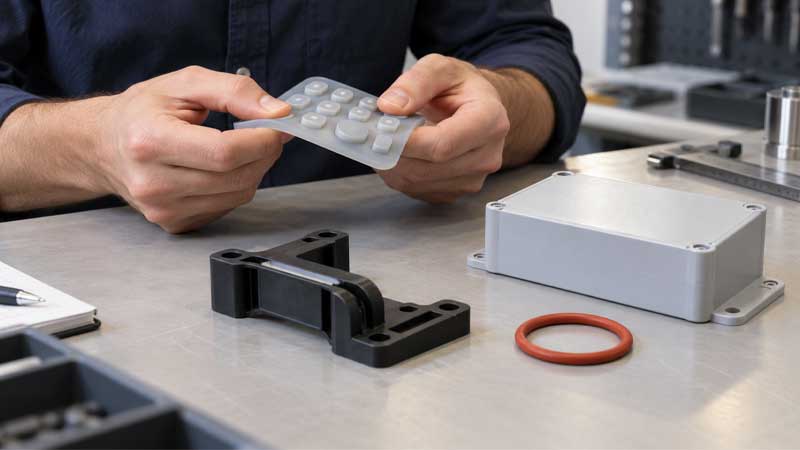
Silicone keypads use molded silicone webs to create mechanical key movement. The web geometry, material hardness, key height, and travel can be adjusted to produce different actuation forces and tactile responses.
Membrane keypads are generally flatter. Their tactile response depends on the membrane construction and switching mechanism. Metal domes can provide a sharp tactile snap, while simpler membrane structures may offer less pronounced feedback.
Silicone therefore offers more freedom when designers want raised keys and customized mechanical travel. Membrane technology can be more suitable when a thin, flat interface is the main priority.
Profile and Space Requirements
Membrane keypads usually require less vertical space. Their thin construction works well for compact control panels, handheld electronics, and equipment where enclosure depth is limited.
Silicone keypads require space for the keys and flexible webs to move during actuation. However, this additional depth allows greater freedom in key height, shape, spacing, and tactile design.
The decision is straightforward when profile is the main constraint. Choose membrane technology when minimum thickness is critical. Consider silicone when physical key travel and three-dimensional key geometry are more important.
Graphics and Appearance
Both technologies support customized graphics, but their visual structures are different.
Membrane keypads provide broad flat surfaces for printed graphics, labels, symbols, and control instructions. They work particularly well when the graphic overlay is an important part of the user interface.
Silicone keypads provide raised three-dimensional keys. They can also use screen printing, laser etching, multiple silicone colors, coatings, and backlighting. These options allow the keypad to combine visual differentiation with physical key feedback.
Neither technology has an absolute advantage in graphic customization. The better choice depends on whether the interface is primarily flat and graphic-driven or raised and tactile.
Environmental Protection
Both silicone and membrane interfaces can be designed for protection against dust, moisture, and contamination. The final performance depends on the membrane structure, housing, seams, compression points, and overall enclosure.
Silicone has an advantage when the keypad itself needs to form part of the flexible protective interface. Its molded structure can integrate keys, surrounding membrane areas, and sealing features into one component.
When Should You Choose Silicone Over Membrane?
Silicone is generally worth considering when the product requires:
- Raised physical keys
- Noticeable mechanical travel
- Customized tactile response
- Frequent glove operation
- Three-dimensional key geometry
- Flexible integration with sealing structures
Membrane technology may be better when ultra-thin construction, a flat surface, and large graphic areas are more important.
Silicone Keypads vs. Plastic Keypads
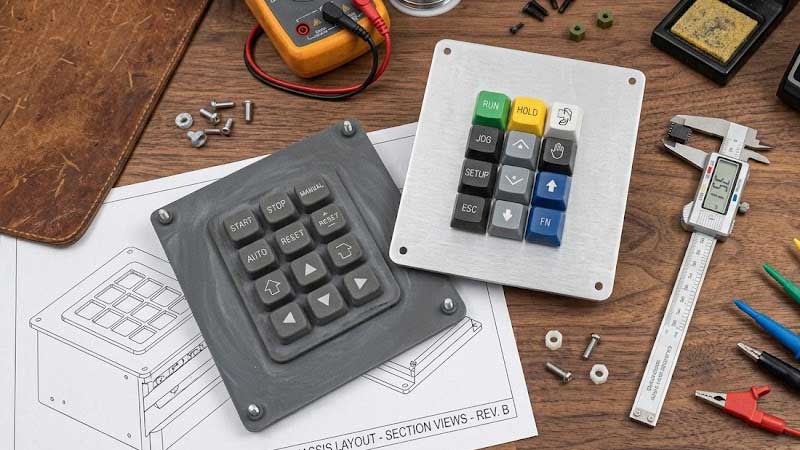
Plastic buttons offer rigid surfaces, precise geometry, and extensive cosmetic possibilities. They are common in consumer electronics, automotive controls, appliances, and equipment with rigid mechanical interfaces.
Silicone takes a different approach by combining the actuator and flexible mechanical structure into the molded component.
Tactile Mechanism
Plastic buttons normally work with a separate switching mechanism. The button may actuate a mechanical switch, metal dome, or another internal component.
Silicone keypads can create the mechanical switching movement through the molded silicone web itself. Pressing the key causes the web to deform and return when the force is released.
This integrated structure gives silicone designers more control over key travel, actuation force, and tactile behavior without relying entirely on the properties of a separate rigid button.
Feel, Flexibility, and Ergonomics
Plastic produces a firm and rigid surface. This can be desirable when users expect hard buttons or when the product requires a specific cosmetic appearance.
Silicone provides a softer touch and elastic movement. Key surfaces can be shaped for different finger positions, and the web structure can be tuned for the desired tactile response.
This makes silicone particularly attractive for equipment where users repeatedly press dedicated controls or operate the interface while wearing gloves.
Durability and Environmental Conditions
Plastic performance varies significantly with material selection. ABS, PC, PA, and other engineering plastics have different temperature, impact, chemical, and mechanical characteristics.
Silicone can offer advantages when flexibility, repeated deformation, temperature resistance, and environmental protection are important. Its elastic structure can also tolerate repeated key movement without relying on rigid hinges or mechanical pivots.
However, neither material should be judged by material name alone. The actual product design, operating environment, material grade, wall thickness, and switching structure determine service performance.
Cost and Manufacturing
Plastic buttons may require several separate components, including the button itself, switch, mounting structure, and decorative elements.
Silicone keypads can integrate multiple keys and the surrounding membrane into one molded component. This can simplify some assemblies, although tooling, conductive elements, decoration, and production volume still affect the final cost.
For OEM projects, the correct comparison should therefore consider the complete assembly rather than the unit price of the button alone.
Silicone Keypads vs. Touchscreens
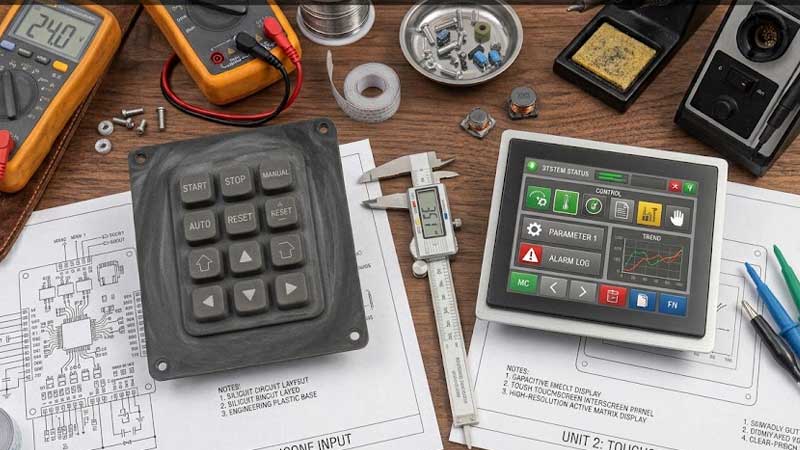
Touchscreens and silicone keypads serve very different interface concepts. Touchscreens provide software-controlled interaction, while silicone keypads provide dedicated physical controls.
Physical Feedback vs. Visual Interaction
The most important difference is tactile feedback.
A silicone keypad provides physical key travel. Users can feel the key move and reach an actuation point without depending entirely on visual confirmation.
A touchscreen provides visual interaction. It can display menus, graphics, maps, dashboards, and different controls depending on the software.
This makes touchscreens particularly powerful for complex interfaces. A single display can replace dozens of dedicated controls and change its layout without changing the hardware.
Silicone keypads are more suitable when dedicated physical controls and tactile confirmation are more important than interface flexibility.
Glove Operation
Touchscreen performance with gloves depends on the touchscreen technology, glove material, screen sensitivity, and device configuration. Some systems work well with compatible gloves, while others become less responsive.
Physical silicone keys provide direct mechanical input. The operator presses the key itself rather than relying on the screen to detect a touch.
This can be valuable in medical, industrial, construction, transportation, and outdoor applications where gloves are frequently used.
Key dimensions still matter. Larger keys, suitable spacing, and appropriate actuation force can make a major difference to usability.
Water, Dirt, and Contamination
Touchscreens used in demanding environments require careful consideration of the display surface, protective glass, touch sensitivity, sealing, and contamination.
Water droplets, dirt, oil, and cleaning agents can affect the interface depending on the touchscreen construction.
Silicone keypads can incorporate raised keys and flexible membrane areas into the interface structure. When combined with suitable housing and sealing design, this can help protect internal electronics from environmental contamination.
The final IP rating still belongs to the complete product assembly, not the silicone material alone.
Durability and Mechanical Damage
Touchscreens introduce glass and display components that need protection in rugged environments. Impact, scratches, temperature changes, and display damage can become important design considerations.
Silicone keys are flexible and can tolerate repeated mechanical deformation. They can also be designed as replaceable or integrated components depending on the equipment architecture.
This does not make silicone automatically more durable than every touchscreen. It means the two technologies manage physical interaction in fundamentally different ways.
When Is a Touchscreen the Better Choice?
Touchscreens are usually more suitable when the product requires:
- Complex graphical interfaces
- Frequent software changes
- Maps or visual dashboards
- Multiple virtual controls
- Data visualization
- Dynamic menus
Silicone keypads are more attractive when physical controls, tactile feedback, glove operation, or rugged input are central to the user experience.
Silicone Keypads vs. Metal Dome Switches
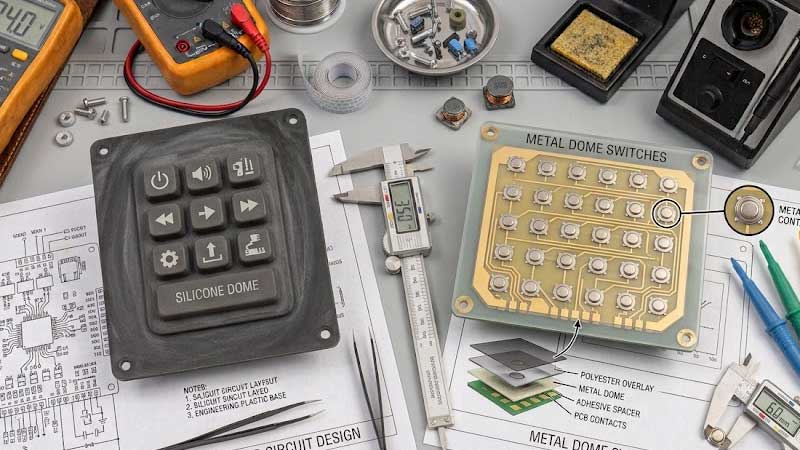
Metal dome switches are another important alternative when tactile feedback is required. They are widely used in compact electronic interfaces because they can provide a distinct snap with very short travel.
Tactile Response
Metal domes are known for crisp, sharp tactile feedback. This makes them useful when users need a clear click-like response.
Silicone keypads generally provide a softer and more progressive tactile feel. Their response can be adjusted through silicone hardness, web thickness, dome geometry, key travel, and actuation force.
If a very sharp tactile snap is the main requirement, metal domes may have an advantage. If the interface needs softer feedback and greater mechanical customization, silicone can be more suitable.
Profile and Mechanical Structure
Metal dome interfaces can achieve very low profiles, making them attractive for compact electronics.
Silicone keypads normally require more vertical space because the molded web must move during actuation. In return, designers gain more freedom in key height, surface shape, spacing, and integrated membrane structures.
Environmental Protection
A metal dome is typically part of a larger interface construction and may require additional layers or housing components for environmental protection.
Silicone can provide the external flexible actuator and surrounding membrane in one molded component. This can simplify the path toward a sealed interface when the rest of the enclosure is designed accordingly.
When Should You Choose Each?
Choose metal dome technology when crisp tactile feedback, very short travel, and low profile are critical.
Choose silicone when the application requires softer tactile feedback, raised keys, custom key geometry, or greater integration with environmental protection.
Hybrid designs are also possible. Silicone actuators can work with metal domes when designers want to combine elastomeric protection with a sharper tactile response.
Silicone Keypads vs. Other Mechanical Input Options
Not every interface needs to use one technology exclusively. Some products combine silicone actuators with metal domes, mechanical switches, membrane layers, or other switching components.
Capacitive controls may also be suitable when a flat interface and light touch are preferred.
The important question is not simply which technology is most advanced. Engineers should identify the required interaction method, physical constraints, environmental conditions, and electrical architecture before selecting the switching technology.
Which Keypad Technology Should You Choose?
The following comparison provides a quick starting point for technology selection.
| Requirement | Silicone | Membrane | Plastic | Touchscreen | Metal Dome |
| Raised physical keys | Excellent | Limited | Excellent | No | Limited |
| Tactile customization | Excellent | Moderate | Moderate | Not applicable | Excellent |
| Ultra-thin profile | Moderate | Excellent | Good | Good | Excellent |
| Glove operation | Excellent | Good | Good | Application-dependent | Good |
| Complex graphics | Limited | Good | Limited | Excellent | Limited |
| Environmental sealing | Excellent* | Good* | Application-dependent | Application-dependent | Application-dependent |
| Soft tactile feel | Excellent | Moderate | Low | No physical feedback | Low |
| Crisp tactile snap | Good | Good | Depends on switch | No physical feedback | Excellent |
| 3D key customization | Excellent | Limited | Excellent | Not applicable | Limited |
Final environmental performance depends on the complete assembly and sealing design.
Choose Silicone When Physical Interaction Matters
Silicone is a strong option when users need dedicated physical controls, raised keys, mechanical travel, glove-friendly operation, or customized tactile response.
It is particularly useful when several of these requirements occur together rather than individually.
Choose Membrane When Thinness and Flat Graphics Matter
Membrane keypads are often a better fit for thin control panels, flat interfaces, and products where printed graphics occupy a large portion of the interface.
Choose Touchscreens When Interface Flexibility Matters
Touchscreens are difficult to replace when users need complex graphical controls, dynamic menus, maps, or software-defined functions.
The choice becomes less straightforward when the equipment operates in demanding environments or requires reliable physical controls. In these situations, engineers need to compare the touchscreen assembly with physical keypad technologies rather than assuming one solution fits every application.
What Should Engineers Consider Before Selecting a Keypad?
User Interaction
Start with how the operator will use the equipment. Consider actuation force, key travel, tactile response, key spacing, glove use, and whether users need to operate controls without looking directly at the interface.
Physical Constraints
Available enclosure depth, PCB position, mounting structure, key size, and panel dimensions can eliminate some technologies before detailed design begins.
For example, membrane technology may be attractive when vertical space is extremely limited, while silicone can offer more flexibility when raised keys are required.
Environmental Requirements
Evaluate temperature, humidity, dust, water, chemicals, vibration, UV exposure, and cleaning procedures.
Environmental requirements should be assessed at the assembly level. Material selection alone cannot guarantee the performance of the finished interface.
Manufacturing Requirements
Production volume, tooling cost, tolerances, decoration, assembly, and inspection requirements can all influence the best technology.
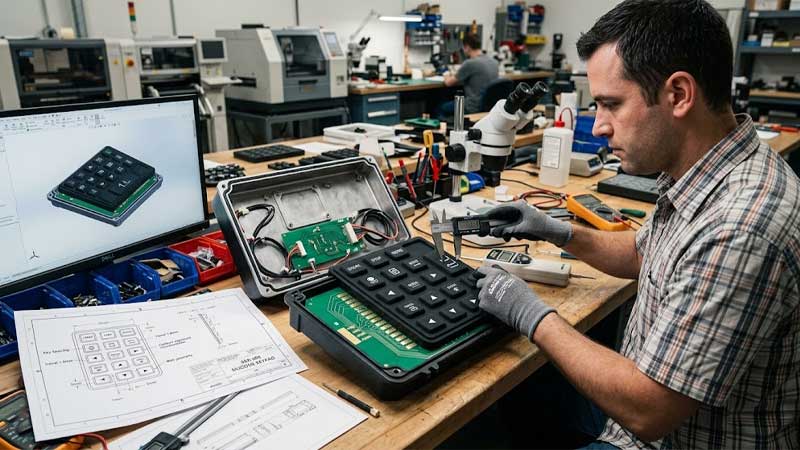
For silicone keypads, SKF engineers review factors such as web geometry, actuation force, conductive pill positioning, key spacing, and molding constraints before production tooling is finalized. This helps reduce risks such as inconsistent tactile force, difficult demolding, or interference between the keypad and PCB.
Why Silicone Keypads Remain a Strong Choice for Custom HMI Design
Silicone keypads remain highly competitive because they combine several functions in one flexible interface structure. They can provide physical tactile feedback, raised keys, customized mechanical response, and support for environmental protection.
Their greatest advantage appears when several application requirements overlap. Industrial equipment may need both glove operation and contamination resistance. Automotive controls may require tactile feedback and vibration resistance. Medical equipment may need physical controls, cleaning compatibility, and reliable repeated operation.
SKF engineers can optimize the keypad around these requirements rather than selecting silicone simply because it is familiar. Key geometry, silicone hardness, web structure, conductive contact, decoration, backlighting, and sealing can all be considered as part of the same design.
Frequently Asked Questions
Are silicone keypads better than membrane keypads?
Not in every application. Silicone is generally better suited to raised keys, mechanical travel, customized tactile response, and glove-friendly operation. Membrane keypads are often preferable when ultra-thin construction and flat graphic surfaces are the main priorities.
Are silicone keypads better than touchscreens?
They solve different interface problems. Silicone keypads are stronger when physical tactile controls and direct mechanical input are important. Touchscreens are better suited to dynamic graphical interfaces and software-controlled functions.
Are silicone keypads suitable for industrial applications?
Yes. They can be designed for industrial equipment where tactile feedback, glove operation, repeated actuation, and environmental protection are important. The material, keypad geometry, sealing structure, and complete enclosure must match the operating conditions.
Which is thinner, silicone or membrane keypad?
Membrane keypads are generally thinner because they use a flat layered construction. Silicone keypads require additional space for key travel and flexible web structures.
How do I choose between silicone, membrane, and touchscreen?
Start with the user interaction. Choose silicone when physical tactile controls are important, membrane when a thin flat interface is preferred, and touchscreen when dynamic graphical interaction is the main requirement. Then evaluate environmental, mechanical, electrical, and manufacturing constraints.
Conclusion
There is no universally best keypad technology. Silicone, membrane, plastic, metal dome, and touchscreen interfaces each have different strengths.
Silicone keypads are especially valuable when a product needs physical tactile feedback, raised keys, glove-friendly operation, environmental protection, and customized mechanical performance. Membrane technology has advantages in thin flat interfaces, metal domes excel at crisp low-profile feedback, plastic works well for rigid button structures, and touchscreens provide unmatched graphical flexibility.
For OEM and ODM projects, the best choice should come from the actual application requirements. Comparing user interaction, space, environment, tactile performance, electrical design, and manufacturing requirements early in development helps engineers select an interface that performs reliably in the finished product.