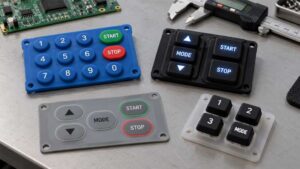
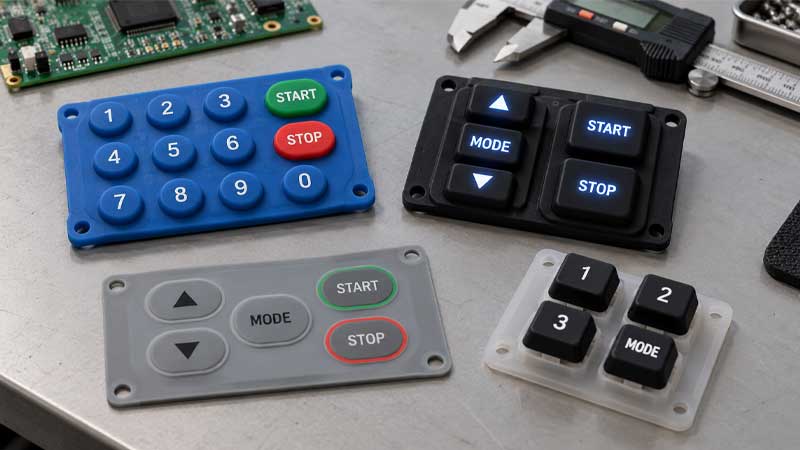
Silicone keypads are a type of physical button that has become widespread in electronic device user interfaces. The legends on silicone rubber keypads help us identify the corresponding functions and make rapid decisions.
There are different printing processes, including laser etching, screen printing, and negative printing, each with its own benefits and shortcomings. The reliability and robustness of the keypad and its legends are significant in different applications.
You may want to figure out which printing option is best for your needs. The following article will help you choose the optimal printing method for your needs and rubber keypad project.
What are the Mechanisms of Laser Etching, Screen Printing, and Negative Printing?
Common legend printing methods can be divided into laser marking and ink marking, which have distinct process mechanisms. And ink marking refers to screen printing and negative printing.
Laser-Etched Silicone Keypad
Laser etching is a non-contact process in which laser machines remove part of the material to form high-contrast, permanent legends on the surface. The depth of the legends depends on the power of the laser, typically reaching 0.001–0.005 inches.
Meanwhile, the depths of the laser engraving process reach 0.01 to 0.02 inches. Thus, silicone keypads are usually treated with the laser etching process to ensure material strength, performance, and durability under repeated keypresses or in tough conditions.
Additionally, laser etching offers treated legends on transparent silicone rubber keypads that provide a backlight effect and enhanced visibility in dark or low-light environments.
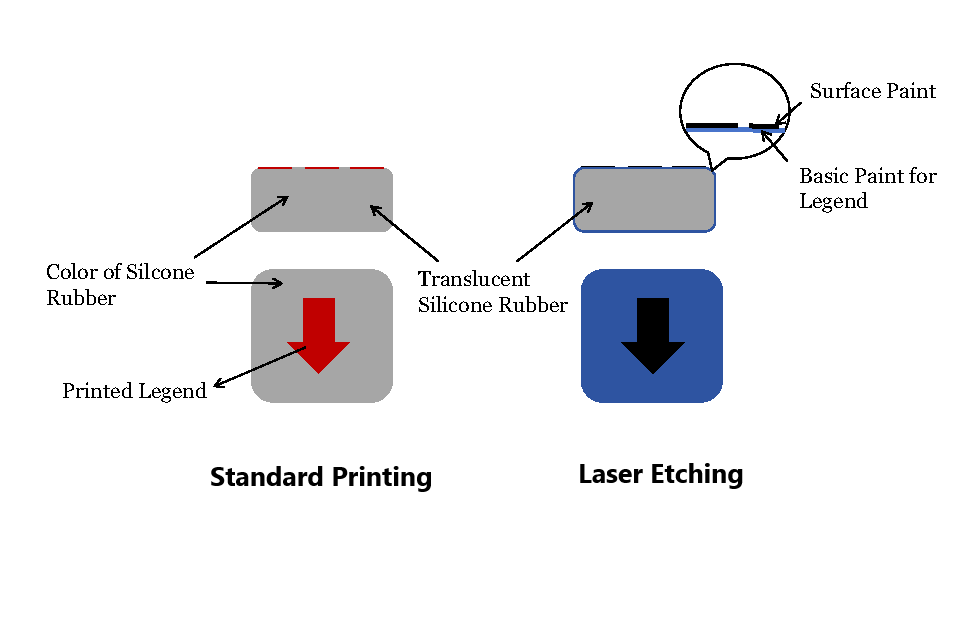
Screen Printing: Positive Printing
Screen printing, also called silkscreen printing, is a process in which a mesh stencil is utilized to apply inked layers to a surface. Compared to negative printing, screen printing is to print legends directly as a type of positive printing.
Negative Printing
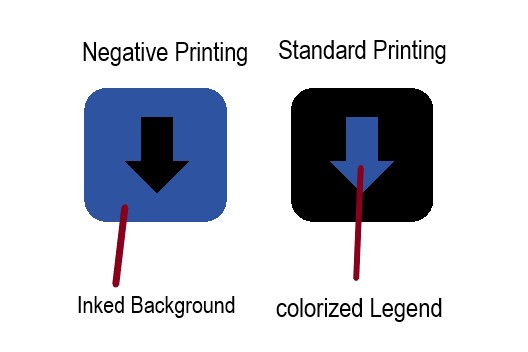
As the name suggests, negative printing produces a printed image that is negative. For instance, standard printing prints the black legend directly on the white substrate, while negative printing prints the areas outside of the legend (i.e., the legend’s background).
These colors can be customized according to your design. The color of the legend is typically determined by the color of the silicone rubber or masking.
Comparison of Laser Etching, Screen, and Negative Printing
| Laser Etching | Screen Printing | |
|---|---|---|
| Appropriate production volume | Small to medium | Medium to large |
| Printing Precision | High precision with specific design specifications and fine detail | Moderate precision of legend printing |
| Cost | Higher initial cost | Lower initial cost |
| Environmental Factor | Friendly environmentally | More carbon footprint, but get more eco-friendly with silicone ink |
| Material Loss | Minimal material waste without additional chemicals or consumables | Moderate |
| Legend Durability | Outstanding durability, resistance to fading, scratching, or friction | Poor, wear off with heavy use |
| Automation available | Yes | No |
| Resistance of Legends | Resistance to abrasion, moisture, temperature | Moderate |
| Printing surface | Unlimited for surface | Maximum curvature for concave and convex surfaces is 0.5mm |
Which Printing Option is optimal for your Silicone Keypad Project?
Rapid Mass Production with Screen Printing
For large-scale production of bulk orders, screen printing is a cost-effective solution for silicone keypads. Although it requires more setup time, including a separate stencil for each color, it is a profitable solution for bulk orders.
Low Setup Cost with Simple Legends: Screen Printing
Screen printing requires template creation and manual operation, which incurs labor costs, as well as the cost of extra materials and consumables, such as screen printing inks, meshes, and screen wash solution.
When it comes to small production runs, screen printing is not an optimal choice. But with silicone keypads with simple legends and medium as well as larger production, the entire setup cost is lower than that of laser etching with a higher initial cost.
Colorful Legend Design: Screen Printing is preferred
Each printing process has its own advantages. Compared to laser etching, which has limited color options, screen printing can produce distinct, colorful patterns and supports a wide range of ink colors.
Flexibility of Printing Process with Laser Etching
Laser etching, including laser engraving, is a precise and durable indirect process for treating silicone rubber. In contrast, both screen printing and negative printing apply inks to the surface of silicone, which can wear due to repeated user contact or daily abrasion.
Thus, laser etching offers flexibility in legend design, handling small and complex patterns or letters. However, screen printing requires creating new stencils with pigments and different numbers of meshes for various colors, fine details, and legend sizes.
Backlit Silicone Keypads: Laser Etching
Laser etching is the optimal printing method for silicone keypads with a backlighting effect because the legend area allows light to transmit uniformly. Designs printed by screen printing are not ideal for backlighting, unless integrated with other techniques.
Protective Coating on Silicone Keypads in Harsh Environments
To withstand high frequencies of abrasion, wear, and actuations with gloves, protective coatings can be sprayed on silicone keypad keytops.
Glossy or Matte Silicone Coating
A glossy or matte silicone coating in a translucent state can be sprayed on to improve durability and resistance to abrasion and wear. Additionally, a matte silicone coating offers improved wear resistance, while a glossy surface effectively reduces dirt attraction.
Epoxy Resin Coating: Smooth and Soft Tactility
A transparent epoxy resin coating provides a hard, glossy surface for the keytops of silicone keypads. This improves wear resistance under tough conditions, such as heavy use.

PU Coating: UV Light Resistance
Polyurethane (PU) is applied to the keytops of silicone keypads to protect against abrasion, UV light, oil, and contamination. It’s a cost-effective solution that prevents aging, cracking, and damage.
FAQ
Are laser-engraved silicone keypads available?
Silicone keypads are generally etched with lasers. Laser engraving removes more material than laser etching, resulting in a deeper marking.
Can I print the legend on the opposite side of the pressed key?
Yes. This printed legend will not be touched.
Is the laser-etched legend on a silicone keypad permanent?
Yes. Laser etching removes part of the material and creates a permanent design on the surface without changing the original structure or strength.
For bulk orders with simple legends or colorful designs, which is preferred?
Screen printing is optimal.
Can I use both screen printing and laser etching for my silicone keypads?
Certainly. Backlight legends are treated with laser etching, and logos are printed with screen printing.
Conclusion
If you want high-precision legends with fine details and a backlight effect, laser etching is optimal for silicone keypads. However, if you require simple patterns and colorful legends for bulk orders, screen printing is preferable for your rubber keypad project.
Our silicone keypad factory and professional team offer durable and reliable legend printing and one-stop shop service, providing an affordable cost and rapid prototype solution to meet your specific requirements.