You may have heard the terms ‘laser cutting’, ‘die cutting’, ‘digital cutting’ and ‘shear cutting’ in relation to the processing of rubber parts and other manufacturing processes.
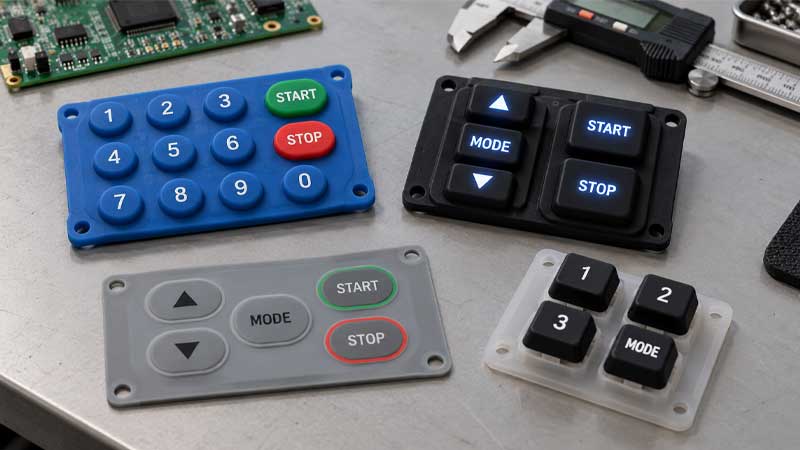
Precise and efficient cutting processes are essential for the pre-treatment of silicone raw materials, the removal of excess silicone from rubber keypads, gasket processing, housing fabrication and the creation of mounting holes in keypads.
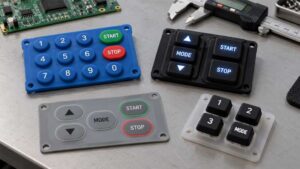
Different cutting techniques are applied at various stages of elastomer keypad manufacturing based on factors such as material thickness, required part precision, production volume and budget, all of which are taken into consideration for your rubber keypad project.
What Are Laser, Die, Digital Knife, and Shear Cutting in Processing?
Considerations in Design and Manufacturing Phases
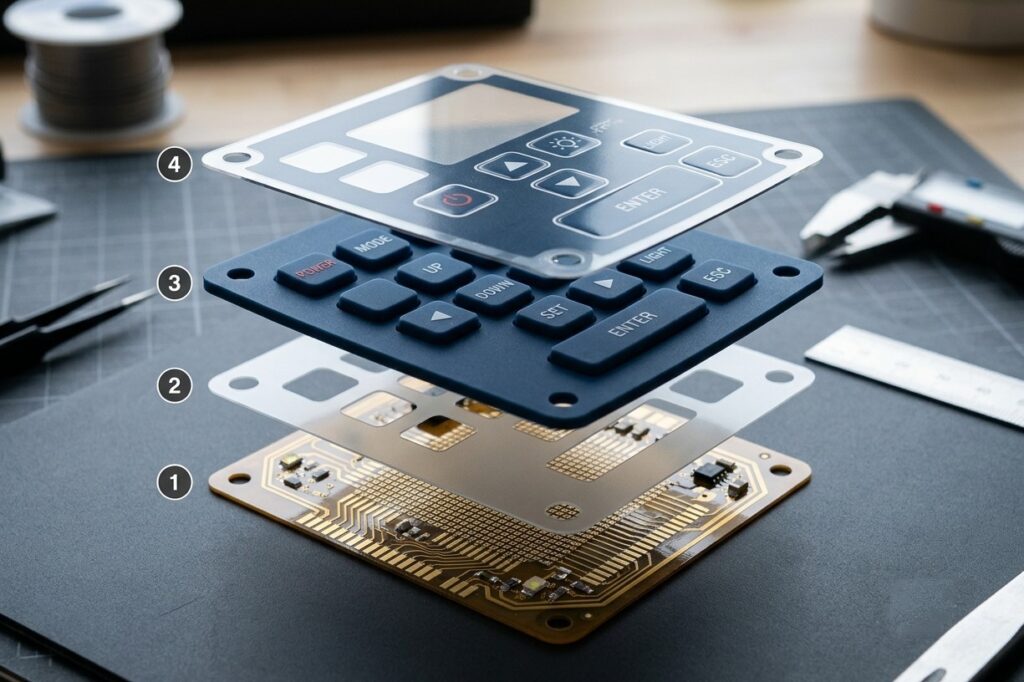
Before selecting a cutting technique, you should take the following factors into account:
- Material type (e.g. silicone rubber, plastic, metal alloy, sheet metal, foam or polymer)
- Thickness of material
- The required tolerance and edge quality (different parts, such as housings, gaskets, deflashing and alignment holes, have different requirements)
- The sizes, shapes and complexity of the parts
- Costs for additional tooling, such as die-cutting technology, which requires mould creation
- Production volume
Laser Cutting
A laser cutter emits laser beams that can be focused on a small spot. These spots are cut by concentrated heat along a predetermined path, causing them to melt, burn or vaporise.

UV lasers are optimal for cutting silicone rubber due to their short wavelength, which decreases issues such as deformation and defects. They also offer optimised control and precision for tight tolerances and dimensional demands when creating mount holes (alignment holes) and specific radii.
Unlike other mechanical cutting methods, lasers cut silicone materials without creating significant mechanical stress, thus preventing warping and other problems.
Die Cutting
Die cutting is a common technique for handling flat materials, including silicone rubber, plastics, metals and foam. It is cost-effective for high-volume production.
In the production of rubber keypads, die cutting is typically used for components and assemblies involving pressure-sensitive adhesives (PSAs), 3M tapes, slip-resistant treads, silicone gaskets for shock absorption, rubber seals and polycarbonate film for graphics overlays in silicone membrane switches.
Converting to silicone rubber keypad manufacturing. Die cutting remains an efficient and common technique for trimming keypads into separate units, involving die preparation and alignment between positioning pins and rubber keypads. Furthermore, this technology is also used for deflashing to remove excess material from the edges of elastomer keypads.
Digital Knife Cutting
Digital knife cutting, also known as CNC (computer numerical control) knife cutting, uses a blade to cut flexible, semi-rigid and rigid materials. Multifunctional tools include vibration, oblique, circular, punching and milling knives, as well as punch rollers.
Shear Cutting
In shear cutting, a machine uses two opposing blades to cut silicone rubber, rubber-like materials, or plastics. In the production of elastomer keypads and relevant assemblies, the shear cutting technique is a cost-effective solution for the large-scale manufacturing of thin-gauge sheets with excellent consistency and efficiency.
Shear cutting technology can be used to process panels and housings for user interfaces with physical buttons precisely, creating housing and display cutouts with tight tolerances and sharp edges for screen assembly.
The Cutting Mechanisms of These Techniques
Cutting is a technology whereby an operator uses a tool or metal to process different materials, including silicone rubber, typically by shaving or drilling.
Laser Cutting: Advanced Thermal Process with Laser Beams
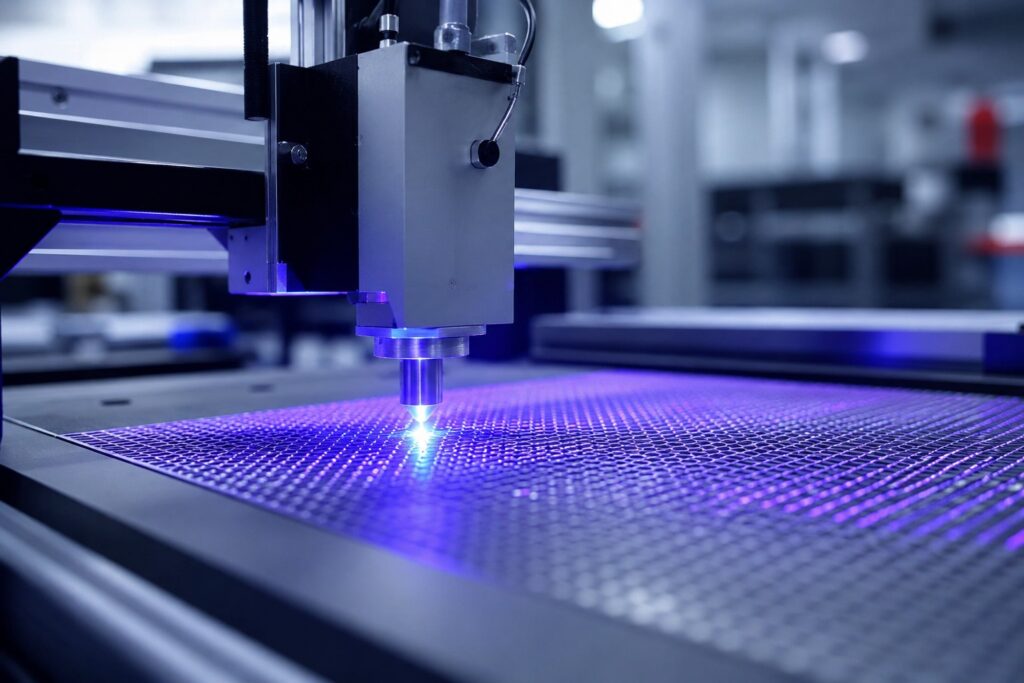
Laser cutters typically rely on CO₂, fibre, UV or solid-state lasers that act as the laser medium. The word ‘laser’ is an acronym for ‘light amplification by stimulated emission of radiation’.
To achieve accurate cuts, laser cutting technology involves:
- Settings and adjustments to laser machines before use, involving speed, focal lens settings and air compressors
- The internal laser medium in the laser machine receives energy from outside
- The medium emits this energy in the form of a beam of light, which cuts specific materials
Die Cutting: Efficiency In Mass Production
Mechanical cutting methods involve physically contacting and cutting materials using physical forces. Examples include shear cutting and die cutting.
As a type of mechanical cutting, the die-cutting process uses a custom die to cut material into a specific shape. This allows a tool to cut material as effectively as a sharp knife, relying on pressure and force on substrates.
Furthermore, the cutting die can be processed with embossing, pressing, perforating or indenting features.
Digital Knife Cutting: Moderate-Volume Manufacturing for Layered Materials and Consistency Needs
Digital knife cutting is an indirect cutting technique that uses a computer to control a rapidly oscillating blade, cutting material based on a programmed line. This makes it optimal for cutting heat-sensitive materials.
The digital knife cutting process involves the following steps:
- Tooling (knives) selection
- Machine setup and material loading
- An oscillating blade, controlled by computer, cuts the material rapidly
Shear Cutting: Pre-Processing & Rough Material Preparation
Shear cutting involves applying opposing forces to fracture the material along a designed line.
The shearing cutting process involves the following:
- Shear angle adjustment: thin sheets require a smaller angle than thick ones. The required shear angle depends on the thickness of the material
- Blade gap, powered backgauge, and clamp adjustments.
- Two sharp blades are located above and below the material being processed
- These blades move past each other and simply cut.
- The upper blade moves down, while the lower blade remains stationary.
Comparison of Laser Cutting, Die Cutting, Digital Knife, and Shear Cutting Techniques
| Features | Laser Cutting | Die Cutting | Digital Knife Cutting | Shear Cutting |
|---|---|---|---|---|
| Precision | Excellent | Great | Superior | Low ralatively |
| Tight Tolerance and Intricate Shapes | Superior | Good, limited in flat shapes | Excellent, enable dealing with complex 3D shapes. | Moderate |
| Applicable Materials | Silicone rubber, films, metal alloys, polymers, plastics | Silicone, plastics, foam, tapes, PSA, polycarbonate film | Silicone, foam, films, thin plastic, textiles, and flexible materials | Metal, sheet metal, and plastics |
| Physical Contact with Workpiece | No | Yes | No | Yes |
| Costs for Mold | No | Yes | No | No |
| Setup Time | Short | Long ralatively, require to align dies | Short | Long ralatively |
| Suitable Thickess of Materials | Thin to thick | Thin (0.030’’), process for thin sheets | Thin to moderate flexibility with an available thickness of ~0.005~5.00” | Thin, processed sheets typically |
| Material Wastage | Less | Less | Minimal | Low |
| Housing Fabrication | Available | Available | Available | Unavailable |
| Optimal Production Amount | Short run and rapid prototypes | Large scale | Small batch and moderat volume | Large batch |
| Suitable Applications | Deflashing, trimming, and mount holes creation in silicone keypads, adhesive cutting | Gasket, seals, graphics, plastic housing, backing adhesive, spacers, and rubber components | Mount holes punch, adhesive gaskets, circuits, and backings | Silicone raw material preparation for rubber keypad manufacturing, and panel preparation |
Which Cutting Technique Should You Choose For Manufacturing?
When to Choose Laser Cutting?
The laser offers superior speed and the unique ability to focus power into a very small area.
Although the laser isn’t the most cost-effective option, it’s a more effective technology that considers precision, quality, and processing speed.
Laser cutting can be used for deflashing and processing holes in silicone keypads. Additionally, this technology can handle internal cutouts, such as mount holes in rubber keypads, for subsequent installation and integration with the housing.
Your requirements of rubber components, protective bezels, panel cutouts, and mount holes can be reached, including:
- Tight tolerance
- Intricate shapes
- Fine Details
- Sharp edges
- Complex shapes of housing with rigid materials
- Cost-effective in small batches
When to Choose Die Cutting?

Die-cutting technology is typically applied for:
- Labels and overlays cutting
- Gasket and seals fabrication
- Rigid housings or bezels provide support and protection for silicone rubber keypads. Examples of materials used for housings include ABS, PC, stainless steel, and aluminum, which are ideal for tough environments.
- Economic in large-scale manufacturing
When to Choose Digital Knife Cutting?
Due to its flexibility and precision, digital knife cutting is used for:
- Graphics overlays and label cutting
- Gasket cutting
- Improved production flexibility and decreased setup time
- Excellent flexibility for dealing with different thicknesses of materials
- Suitable for thin, flexible, semi-rigid, or heavy materials with versatility
- Avoid potential burnt edges, discoloration, and fumes like laser cutting with heat during the cutting process
- Flexible in small scale, without the cost of custom hard tooling
- Preferred for small batch, pre-production, rapid prototypes & samples of design variations (optimal choice to prove out an HMI project in its early stages)
When to Choose Shear Cutting?
The shear cutting technique provides clean metal edges and excellent efficiency for manufacturing reliable, stiff metal enclosures for your HMIs (human-machine interfaces) and electronic user interfaces.
When the material is processed by the shear-cutting technique, you should notice that:
- Preferred for thin sheet processing
- Optimal for simple straight-line cuts
- No chips, swarf
- less material wastage like offcuts or scrap
- Eco-friendly choice
- Minimal post-processing within a smooth edge finish
- Optimal for heat-sensitive materials due to cold-cutting way
- Rapid and consistent in high-volume processing
FAQs
Which cutting technique is optimal for small-batch manufacturing?
Laser and digital knife cutting are optimal for short runs and prototypes, as well as medium-scale manufacturing.
Which cutting techniques have cost-effectiveness in repeatable shapes and medium- to high-volume production?
Die cutting is preferred with consistency.
Can a laser cut silicone?
Yes, laser cutters focus power on a specific area to cut silicone based on your request.
Which types of laser cutters are preferred for silicone cutting?
After some settings adjustments, lasers with CO₂ or UV sources are optimal for cutting silicone keypads. Besides, a diode laser cannot handle the required precision and power.
How to cut a hole for HMI?
A hole punch is suitable for short runs, and a punch press machine offers consistency, quality, and tolerance for larger-batch manufacturing for your HMI.
Is a silicone keypad safe to laser cut?
Yes, a silicone keypad is safe to laser-cut based on proper ventilation.
Final Thoughts
Depending on the material, thickness, and design complexity of the parts to be machined, as well as the features of the specific cutting technique, you should select a suitable cutting technique from these four options. This selection may affect the manufacturability and performance of your human-machine interface (HMI) and electronic interfaces with rubber keypads and relevant components.
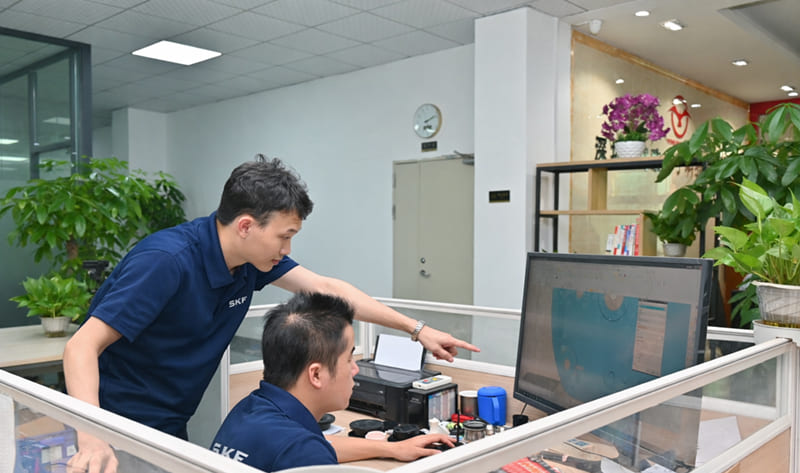
The engineering team at SKF provides solutions that balance durability, quality, cost, and performance in final production and DFM for your project.