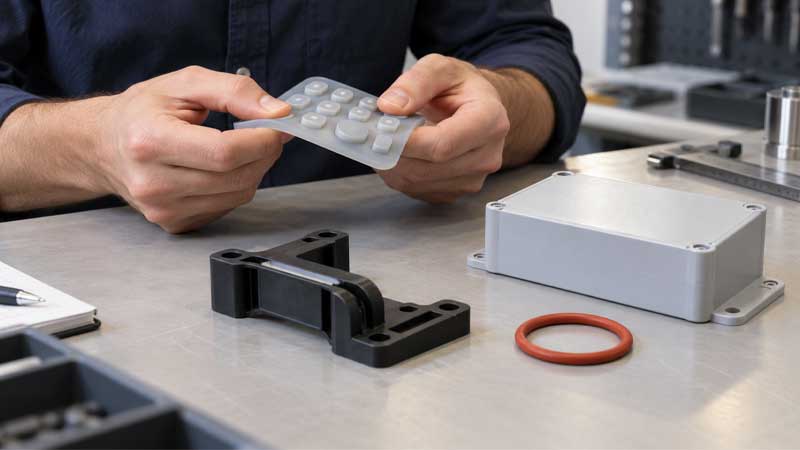
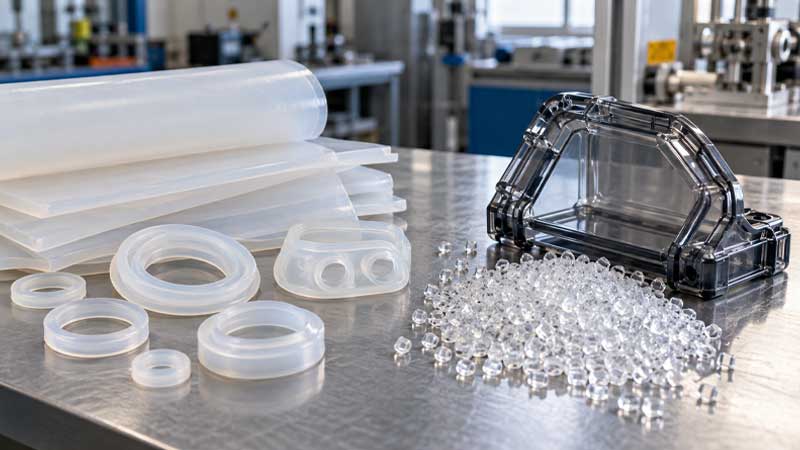
Silicone keypad mold design directly affects key dimensions, tactile response, appearance, and production consistency. Unlike molds for simple silicone parts, keypad tooling must reproduce different key structures while supporting controlled webbing movement, reliable demolding, accurate legends, and stable contact with the PCB.
A production-ready mold therefore starts before tooling machining. Engineers must connect the keypad CAD geometry with mold structure, parting lines, draft, venting, cavity layout, and tactile requirements. SKF engineers review these factors during DFM to reduce tooling modifications and improve production reliability.
What Is Silicone Keypad Mold Design?
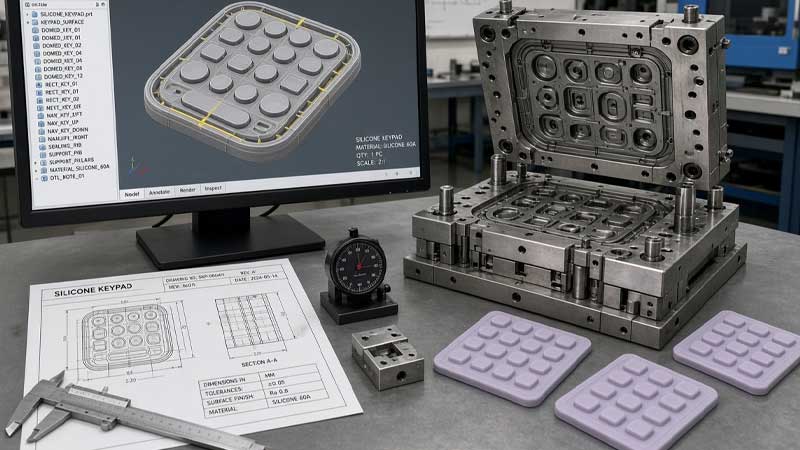
Silicone keypad mold design converts the finished keypad geometry into production tooling. The mold defines the cavities, parting surfaces, key profiles, webbing geometry, venting features, and other details required to form the silicone keypad.
The process usually starts with 2D drawings and 3D CAD models. Engineers then evaluate how the keypad will separate from the mold, where the parting line should be placed, how cavities should be arranged, and how the mold can reproduce critical dimensions consistently.
Mold design also affects more than appearance. Key height, webbing geometry, cavity dimensions, and mold accuracy can influence actuation force, key travel, snap response, and return behavior.
Keypad Geometry That Drives Mold Design
The geometry of each silicone keypad determines many tooling requirements. Small changes in the keypad structure can require changes to cavity geometry, machining methods, draft, or mold separation.
Key Height, Spacing and Base Thickness
Key height affects cavity depth and mold release. Closely spaced keys also require sufficient clearance between cavities to maintain mold strength and dimensional accuracy.
Base thickness must remain consistent enough for stable molding. Large thickness variations can create different shrinkage or deformation behavior across the keypad. Engineers also consider the relationship between key height, base thickness, and PCB clearance when developing the mold.
Key spacing is important for both user operation and tooling. Narrow gaps can make machining more difficult and increase the risk of flash or incomplete separation between adjacent keys.
Webbing Geometry
Webbing connects individual keys to the keypad base and allows each key to move during operation. For this reason, webbing geometry is one of the most important areas in silicone keypad mold design.
Key parameters include webbing thickness, angle, height, transition shape, and radius. These features determine how the web collapses when users press the key and how quickly the key returns after release.
The mold cavity must reproduce these thin and flexible structures accurately. Excessively thin webbing can increase molding and durability risks, while overly thick webbing can increase actuation force and reduce tactile response.
Radii, Corners and Undercuts
Silicone keypad cavities should avoid unnecessary sharp internal corners. Appropriate radii improve material flow, reduce stress concentration, and make cavity machining more practical.
Deep pockets and undercuts also require careful evaluation. Complex undercuts can complicate demolding and may require special tooling structures. CNC tools have practical limits when machining narrow or deep cavities, while EDM can provide different options for detailed cavity features.
DFM review should therefore consider both the desired keypad geometry and the machining method used to manufacture the mold.
DFM Requirements for Silicone Keypad Mold Design
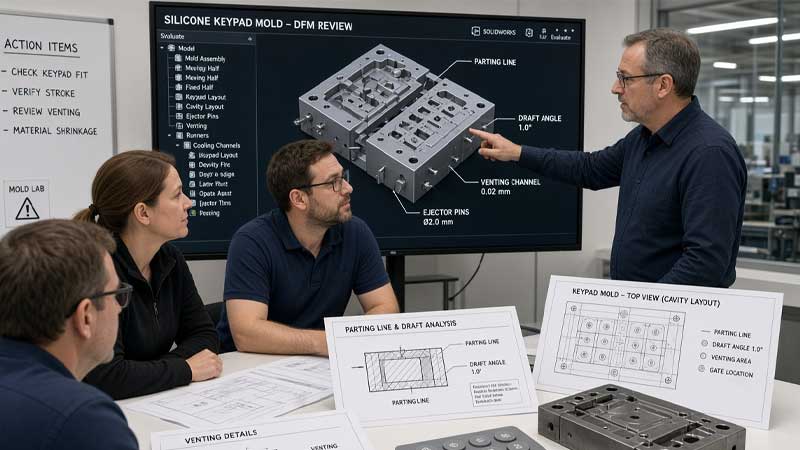
Design for manufacturing should be completed before final tooling production. A keypad may look correct in CAD but still create molding problems if the parting line, draft, venting, or cavity structure is difficult to manufacture.
Parting Line Placement
The parting line defines where the mold separates. Its position affects flash location, appearance, demolding, and the dimensional quality of key edges.
For silicone keypads, the parting line should be positioned carefully around visible surfaces and functional areas. Uncontrolled flash around key edges can affect appearance and may interfere with keypad movement or assembly.
Engineers should also consider how the parting line interacts with sealing surfaces and areas that contact the enclosure or PCB.
Draft Angles and Mold Release
Draft helps the cured silicone keypad release from the mold cavity. Deep or vertical cavity walls can create greater demolding resistance, especially around tall keys or complex profiles.
The required draft depends on factors such as key geometry, cavity depth, surface finish, material behavior, and tooling structure. There is no single draft value suitable for every silicone keypad.
SKF engineers evaluate draft together with the actual cavity geometry instead of adding excessive draft that could change the intended key profile.
Wall Thickness and Radii
Consistent wall thickness supports more predictable molding and dimensional performance. Thin sections need enough geometry to fill reliably, while large thickness transitions should be reviewed for potential deformation or molding variation.
Radii are also important around key bases and webbing transitions. Smooth transitions can reduce stress concentration and improve both mold manufacturability and keypad durability.
Venting and Air Channels
Air trapped inside complex cavities can cause incomplete filling, molding marks, or other defects. Proper venting gives trapped air a path to escape during molding.
Air channels may also be used in keypad structures to prevent unwanted vacuum effects during operation. Their position and dimensions must be considered together with the mold cavity and surrounding geometry.
Webbing Design and Tactile Performance
Silicone keypad tooling must reproduce the geometry responsible for tactile response. The mold does not simply create the external appearance of the keypad; it reproduces the mechanical structure that controls key movement.
Actuation Force
Actuation force is the force required to move a key through its operating point. Webbing thickness, angle, geometry, silicone hardness, and key structure can all influence the force curve.
If the mold reproduces inconsistent webbing dimensions between cavities, individual keys may have noticeably different operating forces.
Snap Ratio and Contact Force
Snap ratio helps describe the sharpness of tactile response:
Snap Ratio = (F1 − F2) / F1
Where F1 is the actuation force and F2 is the contact force.
A higher snap ratio generally produces stronger tactile feedback. However, excessive stress concentration around the webbing can affect long-term durability.
For this reason, mold design should preserve the intended webbing profile and transition geometry rather than treating tactile force as an independent specification.
Key Travel and Return Force
Key travel determines how far the key moves before and after electrical contact. Webbing geometry, key height, base structure, and material properties all contribute to this movement.
After release, the silicone structure must provide sufficient return force to restore the key position quickly. Mold accuracy becomes important when multiple keys must provide consistent travel and return behavior.
Mold Structure, Materials and Cavity Layout
The mold structure should match the product requirements, expected production volume, and required dimensional consistency.
Mold Materials and Machining
Production molds commonly use durable tool materials that can withstand repeated molding cycles. CNC machining is widely used for cavity production, while EDM can support detailed or difficult-to-machine features.
Surface finish should also be considered because cavity texture can transfer directly to silicone surfaces.
Single-Cavity vs. Multi-Cavity Tooling
Single-cavity or low-cavity tooling can be useful during development or for lower-volume products. Multi-cavity molds are more suitable for higher production volumes because multiple keypads can be molded during each cycle.
However, adding cavities increases the importance of cavity-to-cavity consistency. Each cavity must reproduce the same key dimensions, webbing geometry, surface finish, and other critical features.
Cavity-to-Cavity Consistency
For silicone keypads, cavity consistency affects both dimensional quality and tactile performance. A keypad may meet the overall drawing specification while still having noticeable differences in individual key feel.
Tooling accuracy, cavity machining, alignment, material control, and molding process stability must therefore work together.
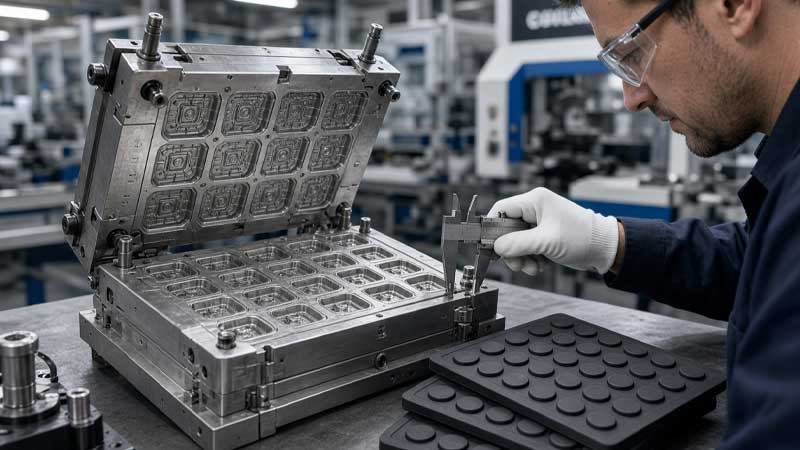
Prototype Tooling and Production Mold Validation
Prototype tooling provides an opportunity to validate keypad geometry before committing fully to production tooling.
Prototype Mold
Prototype samples can be used to evaluate key feel, travel, enclosure fit, PCB clearance, appearance, and overall geometry. Testing at this stage can reveal problems that are difficult or expensive to correct after production tooling is completed.
T1 Trial and Functional Validation
During trial molding, engineers can check:
- Key dimensions
- Flash
- Surface appearance
- Actuation force
- Key travel
- Return behavior
- Conductive contact
- Assembly fit
The actual test items depend on the keypad application and customer requirements.
Mold Modification Before Mass Production
If trial results reveal excessive force, poor return, dimensional variation, or molding defects, tooling can be reviewed and modified before mass production.
This approach reduces the risk of carrying an unsuitable mold design into high-volume manufacturing.
Special Silicone Keypad Mold Designs
Some keypad structures require additional tooling considerations.
Backlit Keypad Tooling
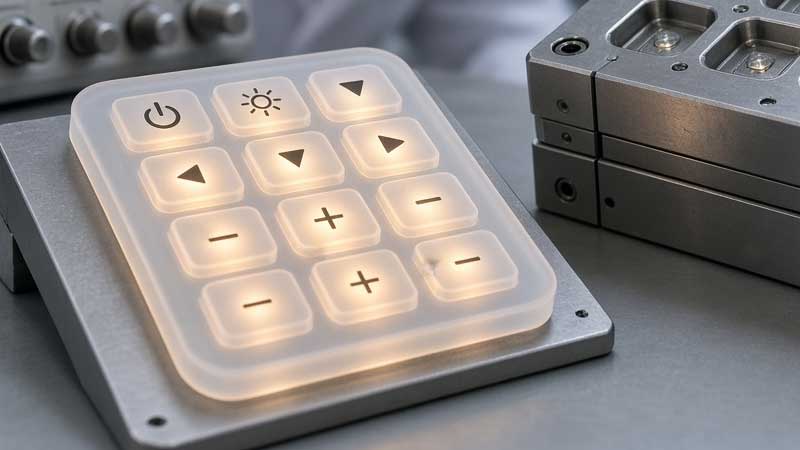
Backlit silicone keypads require controlled light transmission through the silicone structure. Mold geometry must support the required key shapes, light-transmitting areas, and separation between illuminated and non-illuminated regions.
Tooling should also account for LED positioning and the desired appearance of legends or symbols.
Insert and Multi-Color Tooling
Insert molding can combine silicone with supporting components or structural inserts. Multi-color tooling can produce keypads with different silicone colors or integrated visual features.
These structures require more detailed mold alignment and process planning than standard single-material keypads.
Complex Keypad Structures
Waterproof keypads, specialized industrial controls, and highly customized interfaces may combine unusual key profiles, sealing features, conductive elements, or enclosure interfaces.
The mold should be designed around the complete assembly rather than the silicone mat alone.
Common Silicone Keypad Mold Design Problems
Flash Around Key Edges
Excessive flash can result from parting-line problems, mold alignment, tooling wear, or unsuitable molding conditions. Flash around moving keys can also affect tactile operation.
Uneven Key Feel
Different key forces may result from inconsistent webbing geometry, cavity variation, material differences, or process variation. Tooling should reproduce critical tactile structures consistently across all cavities.
Poor Key Return
Slow or incomplete key return can result from unsuitable webbing geometry, excessive deformation, material selection, or insufficient return force.
Air Traps and Incomplete Molding
Poor venting can trap air inside complex cavities. Proper vent locations and air paths should therefore be considered during the initial mold design rather than added only after molding defects appear.
FAQ
What factors affect silicone keypad mold design?
Key geometry, webbing structure, material hardness, draft, parting line, venting, cavity layout, production volume, and tactile requirements all affect mold design.
How does webbing affect silicone keypad tooling?
Webbing geometry determines how each key moves and contributes to actuation force, snap response, travel, and return force. The mold must reproduce these features accurately.
What draft angle is needed for silicone keypad molds?
The required draft depends on key height, cavity depth, surface finish, material behavior, and mold structure. Engineers should determine draft based on the actual keypad geometry.
How many cavities should a silicone keypad mold have?
Cavity count depends on production volume, keypad size, cycle requirements, tooling cost, and required cavity-to-cavity consistency.
Can silicone keypad molds be modified after trial production?
Yes. Trial molding can identify dimensional, tactile, flash, venting, or demolding problems. Tooling can sometimes be modified before mass production, depending on the required change.
Silicone Keypad Mold Design Process at SKF
SKF engineers evaluate each silicone keypad project from both product and tooling perspectives. The review covers 2D drawings, 3D CAD models, silicone material requirements, key geometry, webbing structure, PCB interface, operating conditions, and production volume.
During DFM review, SKF engineers assess parting line placement, draft angles, cavity geometry, venting, radii, machining access, and demolding risks. These checks help identify potential tooling issues before mold manufacturing begins.
After the initial tooling is completed, trial molding allows SKF to verify key dimensions, tactile response, key travel, return behavior, appearance, and assembly fit. If testing reveals issues, critical mold features can be refined before production release.
From initial keypad geometry to production-ready tooling, SKF provides engineering support throughout the mold design process. Our team helps customers optimize webbing and cavity structures, resolve DFM challenges, and develop silicone keypad molds that deliver consistent dimensions, reliable tactile performance, and stable production results.