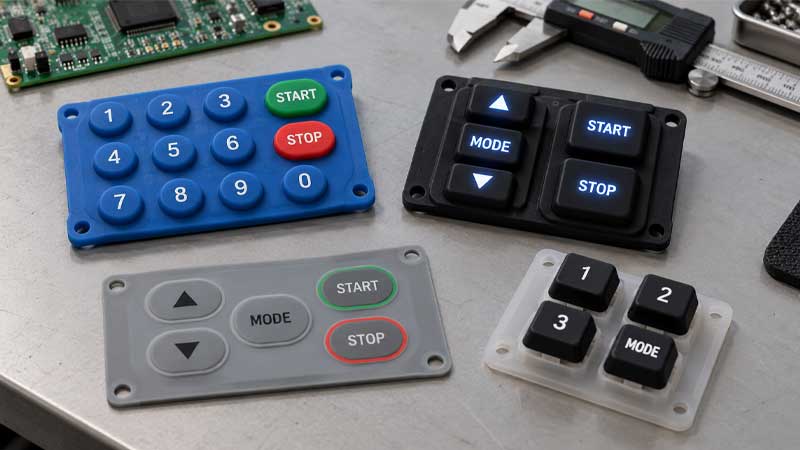
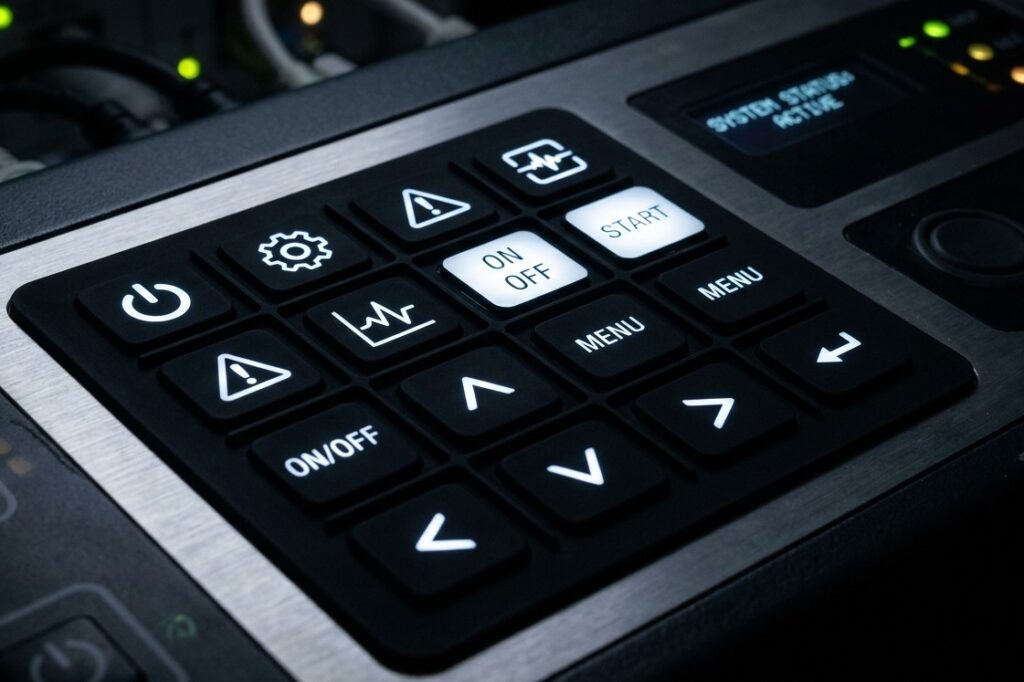
Properly designed light elements in a silicone keypad provide uniform illumination of the key area or the entire keypad in a low-light environment. The energy-efficient and light-efficient design provides a cost-effective and durable solution that improves the user experience in terms of performance, energy efficiency and aesthetics.
The following article will discuss the light element design of silicone keypads, including the light source, light transmission and keytop processes.
The Light Source and Backlight of Silicone Keypad
Lighting optics are needed to project light emitted from a light source onto an object. This refers to the light source that emits light onto the keytop of a silicone keypad, resulting in an optical silicone keypad. Thus, uniform illumination is essential for the optical design of backlit silicone keypads, which relate to light-emitting diodes (LEDs).
Reliable and Flexible LEDs
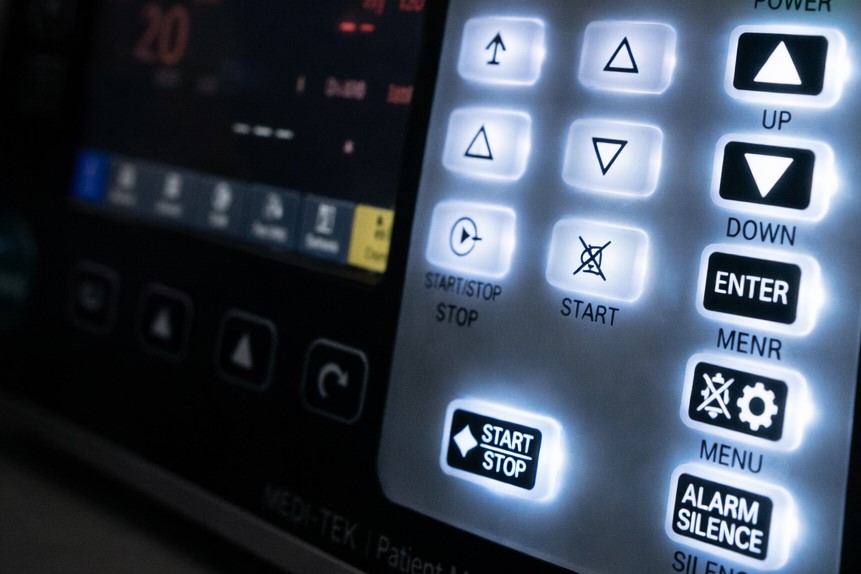
LEDs are a reliable and versatile lighting solution with a lifespan of tens of thousands of hours without brightness degradation. They are typically used for functional lighting to indicate whether an appliance is active or inactive, for example the LED power indicator light. For backlit silicone keypads, LEDs act as orientation lights in input devices in low-light conditions. An illuminated silicone keypad can reduce the discomfort caused by the screen’s glare.
LEDs provide excellent light quality and durability, with multiple colour options, minimal heat generation and a small size that allows them to be integrated with different components. They also have a longer lifespan than standard CFLs.
Definition of Backlight
Backlighting relates to light diffraction, which refers to the propagation of light behind an edge. Light will be deflected when travelling as a wave and hitting an object. The light rays of the backlighting effect achieve a more precise image of the object’s edges, emphasising the symbols or characters on the silicone keypad’s keytop.
How does Light travel through Silicone Material?
The translucency of the silicone material impacts the light transmission result. The amount of light passing through silicone material varies depending on whether it is translucent, laser-etched or ink-painted.
Translucent or Laser Etched Silicone Keypad
Since transparent materials result in hot spots from LEDs and opaque or cloudy materials do not allow light to pass through effectively, a translucent silicone keypad is optimal for a backlit effect due to its visible light transmission properties.
For a translucent silicone keypad, the backlight design, especially the light guide film (LGF), is visible through laser-etched legends and LEDs as the light source.
The surface paint layer of the legend area is removed by laser etching to allow light to pass through. At the same time, the surface paint in areas without legends will block light transmission, ensuring that only the legend areas are backlit. For illumination, LEDs can be placed in the centre or on the side of the printed circuit board.
Silicone Keypad with Light Blocking
For opaque silicone keypads, the legend areas are translucent, allowing light to pass through these areas only. To achieve a backlit effect, the legends are printed using positive or negative printing processes.
Positive printing involves printing positive legends directly onto the keytop of a translucent silicone keypad. This method is simple and cost-effective, but the visibility is poorer than with negative printing and laser etching treatments.
Negative printing involves printing the entire keytop of the silicone keypad, except for the legend areas. The legends and sides of the buttons allow light to pass through.
Key Parts of Light Transmission for Backlit Silicone Keypad
Improved Light Element Design: Cost-Effective Light Guided Film (LGF)
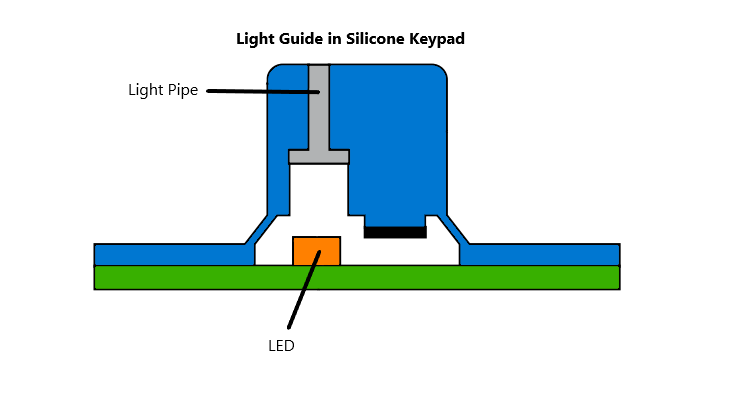
Based on LEDs as the light source, light-guided film has become a cost-effective alternative to other backlight methods, eliminating the need for expensive light pipes and diffusers.
By gathering the light rays from the light source, the LGF increases the brightness of the light and illuminates the backlight area of the silicone keypad. It provides uniform illumination of the desired area of the silicone keypad and avoids light bleed. Additionally, LGF backlighting can be integrated with RGB LEDs to provide a wide colour spectrum and various illumination options over larger areas. Individual keys or all the keys can be lit at once.
Light source Placement
To ensure bright and uniform illumination, the light source must be placed properly within the internal structure of the silicone keypad to effectively prevent hot spots and dark areas. This relates to the distance between the light source and the light channel, as well as the keytop.
Backlight Bleed Issue solved by LEDs and Block Design
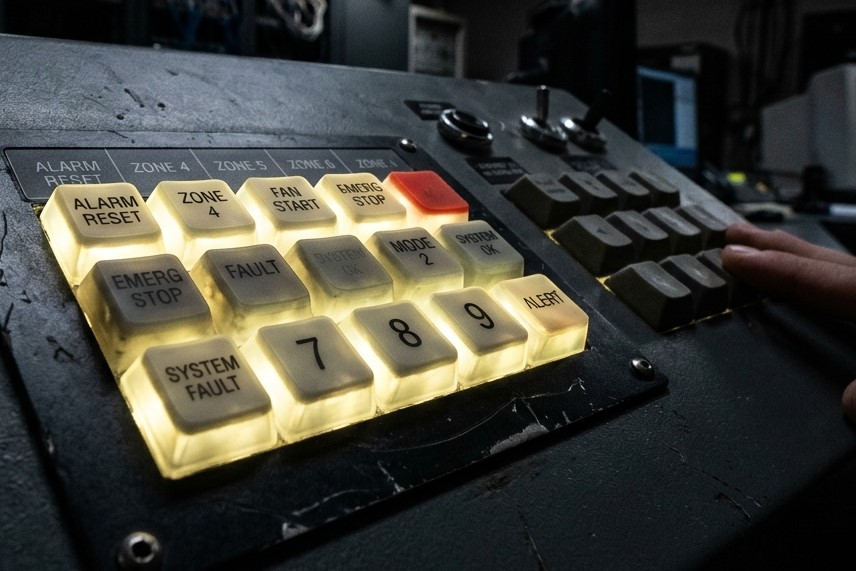
The light has no preferred direction of propagation and is scattered evenly and homogeneously in all directions. Backlight bleed refers to light emitted from an unwanted or unexpected area. You may be wondering whether backlight bleeding decreases when the keys of a silicone keypad are coated with a black ink layer.
However, this would not be energy-efficient enough. This is because the black ink layer absorbs light, which decreases the final backlight performance and the efficiency of the light elements. At the same time, a white ink layer on the surface of the keys enables light to be reflected and emitted in the desired area for illumination.
Proper LEDs Placement
To solve this issue, the placement of the light elements and the reduction of light emitted can be helpful. In terms of light element design, an added optical structure can prevent unwanted light transmission to undesired areas of the silicone keypad. For example, LED placement can be adjusted by integrating LEDs into the printed circuit board (PCB), mounting LEDs on the PCB or placing LEDs between two keys or at the side of a single key on the PCB.
Additionally, a high density of LEDs, such as an LED array, consumes more power and can result in potential hot spots and increased production costs due to the complex design.
Light Blocks ensuring Uniform Backlight
Another method is to use an opaque object to cover areas that should not emit light. Moulded light blocks effectively prevent light transmission from the legends or button areas of a silicone keypad. In general, a 1 mm block requires an extra 1 mm of clearance on each side to ensure the stability of subsequent keystrokes. However, this added space impacts button spacing, so you should strike a balance by positioning the LEDs.
Higher Efficiency by LEDs Design
Less LED Bulbs with LGF Technology
The fewer LED bulbs inside, the less power is consumed. At the same time, the efficiency of light transmission is enhanced. Light guide film (LGF) technology can achieve full backlighting with a small number of LEDs, ensuring cost-effectiveness and an attractive visual effect.
Rather than placing an LED underneath each keytop, the LGF technology places the LEDs along one side of the internal silicone keypad. The light rays emit in all directions and reflect off the sides to achieve uniform and precise lighting, while keeping tooling costs and heat generation low.
Versatility of LED Backlighting
Whether you want a cosy ambience with a low colour temperature or a vibrant appearance with a higher colour temperature, LEDs can be customised to your specific requirements, offering personalised brightness and unlimited colour options.
Backlight without Hotspots
In LED lighting, hotspots are areas of an LED light that appear brighter than the surrounding areas. This decreases efficiency and impacts appearance.
It is essential to select high-quality LEDs for stability and a long life cycle. Additionally, proper LED brightness decreases the operating temperature, avoiding overheating issues, reduced lifespan, reduced overall efficiency and brightness, and damage to nearby components. Pulse-width modulation (PWM) or current-limiting resistors enable control the brightness.
Furthermore, positioning the LEDs further away from the window in all directions is beneficial. This helps to reduce hotspots and improve light distribution. This is especially helpful in a compact silicone keypad layout. Using optically high haze silicone materials, such as milky-white silicone keypads, also enhances diffusion to eliminate hotspots.
FAQ
What should I do if the LEDs are not working on the silicone keypad?
You can test the LEDs to identify the faulty one and then replace it.
Is it possible to create a multicolor backlight effect on a silicone keypad?
Certainly. Different colored LEDs can be inserted under specific keys on a silicone keypad.
Does the added light element affect the tactile feedback for users?
A little bit. To achieve better light diffusion in a backlit silicone keypad, its thickness will increase slightly. However, our professional engineers will design the webbing and the overall structure to eliminate this.
Does the surface finish of the silicone keypad keytops affect light transmission?
Yes. The thickness of the coating and the surface texture affect the brightness and color consistency by acting as fillers. However, there are translucent options with high light transmission.
Does thickness affect the backlighting effect?
Yes. The greater the thickness, the less light is transmitted through the keytop of silicone keypads. The ideal thickness ranges from 0.3 to 0.6 mm.
How long do LEDs last?
It usually lasts for between 30,000 and 50,000 hours and will keep going for around 10 years.
Conclusion
We offer backlit silicone keypads that meet the requirements of advanced, aesthetically pleasing interfaces. These keypads feature professional light element designs, including single key backlighting, large backlight areas, uniform lighting and a variety of light colour options. They are also compatible with low-profile or compact structures. We take any issues regarding visual illumination and user experience into consideration and provide a professional service.