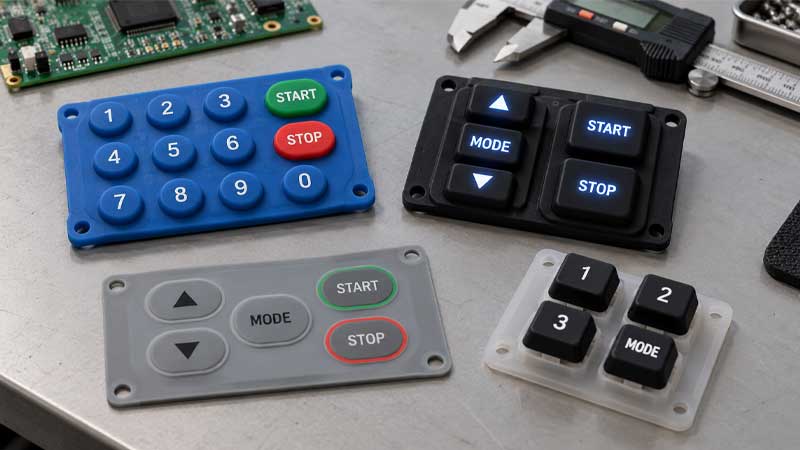
Silicone keypads can look similar while working very differently inside a product. This guide shows how to choose the switching method, key feel, lighting and surface finish that fit your device, then what to confirm before tooling.
There is no single list of mutually exclusive silicone keypad types. A keypad with carbon contacts can also be tactile, backlit and PU coated. The useful way to classify it is by what each choice does: the underside triggers the circuit, the key structure sets the feel, and the top surface controls identification and wear. The housing and circuit complete the assembly.
Conductive-contact silicone keypads
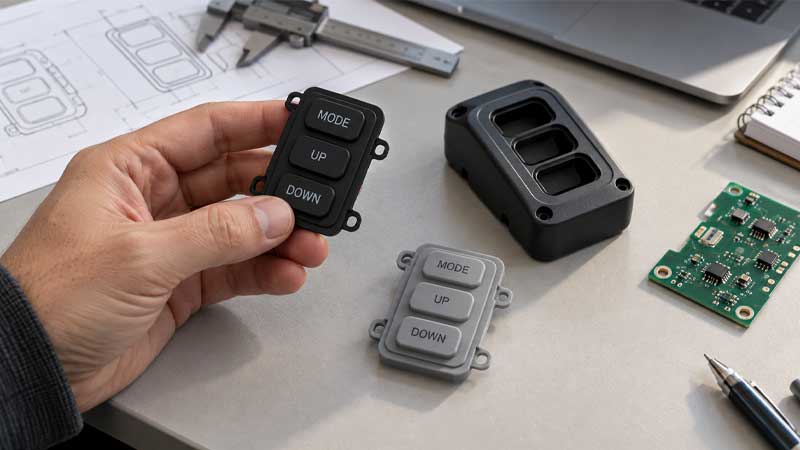
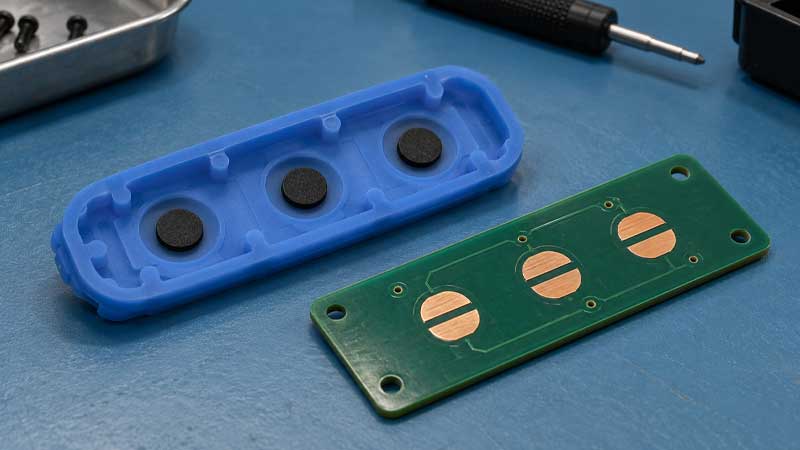
In a conductive-contact keypad, a carbon pill or another conductive feature on the underside bridges pads on the PCB when the key moves down. This can make a compact, quiet switch array. The rubber web around the key may also provide the tactile snap. Contact material alone does not guarantee a particular feel.
Choose this construction when the silicone key itself should carry the contact that closes PCB pads. Define the pad geometry, surface finish, contact resistance target and minimum contact force together. A carbon pill can be paired with a tactile web, backlit legend or protective finish; conductivity describes the switching interface, not the entire keypad. See our conductive silicone keypads page for the product configuration.
Nonconductive silicone actuator keypads
A nonconductive silicone actuator instead pushes a metal dome, tactile switch or other separate switching element. The switch beneath the rubber supplies the electrical closure and may supply most of the click. This route is useful when the circuit architecture or a crisp, short response favors a separate switch, but the total stack height, alignment and support must be checked.
Here, the silicone supplies a shaped button and motion, while a separate component performs the switching. Confirm the actuator tip, dome or switch position, PCB support and available travel in the assembled product. This category can also be backlit or coated.
Tactile and low-force silicone keypads
A tactile silicone key has a thin web that bends and then collapses as the key is pressed. That change in resistance produces a perceptible snap. Web geometry, key size, silicone hardness, travel and the switch below all affect the force curve. A softer or quieter key can be deliberate, especially for frequent inputs; it is not automatically a lower-quality key. For a dedicated configuration, see low-force silicone keypads.
For many conventional rubber keys, 40–60 Shore A silicone and a 40–60% snap ratio are useful starting points. Snap ratio is the drop from peak force to contact force divided by peak force. Around 125–150 gf (about 1.2–1.5 N) is one common initial target for a clear rubber-web feel, not a universal specification. Larger keys, gloved operation, accidental-press risk and high-cycle use can move the target. A metal dome changes the force curve, so do not apply the rubber-web ratio to the complete assembly without measuring it.
Ask users to try samples in the real mounting stack. A keypad that feels crisp on a bench can feel weak when the enclosure flexes or the PCB sits too far away. Compare peak force, contact force, return force and travel on the assembled device. Our tactile silicone keypads page covers the product configuration; this article keeps the focus on the selection decision.
Backlit silicone keypads
For low-light use, translucent silicone can pass light from LEDs below the keypad. A common backlit construction uses an opaque surface layer with laser-removed legend areas so the icon lights up while the surrounding key stays dark. LED placement, wall thickness, light-blocking coverage and circuit layout determine whether the legends are even and free of distracting hot spots. See our backlit silicone keypads options for the dedicated product route.
Backlighting is an optical feature, not a separate contact method. A backlit keypad may use a carbon contact or push a metal dome. Check the assembled panel in daylight and darkness: the icon must remain readable when the LEDs are off, and light should not spill through unintended areas when they are on. For the legend-making process, see laser-etched silicone keypads.
Printed and coated silicone keypads
For an unlit interface, molded color and printed legends may be enough. Multi-color silicone keypads can separate functions without relying on printed color alone. Screen printing suits flat or gently curved keytops and multi-color artwork; pad printing transfers legends onto more curved or irregular surfaces. Both need a wear plan when keys are pressed or cleaned often.
PU coating can protect printed or frequently touched keys. Epoxy-coated silicone keypads use a raised, glossy keytop. Neither finish automatically withstands every cleaner or bend radius. Select the coating against the actual cleaning agents, UV exposure and key deformation, then test adhesion and legibility after repeated presses. Our PU coated silicone keypads page covers that finish in more detail.
P+R Plastic Rubber Keypads
A plastic cap mounted over a silicone key gives the operator a rigid touch surface while the silicone below supplies elastic movement. Graphics can sit behind a transparent cap for protection, and the cap can change the product’s appearance and feel. The trade-off is another part and another interface to control: attachment, clearances, key travel and assembly cost all need review. Our article on plastic-and-rubber keypad construction discusses this combination.

Compare the types at a glance
| Choice | What it changes | Good starting fit | Check before tooling |
| Carbon-contact silicone | Rubber-mounted contact closes PCB pads; web can provide snap | Compact, quiet multi-key controls | PCB pad finish, contact force and resistance |
| Silicone actuator over dome or switch | Separate component closes circuit and can create the click | Shorter or crisper switch response | Stack height, alignment and support |
| Soft or low-force rubber web | Changes effort and feedback through web design | Frequent inputs and quiet interfaces | False presses, return force and life |
| Laser-etched backlit keypad | Translucent path and opaque mask reveal lit icons | Low-light identification | LED position, light bleed and daytime contrast |
| Printed and coated keypad | Protects or decorates exposed legends and keytops | High-touch or cleaning-intensive use | Coating adhesion, flexing and chemical exposure |
| Plastic-cap-over-silicone | Rigid keytop over elastic silicone structure | Hard touch surface or protected graphics | Cap retention, clearance and assembly cost |
The rows describe design choices, not six exclusive finished products. A control panel could combine carbon contacts, a tactile web, backlit legends and a protective coat. Conversely, a molded silicone overlay can act on metal domes without any conductive material in the rubber.
Match the combination to your product
Start with the electrical interface and the operator. A remote control pressed with bare fingers, a gloved machine control and a frequently cleaned medical instrument may all use molded silicone, but they call for different force, contact and finish decisions.
For a handheld remote with many frequently used keys, begin with a molded silicone array and decide whether carbon contacts can interface directly with the PCB. Tune force and travel for quick, comfortable input; add printed legends where lighting is unnecessary. If the device is used in a dim room, design a backlit legend stack and check both night visibility and daytime contrast.
For industrial equipment used with gloves, key spacing, height and a distinct force curve matter more than the softest possible press. Confirm that the housing supports the keypad and that a side press still registers the intended key. If dust or splashes are expected, review waterproof silicone keypad options and design the perimeter seal and assembly compression together. The silicone part by itself does not establish an IP rating for the finished device.
For a device wiped down repeatedly, prioritize a cleanable key shape and a documented list of cleaning agents. Printed legends may need a protective finish or another marking approach. Test coating adhesion and legibility after both chemical exposure and repeated presses. A medical use case does not by itself establish any material certification or finished-device approval.
Define the requirements before tooling
A useful first brief includes the key layout and enclosure drawing, circuit type and PCB pad pattern, target peak force and travel, desired feedback, operating frequency, lighting and artwork, cleaning agents, temperature and moisture exposure, and the intended assembly method. State any required device-level ingress or regulatory tests separately from keypad material properties.
A prototype should be checked in the complete device for force and travel, reliable electrical actuation, key wobble, legend readability, light uniformity if present, and fit at the perimeter. Cycle testing should reflect the expected operating force, duty and environment. For a deeper treatment of dimensions and fit, use the silicone keypad design guide.
Which type should you choose?
Choose the contact architecture first, then set the press feel, and finally add the lighting and surface treatments the product actually needs. The best answer may combine several of these choices.
If you share the device layout, circuit and use conditions, SKF can review a practical silicone keypad construction and the samples needed to confirm it before production.