Cured silicone rubber does not melt and flow like wax or a thermoplastic. Heat can still make a silicone part unusable. The useful question is how long the finished part can retain the properties its job requires at a given temperature.
Does cured silicone have a melting point?
For the silicone rubber used in bakeware, seals, tubing and molded parts, there is no practical melting point at which a cured part becomes a liquid that can be molded again. During curing, chemical links join the polymer chains into a network. Heating does not simply undo those links. The silicon–oxygen backbone helps silicone tolerate heat; the crosslinked network explains why the cured rubber does not flow like a thermoplastic.
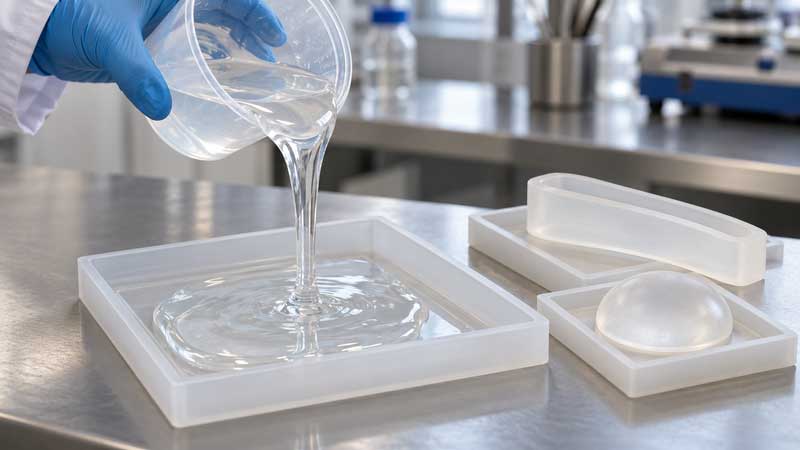
The word silicone also covers materials supplied as liquids, including silicone oils and uncured liquid silicone rubber (LSR). LSR flows before it cures. A finished LSR part is a cured elastomer, not a liquid waiting to be melted. Similarly, silicone sealant is dispensed as a paste and then cures; its initial flow is not evidence that cured sealant can be remelted.
Silicone is also different from silicon, the chemical element used in electronics. Silicon has a melting point of 1,414°C. That number does not describe silicone rubber.

What happens when silicone gets too hot?
Silicone may hold its shape well past the temperature at which its useful properties begin to decline. With enough heat and time, it can become harder, less elastic or brittle. A seal can lose contact pressure; a flexible button or diaphragm can change its feel or fail to recover. A part can also deform under load without having melted.
There is no single temperature at which every silicone rubber compound fails. The table gives a practical reading of published supplier guidance, not a rating for an unidentified product.
| Heat exposure | What it means for cured silicone rubber | What to check |
| Around 100°C / 212°F, such as boiling water at normal pressure | Below the published upper service temperatures of many silicone rubbers; the material itself should not melt. | The actual product rating, other components and exposure time. |
| Around 180–200°C / 356–392°F for long periods | A useful starting range for reviewing general-purpose grades, but property retention depends on the compound and duration. | Continuous-service rating and heat-aged hardness, strength and elongation. |
| Around 230°C / 446°F | Some specific compounds are rated for continuous use here; others will age too quickly for the intended life. | The named compound’s data and the required service life. |
| Around 250–300°C / 482–572°F for short peaks | Specialty compounds may tolerate limited excursions. This is not a general continuous-use rating. | Peak duration, number of cycles and performance after exposure. |
For context, WACKER’s silicone rubber guide describes only slight property changes up to about 180°C for its materials while listing broader operating ranges that include higher temperatures. Silicone Engineering reports 230°C continuous service for its general-purpose grades and 300°C intermittent exposure for one high-temperature grade. Those figures differ because the formulations and permitted exposure differ. They should not be combined into one universal “silicone melting temperature.”
Temperature also interacts with load. A gasket held compressed in hot equipment may lose sealing force through compression set, which is the deformation left after prolonged compression. For that gasket, surviving the temperature without visible damage is not enough. It must still seal after the planned operating time.
Will silicone melt in boiling water, an oven or a flame?
Boiling water: At normal pressure, water boils near 100°C. A properly cured silicone rubber part will not melt in it. Check the finished product’s instructions when it includes adhesive, printing, a plastic handle or another material. Hot water may also affect a seal’s service life if it is held under pressure for a long time.
Oven: A silicone baking mat or mold may be suitable for an oven when the manufacturer rates that specific product for the intended temperature and use. The oven’s set temperature is only part of the exposure. Contact with a heating element, broiler or hot pan can create a much hotter local spot. Discoloration, cracking, loss of elasticity or a persistent change in shape calls for inspection and usually replacement of a food-use item.
Direct flame: “Does not melt” does not mean flameproof. Flame and very hot surfaces can damage silicone rapidly, and overheated material can release fumes. Do not use ordinary silicone parts in direct flame or fire protection applications unless the particular product is specified and tested for that duty. A temperature rating alone does not establish a fire performance rating.
Why might silicone look melted or feel sticky?
A sticky or softened surface does not prove that cured silicone melted. The part may contain uncured material, may have been incompletely cured, or may use a formulation that deteriorates under the exposure. In some condensation-cure moldmaking systems, WACKER documents cure reversion under unsuitable elevated-temperature curing conditions, leaving material tacky or liquid-like. That specific behavior should not be assumed for every silicone product.
The apparent “melt” may also be a coating, adhesive, thermoplastic insert or residue on the silicone. Identify which layer changed before changing the silicone specification. If a working part has become tacky, cracked or permanently distorted, remove it from service and investigate the material, cure and actual contact temperature.
Can you melt and remold silicone?
Once silicone rubber is cured, ordinary heat cannot turn it back into moldable feedstock. Uncured HCR or LSR can be shaped and then cured into a new part; cured offcuts cannot be fed through a standard thermoplastic remelting process. Specialized recycling routes may recover value from silicone waste, but they involve different mechanical or chemical processing.
This distinction matters when comparing manufacturing options. A thermoplastic elastomer (TPE) can be processed by heating and cooling, whereas silicone rubber requires a curing step. The choice affects tooling, scrap handling and the heat behavior of the finished part.
How should you specify silicone for heat exposure?
Start with the component’s job, then ask for a grade and test data that match it:
- Record the continuous operating temperature, short peaks and time spent at each temperature. Measure at the part, especially near heaters or hot metal.
- Define the failure limit. A seal may need to retain compression recovery; a button may need to keep its force and return; a tube may need to retain flexibility and strength.
- Include load and environment. Compression, repeated movement, hot water, oil or chemicals can change the result even when temperature is the same.
- Review the supplier’s data for the specific compound, then test a finished part under representative exposure. ASTM D573 provides a method for assessing heat aging of rubber; ASTM D395 addresses compression set. Neither test alone guarantees service life in an assembled product.
The deciding number is the temperature at which the required function survives for the required time, not a supposed melting point.
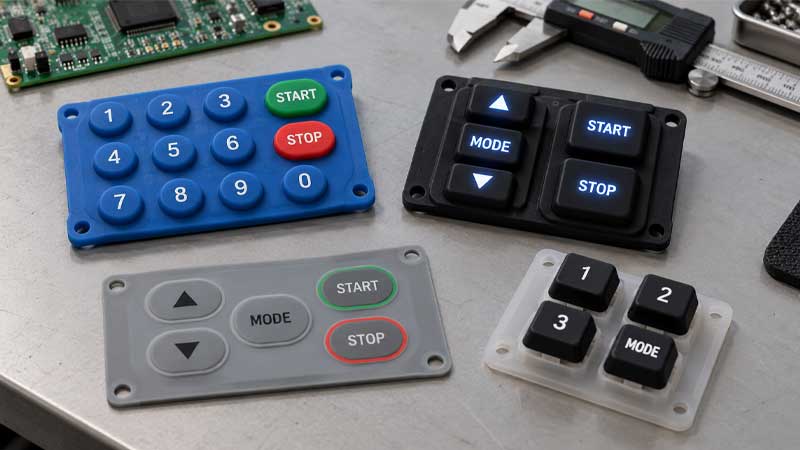
If you are specifying a molded silicone keypad or other flexible component near a heat source, share the temperature profile, exposure time and required force or sealing performance with SKF so the material and finished-part tests can be chosen for the actual application.