Silicone and latex are both used to make flexible products, but they are not the same material. This comparison explains where silicone rubber and natural-rubber latex differ in performance, what “latex” means in a finished product, and how to choose between them for a defined application.
The short answer
Silicone rubber is often a useful starting point when a part must tolerate heat, outdoor exposure or a requirement to avoid natural-rubber-latex proteins. Natural rubber can be a better candidate when high resilience, stretching or abrasion resistance matters and heat, ozone and oil exposure are controlled. The best choice still depends on the specific compound, part geometry and service conditions.
| Selection factor | Silicone rubber | Natural rubber made from latex | What to check |
| Heat and weather | Generally better suited to a broad temperature range and prolonged ozone or UV exposure | Generally has a narrower heat range and needs protection against ozone and weathering | Continuous and peak temperatures; exposure time; deformation under load |
| Repeated movement and wear | Can flex repeatedly, but tear and abrasion vary strongly by grade | Often offers high resilience and good tear and abrasion resistance | Strain level, sharp edges, rubbing surfaces and cycle target |
| Natural-latex allergy | The silicone polymer does not contain natural-rubber-latex proteins | Residual proteins may matter for users with latex allergy | Intended skin contact and declarations for the entire product |
| Petroleum oils and fuels | General-purpose grades may swell or lose properties | General-purpose grades are usually poor choices too | Exact fluid, temperature, concentration and contact time |
| Finished-part cost | Compound and processing may cost more | Can be economical where its service limits fit | Tooling, yield, inspections, service life and replacement cost |
These are material-family tendencies, not guarantees for every product. A supplier’s data sheet and a test on the finished part take priority over a broad comparison table.
What materials are being compared?
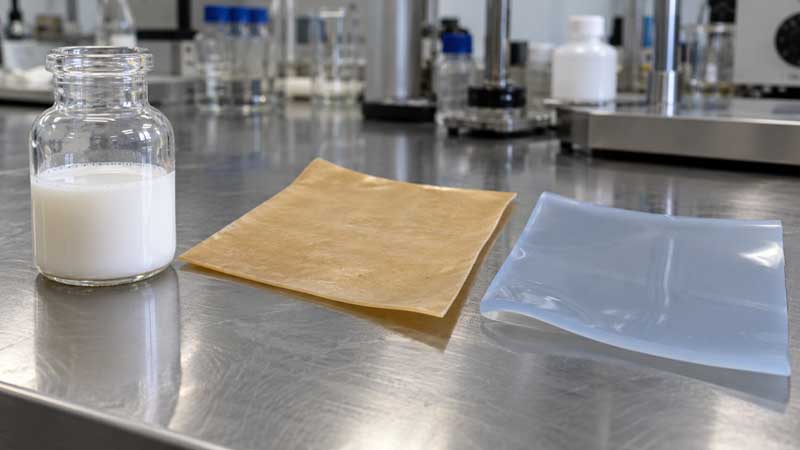
Natural rubber latex is the milky dispersion collected from the rubber tree, Hevea brasiliensis. It can be processed into thin dipped goods or converted into solid rubber for other manufacturing routes. After curing, the main elastic polymer in the finished natural-rubber part is polyisoprene. Comparing liquid latex directly with a cured silicone part can obscure a major difference in product form and process.
Silicone rubber is a synthetic elastomer whose polymer backbone contains alternating silicon and oxygen atoms. Its chemistry helps explain its heat and weathering behavior, although fillers, curing and part design still control actual performance. Silicone rubber is an elastomer; it is not natural rubber latex.
Latex can also mean a synthetic polymer dispersion, such as one used in paint or acrylic-latex caulk. That is a different comparison. Here, latex refers to natural-rubber latex and products made from it, unless stated otherwise. NIOSH notes that some synthetic rubbers are also called latex but do not release the natural-latex proteins responsible for natural-rubber-latex allergy.
How do silicone and natural rubber perform?
Heat, cold and outdoor exposure
A material choice must cover the temperature at the part, not just the ambient air. As broad initial screening references, general silicone rubber is often discussed around −50°C to 200°C, while natural rubber is commonly discussed around −40°C to 80°C. These are not operating ratings for every compound or finished product. A supplier’s stated limits may be narrower or wider, and the allowable range may change under load or prolonged exposure.
Heat can accelerate aging in natural rubber, changing stiffness, strength and recovery. Ozone can cause surface cracks, particularly where a natural-rubber part remains stretched. Silicone rubber generally tolerates weather and ozone better. That favors silicone for a sun-exposed flexible cover or outdoor seal, provided its mechanical strength and the rest of the assembly also meet the requirement. An indoor component with severe rubbing may lead to a different choice.
Elasticity, tear and abrasion
Both materials can stretch and recover, but “more elastic” does not tell a designer how long a part will last. Natural rubber often combines strong rebound with good tear and abrasion resistance. Those qualities can matter in vibration mounts, dynamic rubber parts and surfaces that rub against other components.
Silicone rubber can also support repeated flexing, but its tear strength and abrasion resistance vary substantially by formulation. A thin edge or notch can start a failure even when a bulk tensile test looks acceptable. For a flexing part, compare tensile and tear data for the proposed compounds, then test prototypes at the intended strain, frequency, temperature and number of cycles. For a seal held under compression, compression set may be more useful than a rebound figure.
Oils, chemicals and cleaning
Neither material is universally “chemical resistant.” Many general-purpose silicone and natural-rubber compounds are poor candidates for prolonged contact with petroleum oils or hydrocarbon fuels. Fluids may cause swelling or change strength and sealing force. Where oil exposure is the main requirement, another qualified elastomer may be more suitable; the SKF comparison of silicone and other rubbers provides a broader starting point.
Cleaning and sterilization claims need similar care. A rubber part may survive one wipe yet degrade after repeated exposure to a concentrated cleaner, heat or steam. Specify the actual fluid, concentration, temperature, contact time and cleaning frequency. Test changes in mass, dimensions, hardness and function after the intended exposure.
Natural-latex allergy and skin contact
Natural-rubber latex can contain proteins that trigger allergic reactions in sensitized people. Silicone polymer does not contain those natural-latex proteins, but that does not prove that an entire assembled product is “latex-free.” Other components, adhesives, packaging or production materials may be relevant, and skin reactions can have causes other than natural-latex proteins.
If a product needs a natural-latex statement, collect material declarations for the relevant components and decide the claim at product level. For medical products, the FDA recommends wording such as “not made with natural rubber latex” rather than an unqualified “latex-free” claim. That guidance addresses medical-product labeling; it does not establish that any particular silicone grade is medically suitable.
Manufacturing route and cost
Natural-rubber latex can be dipped to produce thin, continuous articles. Natural rubber can also be compounded and molded into solid parts. Silicone rubber is supplied in formulations suited to processes such as compression molding or liquid injection molding. The chosen route affects wall thickness, tooling, tolerances, surface finish and feasible production volume.
Natural rubber may be less expensive in a suitable general-purpose part, but raw-material price alone is a weak purchasing measure. Compare the cost of the finished, qualified part, including tooling, scrap, inspection, expected service life and replacement. A cheaper compound is not economical if it fails early in the intended environment.
Which material suits which application?
For thin, highly stretchable dipped goods, natural-rubber latex is an established process material. The product still needs appropriate controls for latex proteins, aging and its intended use. Silicone may suit a similar function through a different grade and manufacturing process, but the same geometry or tooling should not be assumed.
For dynamic parts facing rubbing or repeated deformation, a suitable natural-rubber compound can offer useful rebound and wear performance where heat, ozone and oils are limited. A silicone grade may be preferable if environmental exposure dominates; evaluate tear, abrasion and fatigue for the actual part.
For outdoor covers, flexible seals or components near heat, silicone is often the stronger starting candidate. A seal also needs the right compression, mating surface and long-term recovery. If the part instead has persistent contact with petroleum oil or fuel, neither ordinary silicone nor natural rubber should be chosen without fluid-compatibility evidence.
These examples illustrate different failure priorities. They do not turn either material into a universal substitute for the other.
What should you specify and test before production?
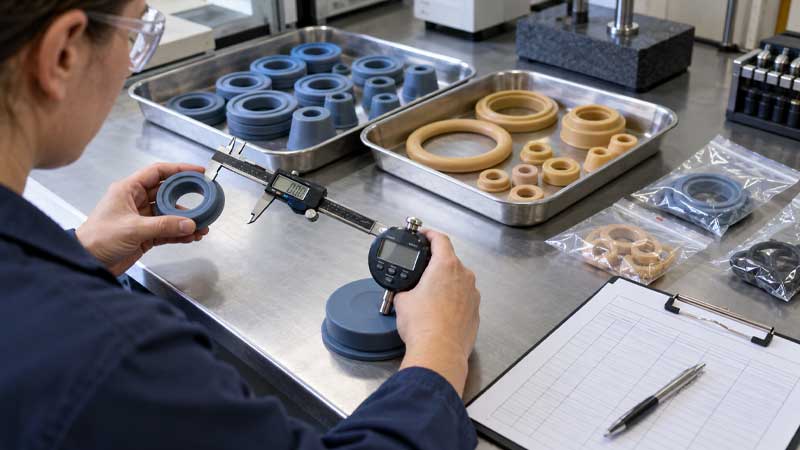
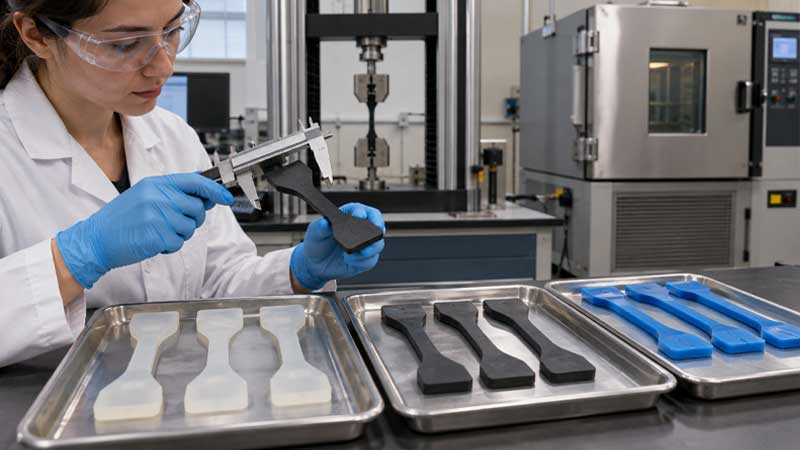
Begin with a drawing or dimensions and a short description of the part’s job. Give the supplier the minimum, continuous and peak temperatures; UV or ozone exposure; fluids and cleaning agents; skin contact; mechanical movement or compression; expected life; and any applicable product requirements. Ask for the specific compound grade and manufacturing process, rather than “silicone” or “latex” alone.
| Specification | General reference or method | Design consideration |
| Service temperature | Silicone rubber: about −50°C to 200°C; natural rubber: about −40°C to 80°C for initial screening | Confirm the compound’s limits at the actual load and exposure duration |
| Tensile and elongation | ASTM D412 is one common test method | Compare the same method and test conditions; test the finished geometry |
| Tear resistance | ASTM D624 is one common test method | Review notches, thin walls and assembly stress |
| Compression set | ASTM D395 is relevant to compressed rubber parts | Specify compression, temperature, time and recovery before comparing values |
| Fluids and cleaning | No universal numerical range | Use the actual medium and exposure cycle |
| Allergy or contact declaration | Application-specific | Cover the relevant finished assembly and intended claim |
ASTM’s rubber standards catalog identifies these methods. A test-method number is not a pass criterion: the project must define acceptable changes in strength, dimensions, function or appearance. Prototype and finished-part tests should reproduce the most likely failure conditions.
Conclusion
Choose silicone rubber first when temperature range, weathering or avoidance of natural-rubber-latex proteins drives the design. Consider a suitable natural-rubber compound when resilience and wear are more important under controlled exposure. In either case, confirm the compound, manufacturing route and finished-part performance before production.