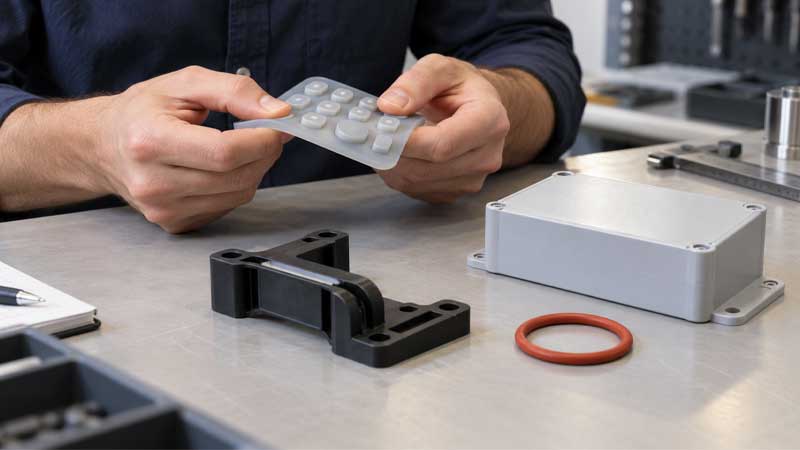
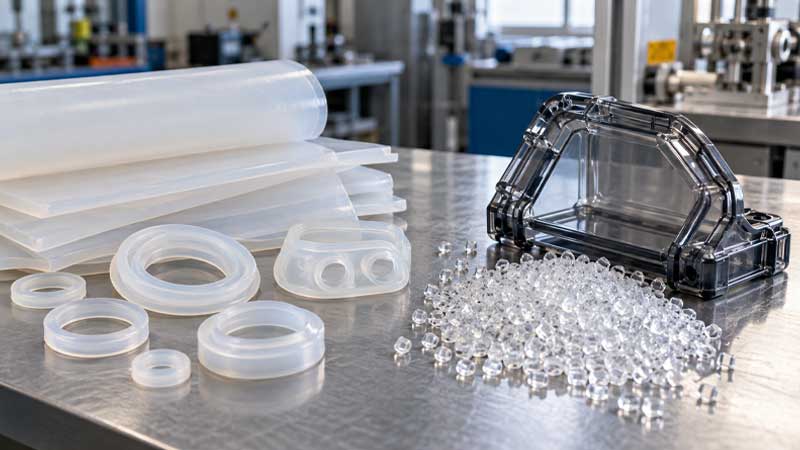
Silicone keypads are widely used for electronic controls because they combine flexible silicone construction with reliable tactile switching. However, silicone itself is electrically insulating. Conductive contacts are therefore needed when silicone keys activate PCB or FPC circuits.
Carbon pills are one of the most common conductive contact solutions for silicone keypads. Positioned under keys, carbon pills move with silicone buttons and bridge two conductive traces when keys are pressed. This simple structure creates the electrical connection needed to register button presses.
For custom silicone keypad projects, carbon pills should not be treated as isolated components. Their diameter, thickness, resistance, position, PCB contact pattern, key travel, and silicone web geometry all affect switching reliability.
What Are Carbon Pills and How Do They Work in Silicone Keypads?
Carbon pills are small conductive elements molded into or integrated with the undersides of silicone keypad buttons. They are usually made from silicone rubber containing conductive carbon material. The carbon reduces electrical resistance in the elastomer and allows current to pass through the contact when compressed against the circuit.
Carbon pills are also called conductive carbon pills, carbon contacts, conductive pills, carbon pads, graphite pills, or carbon pucks. The exact terminology varies between manufacturers.
Where Are Carbon Pills Located?
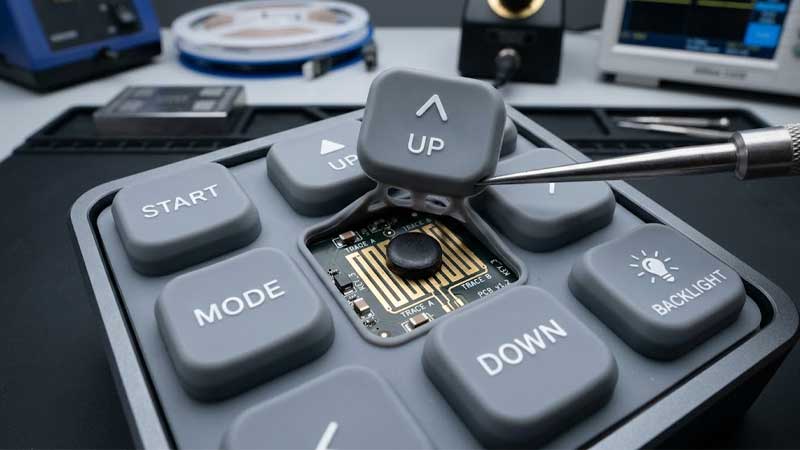
In typical silicone keypad designs, carbon pills sit below key centers. The basic structure can be understood as:
Keycap → Silicone Web → Carbon Pill → PCB Contact
Carbon pills provide the electrical contact needed for silicone keys to activate PCB or FPC circuits, while silicone webs control most of the mechanical movement and tactile response.
How Do Carbon Pills Create Electrical Contact?
The switching process begins when users press silicone keys. Force transfers through key centers to silicone webs, causing the webs to deform and move carbon pills toward PCB contacts.
As keys continue moving, silicone webs bend or buckle around buttons, creating the characteristic tactile response of elastomeric keypads.
When carbon pills reach PCBs, conductive surfaces bridge two separated contact traces and create electrical paths. This changes circuits from open states to closed states, allowing electronic systems to detect key presses.
Interdigitated or separated PCB contact patterns are commonly used to support this switching method.
How Do Carbon Pills Reset After Key Release?
When users release keys, silicone webs return toward their original positions. Carbon pills move away from PCBs, opening circuits again.
This repeated movement makes carbon pill position, silicone web geometry, PCB alignment, and contact force important for long-term switching reliability.
How Do Carbon Pills Affect Silicone Keypad Feel?
Carbon pills provide the electrical switching function, but they do not determine complete tactile responses by themselves. Actuation force, key travel, snap ratio, web thickness, web angle, and silicone hardness are primarily controlled by the mechanical design of the keypad.
However, carbon pill dimensions and position can influence contact timing and the mechanical stack beneath each key. For custom keypad designs, electrical contact requirements should therefore be evaluated together with tactile and mechanical requirements.
What Are Carbon Pills Made Of?
Carbon pills generally use silicone rubber matrices combined with conductive carbon materials. Carbon creates conductive paths through elastomers, while silicone provides the flexibility and mechanical characteristics needed for rubber keypad contacts.
The exact formulation is not universal. Carbon loading, silicone formulation, hardness, molding process, and conductive performance can vary between manufacturers and product grades.
This formulation directly affects electrical resistance and mechanical behavior. Carbon pills intended for standard remote controls may not have the same resistance specifications as low-resistance contacts used in more demanding electronic interfaces.
For this reason, engineers should specify required contact resistance under defined test conditions instead of selecting carbon pills based only on appearance or nominal material descriptions.
Carbon Pill Size, Shape, and Contact Resistance
Carbon pill dimensions are important because conductive contacts must match PCB layouts and available space under silicone keys.
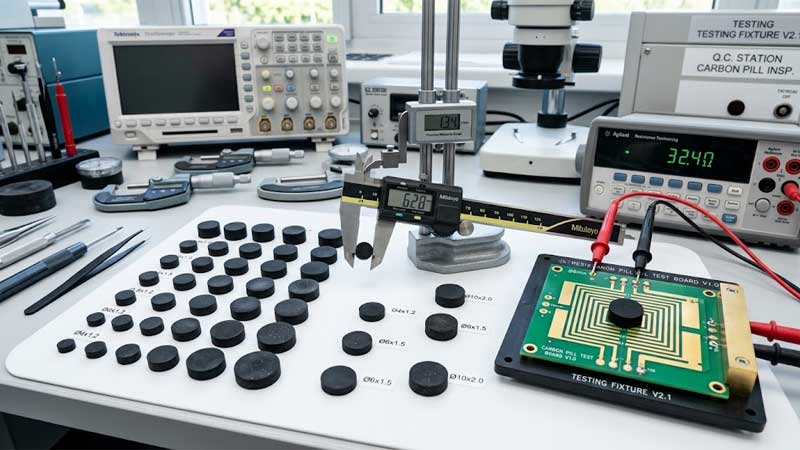
Round carbon pills are common. Industry supplier data shows typical diameters ranging from approximately 2 to 8 mm, while other design guides list broader ranges depending on application and supplier. Thickness is also application-specific, with around 0.5 mm appearing as a common reference value in some silicone keypad designs.
Actual specifications should be determined by complete keypad structures rather than generic standards.
Carbon Pill Diameter
Larger pills can provide more contact area and greater tolerance to positional variation. However, pills cannot simply be enlarged without considering neighboring contacts, key spacing, housing clearance, and PCB patterns.
The relationship is essentially:
Carbon Pill Diameter + PCB Pad Size + Position Tolerance = Reliable Contact Area
If pills are too small, minor alignment errors may cause intermittent switching. If pills are too large, they can reduce electrical spacing or interfere with nearby contacts.
Carbon Pill Thickness
Thickness affects mechanical stacks and contact timing. It can influence key travel, clearance, compression, and the point at which circuits close.
Therefore, carbon pill thickness should be considered together with silicone webs and total button travel.
Contact Resistance
Contact resistance is one of the most important electrical specifications.
Published manufacturer data varies significantly. Some carbon pill products specify resistance below 20 Ω, while other common carbon pill designs are specified below 100 or 200 Ω under defined test conditions.
There is therefore no single resistance value that applies to every carbon pill.
The correct target depends on conductive formulation, contact force, PCB surface, circuit requirements, and application. Engineers should define resistance requirements together with actual test methods and operating conditions.
How Are Carbon Pills Integrated Into Silicone Keypads?
Carbon pills can be integrated into silicone keypads during molding processes. In common manufacturing approaches, pre-formed conductive pills are positioned in molds before silicone molding. Positioning fixtures or jigs help place pills accurately under corresponding keys. During molding and vulcanization, carbon pills become integrated with silicone keypads.
This process requires accurate control of several variables.
Carbon pills must be placed at correct locations. Silicone must form secure connections around contact areas. Pills must remain stable during molding. Finished keypads must also maintain specified contact geometries after demolding.
As a silicone keypad manufacturer, SKF engineers review carbon pill placement during tooling and DFM stages rather than treating conductive contacts as separate issues after keypad designs are completed.
This approach helps identify potential problems with pill positioning, key travel, mold structure, and PCB alignment before mass production.
Carbon Pill and PCB Contact Design
Carbon pills only work reliably when PCB contacts are designed to match them.
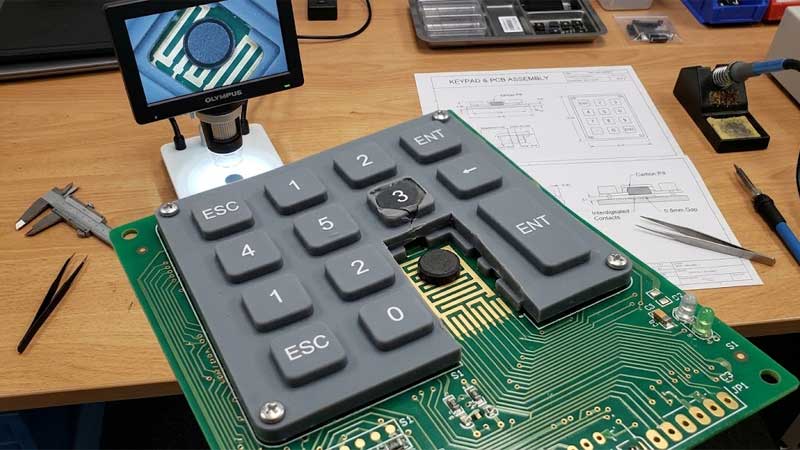
PCBs normally contain two conductive areas that are separated when keys are not pressed. Carbon pills bridge these areas when buttons are actuated. Contact patterns, surface finishes, spacing, and pad dimensions therefore have direct influences on switching performance.
PCB Contact Pattern
Interdigitated contact patterns are commonly used for rubber keypad switching. Carbon pills contact multiple portions of conductive patterns as they move downward.
Designs should provide enough contact area while maintaining adequate electrical separation between two traces.
Pill-to-Pad Alignment
Carbon pills and PCB pads should be designed as one system.
Designs need to account for:
- Carbon pill diameter
- PCB contact size
- Contact gap
- Key center position
- Molding tolerance
- Assembly tolerance
- Housing tolerance
Keypads can have excellent carbon materials and still produce intermittent switching if pills do not land correctly on PCBs.
Some design guides recommend making PCB shorting pads larger than carbon pills to provide additional positional tolerance. Exact ratios should follow manufacturers’ design rules and tolerance stacks of actual products rather than being treated as universal specifications.
PCB Surface Finish
PCB surface finish also matters. Gold-plated and nickel-based contact surfaces are commonly used for rubber keypad interfaces because contact surfaces need to remain stable through repeated operation.
For new projects, PCB finishes should therefore be discussed during keypad design instead of being finalized independently.
Carbon Pills vs. Conductive Ink, Metal Pills, and Metal Domes
Carbon pills are not the only way to create electrical contacts in silicone keypads.
| Contact Method | Main Advantage | Main Consideration |
| Carbon Pill | Cost-effective, durable, established design | Higher resistance than some metal contacts |
| Conductive Ink | Flexible shapes and thin contact layer | Resistance and wear require process control |
| Metal Pill | Very low electrical resistance | Higher material and manufacturing cost |
| Metal Dome | Strong click and tactile response | Different mechanical structure |
Carbon pills are widely used because they combine conductive performance with the flexibility and manufacturing compatibility of silicone. Conductive carbon printing can be useful when special contact shapes or thin structures are required. Metal or gold conductive pills can be selected when lower resistance targets are needed.
Metal domes are different solutions. They can provide distinct click responses while also functioning as electrical switching elements. They should therefore be evaluated as different keypad architectures rather than simply as lower-resistance replacements for carbon pills.
Common Carbon Pill Problems in Silicone Keypads
Carbon pill failures are often related to interactions between mechanical and electrical designs.
Carbon Pill Misalignment
If pills do not align with PCB contacts, conductive areas may not bridge both traces correctly. Results can include intermittent activation or complete key failure.
Insufficient Contact Force
Pills need sufficient pressure against PCBs to create stable electrical contacts. Incorrect web geometry, excessive clearance, or insufficient key travel can prevent reliable switching.
Excessive Contact Resistance
Carbon pills with unsuitable resistance may not meet electrical requirements of controllers or circuits. Resistance should be checked under appropriate production and operating conditions.
Surface Contamination
Dust, oil, molding residue, or other contamination at contact interfaces can affect switching reliability. Clean handling and appropriate PCB/contact specifications are therefore important.
Poor Pill Bonding
If carbon pills are not properly integrated with silicone keypads, movement or separation can occur during use. Molding conditions and pill positioning need to be controlled during production.
These examples show why electrical problems cannot always be solved by changing carbon materials alone. Complete systems include carbon pills, silicone webs, PCB contacts, mechanical travel, alignment, and assembly tolerances.

How Are Carbon Pill Silicone Keypads Tested?
Testing should cover both electrical and mechanical performance.
Electrical validation can include contact resistance and continuity testing. Tests should use defined voltage, current, contact force, and measurement methods so results are meaningful and repeatable.
Mechanical validation can include actuation force, key travel, tactile response, return behavior, and life-cycle testing. Carbon pill products are often selected for applications requiring repeated operation, and some industry sources report life expectations exceeding millions of actuations under specified conditions.
Dimensional and visual inspection is also important. Engineers can check carbon pill diameter, thickness, position, bonding condition, and finished keypad geometry.
SKF engineers can validate carbon pills together with complete keypad structures. This helps identify whether electrical failures originate from conductive materials, contact geometry, mechanical travel, or assembly alignment.
When Should You Choose Carbon Pills for a Silicone Keypad?
Carbon pills are strong choices when projects require proven conductive contacts for silicone keypads, especially when durability, cost, flexible keypad geometry, and reliable repeated switching are important.
They are commonly used in products such as remote controls, calculators, industrial controls, medical equipment, handheld electronics, and other electronic interfaces.
Carbon pills may not be the best option for every application. Projects requiring extremely low contact resistance may benefit from metal or gold contacts. Designs requiring particular click responses may be better suited to metal domes. Very thin or unusually shaped contacts may make conductive printing worth considering.
The right solution depends on complete electrical and mechanical requirements.
How SKF Designs Carbon Pill Silicone Keypads
For custom silicone keypads, SKF engineers evaluate conductive contacts as part of complete product designs.
The process starts with keypad drawings, PCB or FPC layouts, operating environments, and electrical requirements. SKF then reviews carbon pill diameter, thickness, position, resistance targets, key travel, web geometry, and PCB contact dimensions.
During prototype validation, the focus is not only on whether buttons can activate circuits. The team also checks contact consistency, tactile performance, alignment, mechanical return, and long-term reliability.
This integrated approach helps reduce problems that may otherwise appear during assembly or mass production.

FAQ About Carbon Pills in Silicone Keypads
What Are Carbon Pills in Silicone Keypads?
Carbon pills are conductive silicone rubber contacts located under silicone keypad buttons. When keys are pressed, pills bridge two PCB traces and close electrical circuits.
What Are Carbon Pills Made Of?
Carbon pills are generally made from silicone rubber combined with conductive carbon materials. Formulations determine properties such as electrical resistance and mechanical performance.
What Size Is Typical for Carbon Pills?
Common round carbon pills are available in various diameters. Supplier specifications commonly show sizes around 2–8 mm, while broader ranges are also available. Correct sizes depend on PCB contact designs and keypad geometries.
Are Carbon Pills Better Than Conductive Ink?
Neither is universally better. Carbon pills provide defined conductive contacts and are widely used for durable silicone keypad applications. Conductive ink can be useful when custom contact shapes or thin contact layers are required.
Can Carbon Pills Be Customized?
Yes. Custom projects can specify pill diameter, thickness, shape, resistance, position, and other requirements according to keypad and circuit designs.
Conclusion
Carbon pills provide electrical switching functions in many silicone keypads, but reliable switching depends on more than conductive materials themselves.
Carbon pills, silicone webs, key travel, PCB contact patterns, resistance targets, alignment tolerances, and assembly structures must work together. For this reason, carbon pill specifications should be developed alongside silicone keypad and PCB designs.
For OEM and custom silicone keypad projects, early review of carbon pill and PCB interfaces can help prevent intermittent contacts, poor tactile performance, and production problems.