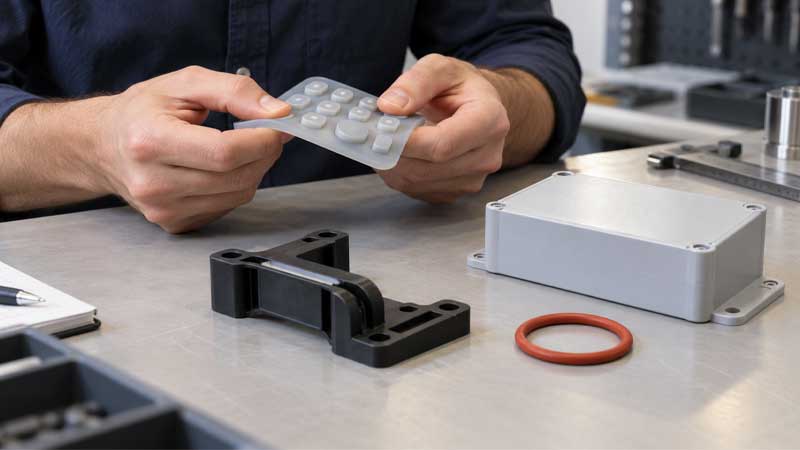
SKF provides wearables and smart gear with silicone rubber keypads as interactive buttons. These keypads are designed for space-saving compatibility in compact layouts or slim constructions. They offer real-time tactile responses and customized layouts for specific functionality. They also have precise dimensions for integration with circuits, backlights, and electronics.
In addition to engineering rubber keypads for large industrial control consoles, SKF focuses on balancing wearing comfort, operational experience, and custom user interfaces for your wearables, portable electronics, and consumer electronics projects.
How do silicone keypads improve the performance of wearables?
Flexible Silicone Rubber and Desired Shapes & Sizes Rubber Keypads
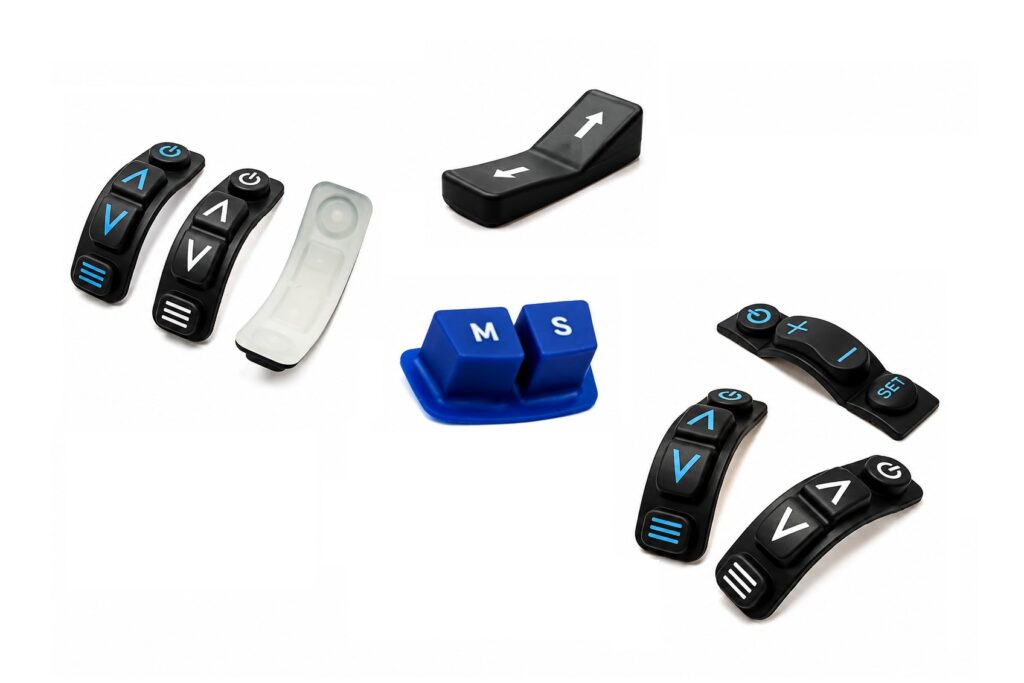
Flexible and elastic silicone rubber can be processed into low-profile, 3D-curved shapes with an ergonomic touch to fit the distinct surfaces of wearables or portable electronics. It can gently and naturally match the skin of humans.
Moreover, the slim design, achieved through injection or compression molding, offers space-saving and lightweight features for your devices.
Waterproof and Environmental Sealing
Wearables integrated with well-designed seals, gaskets, or waterproof silicone key mats create a barrier against moisture, dirt, and contamination. In terms of these electronics’ applications, stain and corrosion resistance are also essential to prevent material degradation, discoloration, and loss of elasticity.
Impact-Resistance
In combination with the aforementioned environmental and stain protection, impact absorption reduces damage to sensitive internal components, thereby improving the lifespan of wearables used for healthcare and sports monitoring. Silicone rubber naturally acts as a mechanical damper, absorbing vibrations and shocks.
Highly Design Flexibility
Silicone rubber supports dual-color and multiple-color buttons, as well as dual hardness demands and the design of physical buttons in slim wearable constructions, whether it’s the low-profile design integrated into wearable products or the bold, innovative appearance.
Integration with Silicone Rubber in Interaction of Wearable Electronics
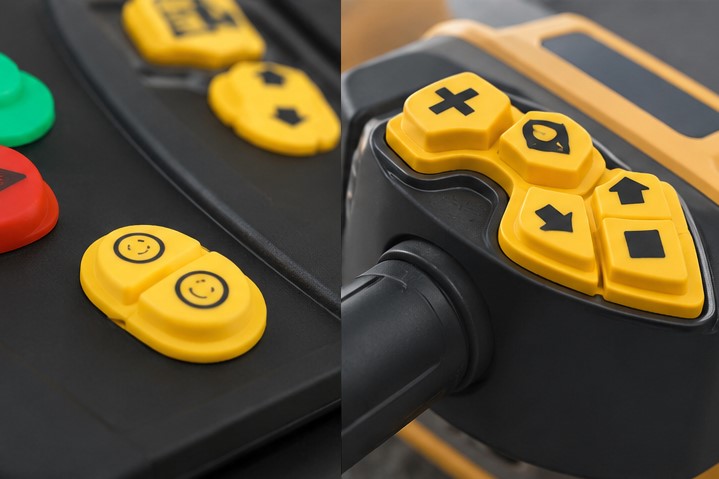
Customized Shapes and Sizes of Rubber Keypads and Silicone Buttons
Despite having flat circuit boards, user interfaces, and frames, wearable devices are usually designed to be small, portable, and ring-shaped. The interactive buttons, display, PCB, and other relevant electronic components should be bendable and flexible.
Additionally, silicone rubber keypads and single silicone buttons can be embedded in compact layouts to save space. They can also match the concave or convex shapes of curved skin and offer lightweight features and reliable performance.
Silicone rubber keypads integrated with FPC (Flexible Printed Circuit)
Wearables and some portable devices require stretchability and flexibility, as well as integration with FPCs (flexible printed circuits). Bendable FPCs and silicone keypads are embedded in these electronics.
Backlit and Glow-In-The-Dark Silicone Keypads in Wearables with Design Flexibility
In response to requests for improved visibility and user experience in low-light environments, backlit or glow-in-the-dark silicone keypads provide a flexible and energy-efficient solution. Light guides, adjustable transparency, and laser-etched graphics support your low-profile design and provide dead-front illumination for your wearable project.
Glow-in-the-dark rubber keypads and silicone buttons are processed with luminescent pigments to improve visibility in dark environments. You can find the buttons you need.
Hybrid User Interfaces in Wearables with Touch and Tactile
Some of our clients often combine a silicone keypad and a capacitive touchscreen to create a hybrid user interface. This combination provides smooth control with an easy touch and reliable physical buttons that offer a crisp tactile response for essential functions.
Key Profile Structure Design in Silicone Rubber Keypads
Different Types of Structural Key Profile
The following table shows the features of different structural designs, including high- or low-key profiles, key and cavity shapes, travel distance for activation, actuation force, lifetime, and applications in specific settings.
Standard Bell & Cone-Shaped Silicone Rubber Keypads
The distinct structures and shapes of the silicone keypads are visible. The “flat cone,” “single cone,” and “single bell” types are commonly used for standard rubber keypads, which have a classic elastic web and provide tactile feedback when the switch is activated.
Of these three types, the flat and single cone types have relatively poor stiffness and durability, while the single bell type is highly robust for long-term use. Furthermore, with proper processing, qualified silicone material, and structural design, single-bell rubber keypads can withstand around five million actuations.
Furthermore, the three standard elastomer keypad profiles differ in actuation force. Generally, the single-bell type requires the least force, the single-cone type requires moderate force, and the flat-cone type requires the most force.
Double-Bell & Double-Cone Silicone Rubber Keypads
There are two types of special keypad structures: double-bell and double-cone silicone keypads.
According to the elastomer keypad travel definition, additional cavities in the key parts increase the keypad’s overall travel distance. This provides functional and pleasant tactile feedback, as well as deeper penetration. These features create a softer touch and longer stroke during operation, and they are used in digital pianos, high-end consumer electronics, and remote controllers.
Moreover, overstroke refers to the additional travel that a rubber keypad reaches after initial contact between the PCB and the actuator closure. These double-bell and double-cone silicone rubber keypads solve the overstroke issue and provide an enhanced experience.
Flat Bell Silicone Rubber Keypads with Soft Tactility and Straight-Wall
The rubber keypad structure also has a flat bell feature. It is designed with thick, vertical sidewalls and without an angle hinge, which could collapse when pressure is applied to the keypad by a finger or from an external source.
Some clients prefer soft tactility and a linear touch to the crisp tactile response of standard elastomer keypads with metal domes. The flat-bell silicone rubber keypad is preferred because it requires less force and has a shorter stroke. This makes it optimal for frequent operation and heavy use in devices such as typing devices, remotes, calculators, and silicone keyboards in office or medical settings. You definitely do not want to press and activate a silicone button with a lot of force every time, as with industrial emergency buttons’ rubber keypads.
Comparison of The Features in These Rubber Keypads Structure
| Features | Standard Silicone Keypads | Doube-Bell & Double-Cone Silicone Keypads | Flat-Bell Silicone Rubber Keypads |
|---|---|---|---|
| Force Range (g) | 30~350 | 30~250 | 20~80 |
| Travel Range (mm) | 0.5~3.0 | 1.0~4.0 | 0.3~1.0 |
| Lifetime | Short to medidum options | Moderate | Excellent |
| Curvature | Moderate and steep types | Steep curve | Smooth curve |
Applications
Wearable Monitors for Healthcare and Sports
Our stain- and impact-resistant silicone rubber keypads are used in wearable healthcare, sports, and fitness monitors and activity tracking, offering precise operation and durability for long-term use.
Wearable Panic Buttons or Emergency Buttons
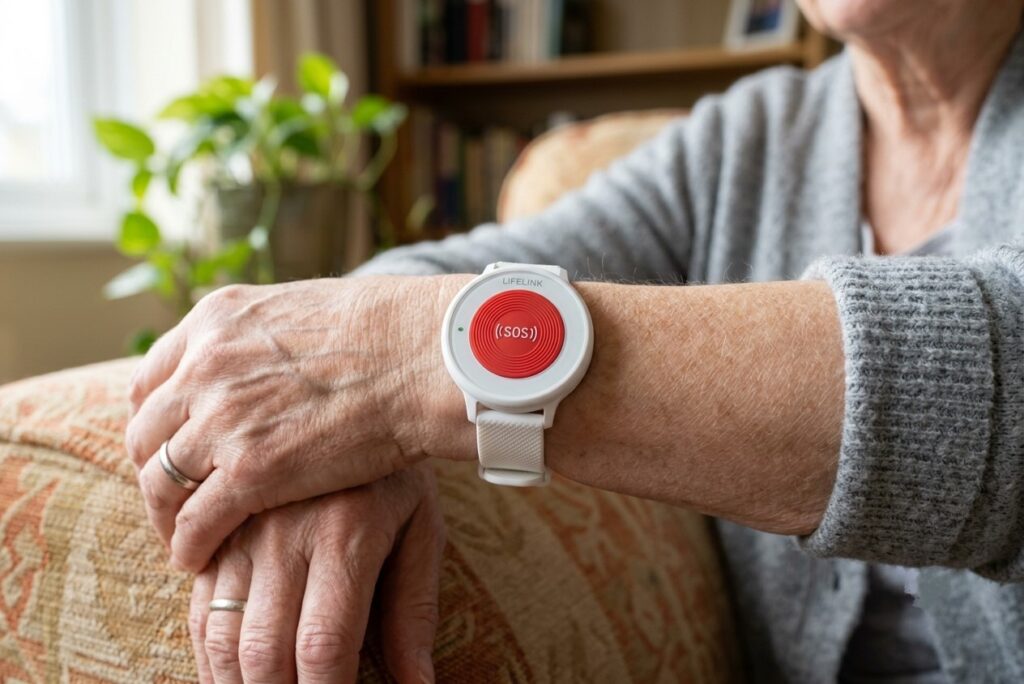
For comfort and rapid operation, wearable panic buttons are designed with noticeable buttons, portability, and ease of use. They connect via Bluetooth or the internet and offer location information in case of an emergency.
Rubber keypads are integrated with circuits and protective housing or a seamless design, offering reliability and usability as portable safety devices.
FAQs
How can the environmental resistance of wearables be improved?
SKF offers protective coatings and plastic keycaps that isolate your rubber keypads from environmental factors in wearable electronics.
Do protection coatings affect the touch and tactile response of wearables?
No. We also offer ultra-slim coatings and rubber keypads that maintain tactility and touch.
How do you ensure that the printed characters conform better to the curved surfaces of rubber keypads?
The screen printing technique can handle moderate curvature cost-effectively in high-volume production, and the depth or height of the concave or convex keytops is limited to around 0.06 inches for durability and adhesion. Pad printing is optimal for higher curvature.
Do the legends on curved silicone keypads tend to rub off easily?
Generally, no. SKF provides laser-etched silicone keypads that are significantly more durable and resistant to wear to prevent rubbing off or peeling of legends and graphics.
Can I combine a flat-bell silicone keypad with a gentle touch and a metal dome with a crisp response?
Yes, but due to the gentle and soft tactile feedback of the flat-bell structure, standard rubber keypads with a web design are recommended for an optimized user experience, as well as for acoustic and haptic feedback.
Final Thought
SKF provides professional wearable silicone rubber keypad solutions with designs for manufacturing, space efficiency, superior durability, excellent performance, ergonomics, reliability in harsh conditions, and design flexibility in layouts and aesthetics.