Perhaps you have researched distinct testing methods for silicone rubber keypads. When designing a silicone keypad, it is important to consider wear resistance, durability, electrical properties, discoloration issues, and material aging when planning to prototype, create tooling, or put it into production. A series of tests can identify potential design weaknesses and ensure the production of functional silicone keypads, thereby eliminating unnecessary losses of raw materials, tooling, and machine failure.
The following will discuss concrete reliability and lifecycle testing, as well as the corresponding data analysis and validation for design and measurement improvements.
Key Factors Affecting Silicone Rubber Keypad Performance
Lifetime of Silicone Keypads for Long-Term Operation
The activation of a silicone rubber keypad relies on the application of physical pressure by a finger. However, the surface of the silicone buttons and the actuators (which are electrical contacts, such as carbon pills or metal domes) face diverse wear conditions, material degradation, and performance changes when subjected to repeated and cyclic presses. Additionally, the structural integrity of the circuitry is affected.
Mechanical Life Cycle Test for Silicone Rubber Keypads
Life Cycle Test for Durability Assessment of Silicone Keypads
A life cycle test is necessary for evaluating the durability of silicone keypads before high-volume production and application. This test eliminates electronic equipment failures in the field.
During testing, an automated tester continuously presses on each key of the silicone rubber keypad at a preset speed for hundreds or thousands of actuations.
Procedures of Life Cycle Test
The evaluation of lifetime depends on actuation force degradation and change in tactile ratio, which determine the percentage of snap retained after a specific number of actuations. Generally, a tactile snap change remainder of 80% or more indicates high-quality rubber keypads. Additionally, the wear condition of conductive carbon pills or metal domes is monitored during cyclic actuation in life cycle testing. If an excessive force drop larger than 15% occurs, it will be fed back into the silicone button design for improvement.
Analyst & Evaluation of Life Cycle Test
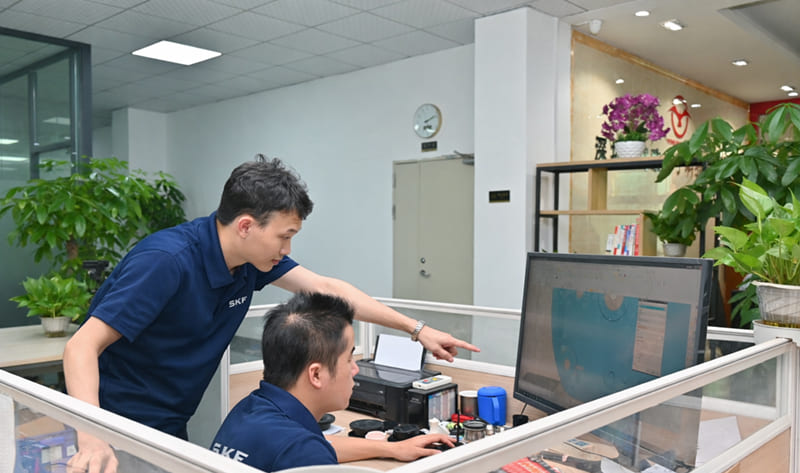
At SKF, we focus not only on your rubber keypad design with the desired graphics and tactility, but also on the reliability of our silicone products, which is strictly controlled.
Prior to approving tooling for bulk orders, we test your silicone rubber keypad samples in terms of actuation force, environmental resistance, material degradation, and mechanical strength to ensure reliable long-term activation.
Graphics & Coatings Durability Testing for Legends of Keypads
RCA Abrasion Testing
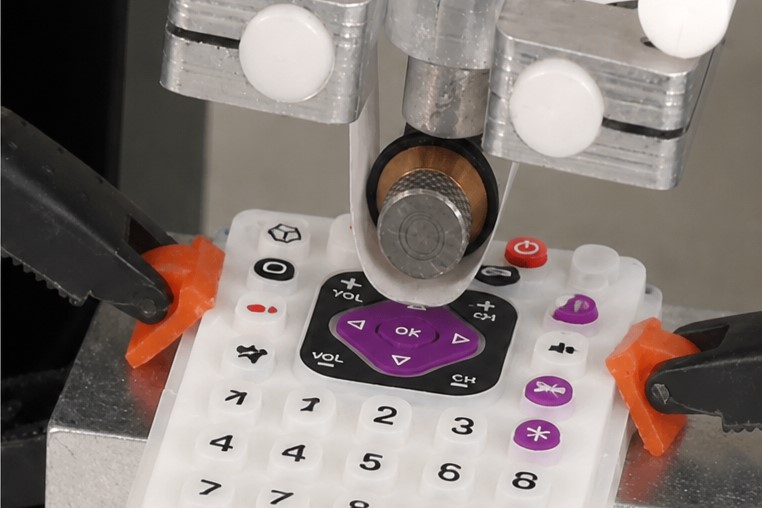
RCA stands for Radio Corporation of America. In RCA abrasion testing, the tester moves RCA paper tape that presses on the keytops of silicone rubber keypads, simulating cloth or a finger with low-force, repetitive contact. The failure metric refers to the amount of ink removed and the amount of rubber exposed during repeated abrasion cycles.
Despite abrasion resistance, SKF also offers salt corrosion and color matching tests for qualified rubber keypads.
Solvent Rub Test: Chemical Resistance of Rubber Keypads
The solvent rub test involves rubbing the surface of silicone buttons to ensure that the legends and coatings won’t abrade or fade. Solvents used in the test include isopropyl alcohol (70% concentration), oily substances such as hydraulic oil or diesel, hydrogen peroxide, bleach, a 5% NaCl solution, and sunscreen. In a solvent rub test, a silicone finger test probe typically uses alcohol.
This test checks for discoloration, graphics smearing, keytop and surface swelling, and tactile changes.
Environmental Durability Testing for Silicone Rubber Keypads
What is environmental durability testing focused on?
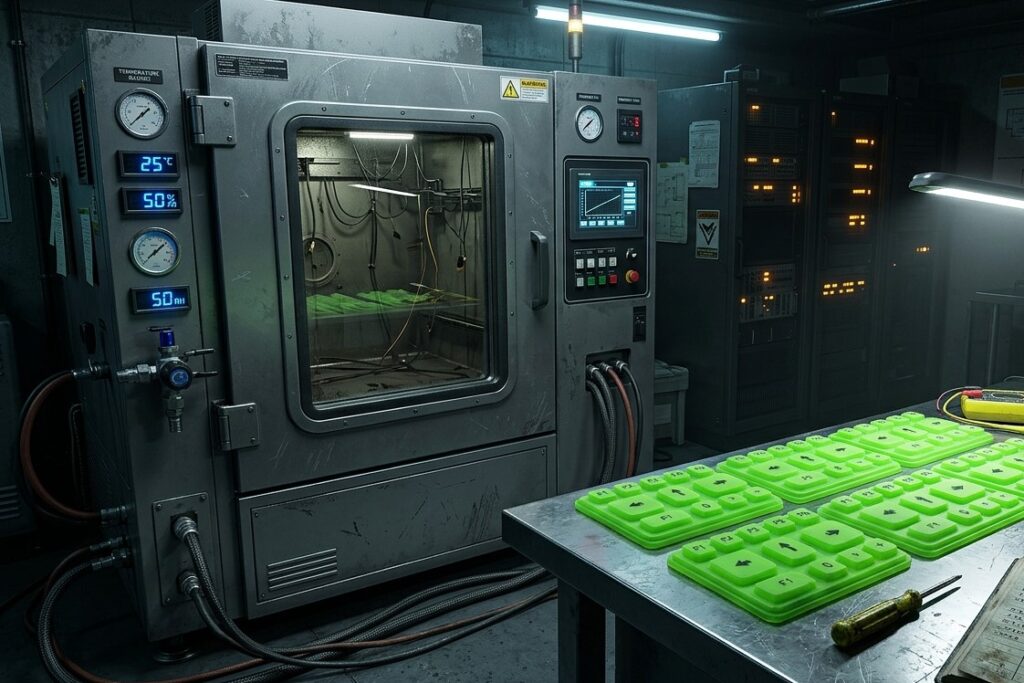
Unlike ideal lab conditions, harsh environmental elements will affect or damage silicone rubber keypads. Environmental durability testing in environmental simulation chambers addresses these elements and potential risks.
These programmable chambers simulate different ambient conditions, including high or low temperatures, humidity, condensation, and UV exposure.
Temperature Resistance & Stability Simulation Testing
Temperature can affect the properties and performance of silicone rubber during keypad operation. This can cause unqualified silicone keypads to become brittle, crack, and harden.
In temperature resistance simulation testing, the chamber cycles from -40°C (-40°F) to 125°C (257°F) for about 30 minutes per cycle. Additionally, 100 cycles are performed to ensure consistent testing data and detect any conditions related to hardening, flexibility changes, cracking, or brittleness.
Thermal Shock by Fast Change Rates Testing Chamber
You may have heard of environmental simulation testing for temperature resistance and weatherability. There is also thermal shock simulation testing to evaluate high-performance silicone keypads. This testing is important if your silicone rubber keypads will be used in harsh conditions with rapidly changing temperatures.
Thermal shock simulation testing uses chambers with fast change rate testing, which typically apply scroll compressors. These chambers are programmed with specific temperature change conditions. Your silicone keypads are placed in the chambers and undergo multiple temperature cycles with cycling rates of ~3℃ to 30℃ (~37.4℉ to 86℉) and temperatures ranging from -40℃ (-40℉) to 125℃ (257℉). The temperature in the chambers is mainly adjusted by the supply air.
According to the performance requirements and applications of your rubber keypads, SKF testers evaluate the performance of the silicone rubber keypads during the transition from hot to cold extreme temperatures by assessing the integrity of the seals and the adhesion between the circuitry and the silicone buttons.
Our testers also collect and analyze start and end temperatures, as well as the number of keypad samples loaded, for final assessment.
Humidity and Condensation
For environmental exposure to humidity and condensation, this durability testing proceeds at 85% relative humidity (RH) for 500 hours. Passed silicone rubber keypads have no visible cracks or damage on the surface, low contact resistance (less than 100 Ω), and minimal material force degradation (typically less than 10% for carbon pills).
Accelerated Aging Simulation for Lifecycle Prediction of Silicone Rubber Keypads
Accelerated aging test chambers can simulate exposure to fluorescent ultraviolet (UV) light and pressure.
UV Accelerated Aging Simulation Testing
UV accelerated aging testing uses UV lamps and a water spray to simulate sunlight and rain in an operating environment. The temperature spectrum is between ~50 and ~70℃ (122-158℉), and there are two cycles of UV lamps and condensation. After being positioned in chambers for several days or weeks, the tested silicone keypads demonstrate potential changes or damage, such as a change in gloss, cracking, or yellowing, that may occur outdoors over the course of months or years.
If your keypads are used in outdoor terminals, financial equipment, security access devices, or heavy-duty vehicles in agricultural or construction settings, aging simulation can provide feedback on protection design improvements.
Furthermore, our testing complies with relevant standards, such as the ASTM G154_00A accelerated aging test and the GB/T16422.3_1997 plastic exposure to sunlight test.
Pressure Accelerated Aging Simulation Testing
The pressure-accelerated aging simulation chamber evaluates the pressure resistance of circuit boards integrated with silicone keypads under steam at specific pressures and temperatures. The stability and durability of rubber keypads can be measured by exposing tested samples to high moisture and pressure.
FAQs
Will condensation affect the results of thermal shock simulation chamber testing?
No, SKF conducts thermal shock simulation testing using automated temperature control, sensors, and dry air with an adjustable temperature. This ensures consistent testing data and minimizes the influence of condensation.
Do you only conduct testing of silicone keypads before mass production and delivery?
No, silicone keypads from SKF undergo design, engineering, and production validation testing to ensure the quality and yield rates of silicone keypad products before delivery.
How do you test the dimensional tolerance of silicone keypads?
SKF uses highly effective profile projectors to test dimension tolerance by projecting light onto glass and using optical magnification to project the silicone keypads onto a screen. Then, they measure by comparing to a digital overlay or measuring scale. This method allows for precise measurement of multiple components in seconds.
What is the difference between a conductive carbon pill and a metal dome of keypads in terms of lifecycle?
Carbon pills offer an excellent life cycle and quiet operation, whereas metal domes typically provide a moderate life cycle and crisp tactile feedback.
How does temperature testing at SKF prevent keypad failure in the field?
SKF controls and monitors temperature, duration, and cycle times in simulation chambers to inspect the flexibility and performance of rubber keypads as an alternative to damaged silicone buttons or to test extreme limitations.
Final Thoughts
Reliability and lifecycle testing of silicone rubber keypads focuses on the influence and simulation of mechanical lifecycles, environmental exposure, extreme climate changes, wear and tear, and graphics and coating conditions.
These tests enable feedback for design improvements, reduce waste of raw materials, and ensure long-term, stable performance of keypads based on your needs for custom silicone keypads.