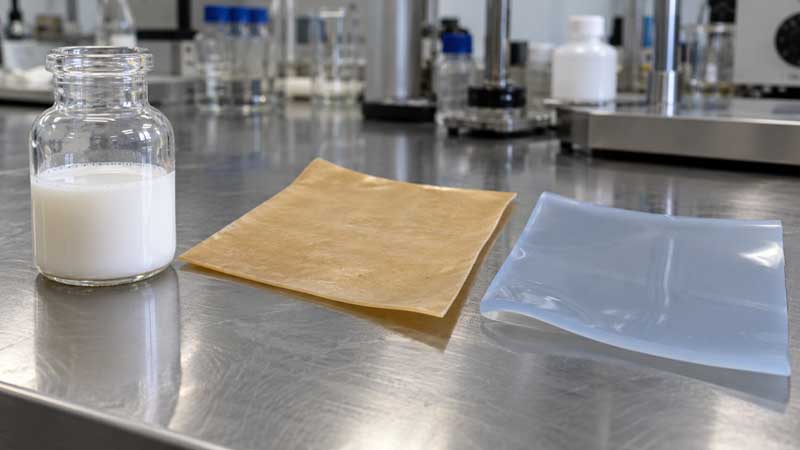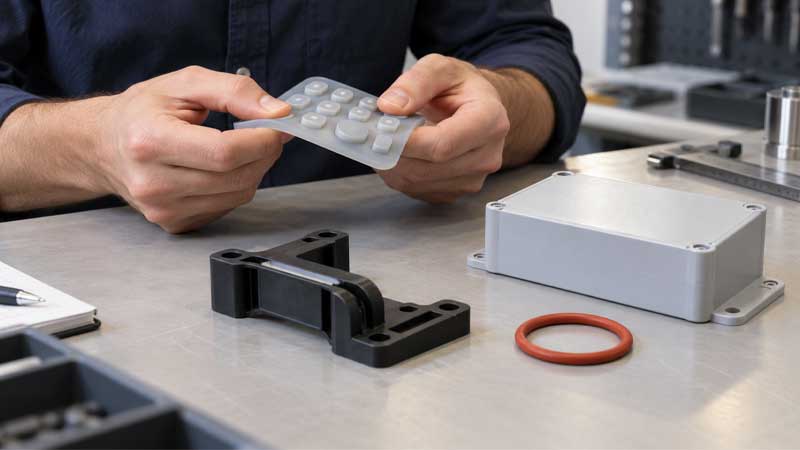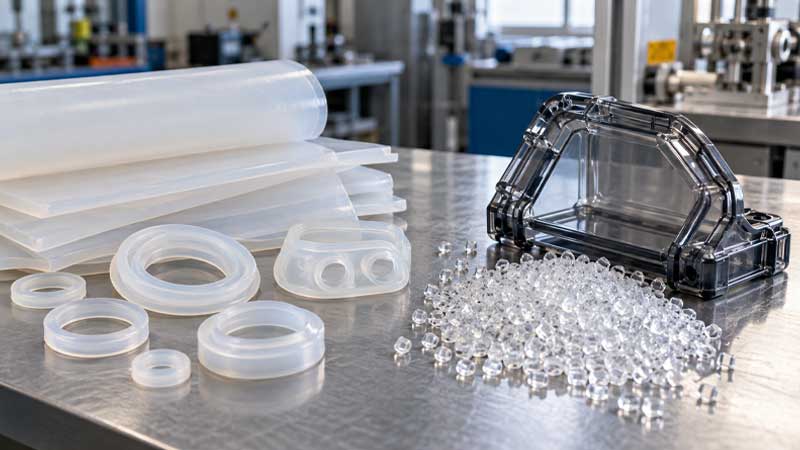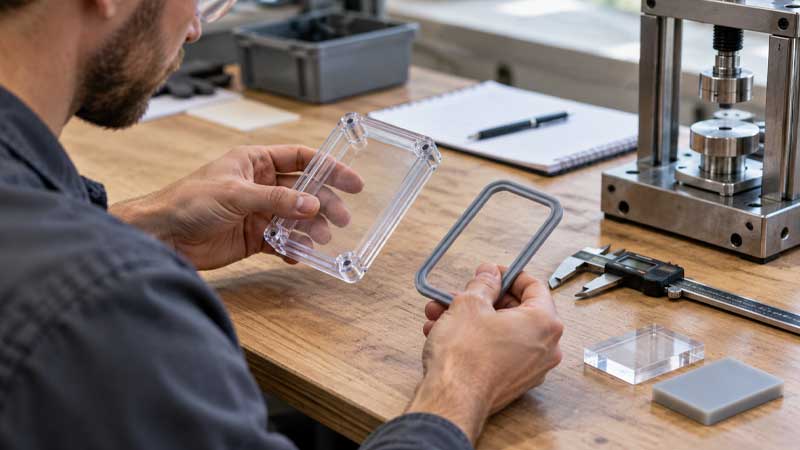
PETG and silicone can both be used to make clear or protective parts, but they behave differently in a finished product. The key question is whether the part must hold a shape or repeatedly bend, compress, and recover. This guide compares PETG with cured silicone rubber and shows when each makes sense.
The short answer
PETG is a glycol-modified polyester and a thermoplastic: it softens for processing and becomes solid again on cooling. Silicone rubber is an elastomer: its cured molecular network allows it to deform and recover, but it cannot simply be melted back into shape. PETG may bend before it breaks, particularly in a thin section, yet that ductility does not make it feel or perform like silicone rubber.
Both materials can be formulated for a translucent appearance and can appear in products exposed to moisture. Those similarities do not make them interchangeable. A clear cover that must retain its dimensions and a gasket that must stay compressed against a joint have different jobs.
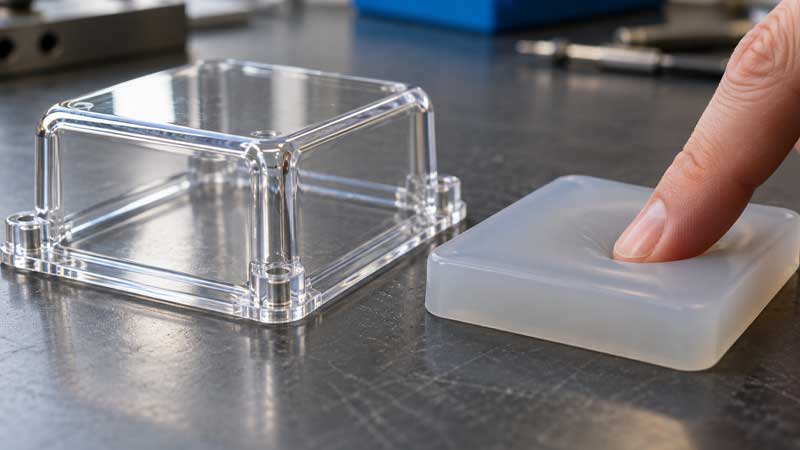
How do PETG and silicone differ in a finished part?
| Property or design question | PETG | Cured silicone rubber |
| Material behavior | A thermoplastic copolyester: softens for melt processing and solidifies on cooling. | A cured elastomer: deforms and recovers but does not remelt for ordinary reshaping. |
| Shape and feel | Relatively rigid and shape-holding; a thin section can bend. | Soft to firm depending on compound; compliant even in thicker sections. |
| Repeated movement | Suitable only if strain, geometry, creep, and fatigue meet the design requirement. One bend during assembly differs from daily cycling. | Designed for elastic deflection, but tear, fatigue, and aging must still be checked for the specific part. |
| Compression and sealing | A solid PETG part can form a mating surface but cannot conform to a joint like a rubber gasket. | Can supply contact pressure and accommodate small surface variations; compression set and joint design control long-term sealing. |
| Temperature | Many standard PETG grades have a heat-deflection temperature (HDT) around 65–80°C under a light test load. Heat and sustained load can reduce shape stability. | Silicone rubber commonly has a service temperature range around −50°C to +180°C while remaining flexible; heat aging still matters. |
| Water and chemicals | Solid parts can resist water, but joints and printed layers may leak. Chemical resistance and stress cracking depend on grade and cleaner. | Can form a water seal when compressed correctly. Fluid compatibility is compound-specific; some hydrocarbons and oils can cause swelling. |
| Outdoor exposure | Confirm UV/weather performance for the chosen grade, color, and expected lifetime. | Silicone rubber generally has good UV/weather resistance; confirm the selected compound and assembly. |
| Appearance | Clear, glossy grades are available and suit rigid windows or guards. | Transparent, translucent, and opaque grades exist, usually for soft optical or tactile features rather than rigid windows. |
| Manufacturing | Melt processing includes injection molding, extrusion, thermoforming, and FFF filament printing where the grade permits. | Usually compression molding, liquid silicone rubber molding, or casting; direct 3D printing needs a specialized process. |
| End-use roles | Cover, tray, housing, locator, or rigid support. | Gasket, seal, flexible grip, or soft control surface. |
| Food or medical contact | A material-family name is not an approval; check the exact grade, additives, process, and applicable documentation. | The same rule applies: select a documented compound and verify the finished part’s requirements. |
These are approximate reference values. PETG HDT describes deflection under load; the silicone range describes service temperature, so the figures are not directly equivalent.
Bending is not the same as elastic recovery
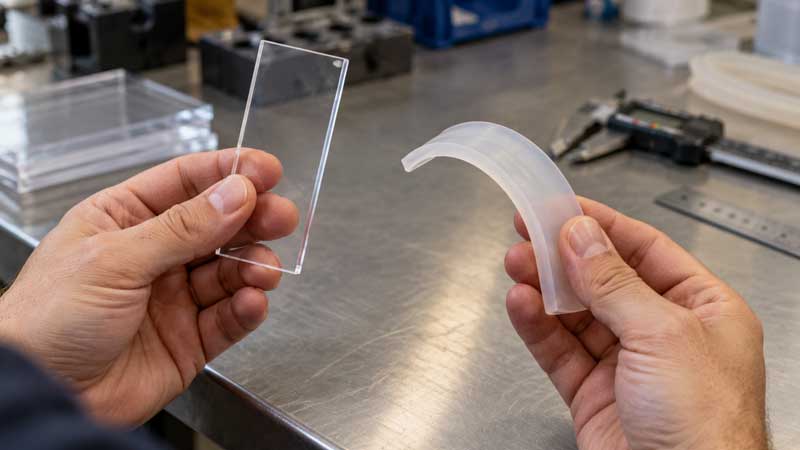
A thin PETG strip can feel flexible because its geometry lets it bend. Make the same material much thicker and it will feel far stiffer. This is useful for a clip or a protective cover that must give slightly during assembly. But if the feature remains bent under load, or is cycled repeatedly, it may lose some of its original shape. The design needs a permitted strain, a suitable radius, and testing over the expected number of cycles; “PETG is flexible” is not enough to qualify it as a spring or a soft seal.
Silicone rubber is selected when deformation is the intended everyday action. A gasket is squeezed every time the enclosure is closed; a soft control surface deflects with each press. Silicone’s recovery is useful here, but it is not perfect. Compression set means some deformation remains after a rubber part has been compressed and released. Excessive set can reduce sealing force over time. Compound choice, compression, temperature, and exposure time all matter, so a seal should be tested in its actual joint.
Heat, load, and long-term shape
For temperature, the practical distinction is straightforward. Published PETG data commonly place HDT around 65–80°C under a light test load, whereas silicone rubber guidance gives a typical service range of about −50°C to +180°C. HDT marks when a loaded test specimen deflects; it is not a continuous-use rating. Printed PETG may also behave differently from molded material because layer direction and bonding affect the part.
In practice, heat and load interact. A warm PETG bracket supporting a constant weight should be checked for gradual deflection, not judged only by whether it survives a short exposure to that temperature. A silicone seal exposed to heat needs a different check: after aging, does it still exert enough contact pressure and retain the required mechanical properties? If the application includes cleaning cycles, oils, or outdoor exposure, test the materials under those conditions rather than relying on a general “chemical resistant” or “weather resistant” label.
Can PETG replace silicone?
Choose PETG when the part needs a relatively rigid form, such as a cover, tray, locating feature, or housing. Its toughness, processability, and potential for clarity can be useful. If the part will carry sustained load or sit near heat, check its heat resistance, creep behavior, and actual geometry. A thin PETG tab that bends once during assembly is a different requirement from a button that must flex thousands of times.
Choose silicone rubber when the useful feature is elastic recovery: a compressible gasket, flexible grip, soft button, or sealing lip. The design still needs a suitable compound and an appropriate compression or deflection range. Silicone is not automatically the right seal for every fluid, pressure, or cleaning chemical; compatibility and assembly tests decide that.
Consider three common design situations:
- A clear guard or instrument cover: PETG may supply the needed shape, visibility, and impact toughness. If a soft edge or dust seal is needed, design it as a separate feature rather than expecting the cover itself to compress like rubber.
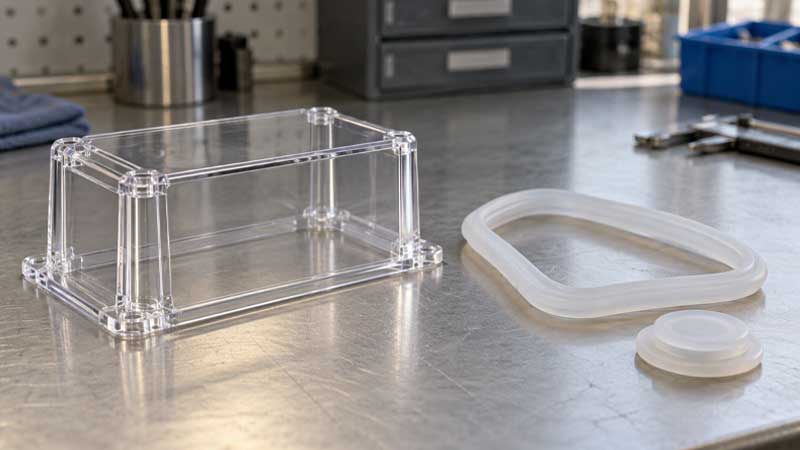
- A removable cap that must stop water entering: PETG can form the cap, but the sealing performance depends on the interface. A silicone gasket may provide compliance around small surface variations; the closure force and gasket retention still need to be defined and tested.
- A repeatedly pressed control: PETG can form a bezel or support, while silicone can form the moving contact surface. A PETG flexure could be viable for a different control design, but the number of cycles, feel, travel, and failure mode would have to be checked. Material choice alone does not set the button’s life.
Neither material alone makes an assembly waterproof. A PETG enclosure may resist water at its surface yet leak through a joint or, if 3D printed, through poorly fused layers. A silicone gasket only works if the mating surfaces, compression, fastening, and long-term deformation are designed together. Likewise, an RTV silicone bead may fill a gap without being a dependable structural bond to PETG. Treat sealing and bonding as separate requirements.
Manufacturing and 3D printing: where the confusion starts
PETG is commonly sold as filament for fused-filament fabrication (FFF), where a printer deposits melted plastic layer by layer. Silicone rubber generally is not processed as an ordinary melt filament. It is often molded or cast after mixing and curing, although specialized direct silicone 3D-printing methods are available. A PETG print can also serve as a prototype or mold component for a separately cast silicone part; it does not turn PETG into a silicone substitute.
A printed PETG trial is useful for checking the shape of a housing and the space available for a seal. It is less reliable as a direct prediction of an injection-molded part’s strength or watertightness: print orientation, layer bonding, voids, and surface texture can change the result. Similarly, a quick silicone prototype can confirm fit and feel without automatically qualifying the final production compound. Keep prototype conclusions tied to what the prototype actually tested.
The two materials often work better together than as alternatives. A PETG housing can provide shape and support while a separate silicone gasket, grip, or button supplies compliance. Whether that combination meets the project requirements depends on the fit, retention method, temperature, fluids, and testing. For the broader material-family decision, see SKF’s silicone versus plastic guide.
If a silicone part must stay attached to PETG, choose the retention method early. A groove, captured edge, fastener, or qualified adhesive can all be considered, but each has different tolerances and assembly demands. Do not assume uncured silicone will bond securely to PETG just because it fills the gap. If an adhesive or overmolding route is proposed, validate it on the actual PETG grade and surface condition after temperature and fluid exposure.
How should you choose?
Start with the part’s function rather than the material name:
- Movement: Must it stay rigid, bend occasionally, or compress and recover repeatedly?
- Load and heat: What force acts on it, for how long, and at what operating temperature?
- Contact: Which fluids, cleaners, skin-contact rules, or food-contact requirements apply to the finished part and exact grade?
- Process: Will it be molded, formed from sheet, printed, or combined with another component?
- Validation: Which tests will confirm fit, deformation, leakage, aging, and durability in the real assembly?
For a housing and gasket, a useful validation plan may include dimensional checks, leak testing after assembly, and another leak test after temperature cycling or prolonged compression. For a repeatedly pressed feature, measure force and travel before and after cycling, then inspect for cracking, set, or loosened retention. The exact test duration and acceptance limits must follow the product’s service conditions; a single material data sheet cannot establish them.
PETG is generally the better starting point for a shaped, relatively rigid plastic part; cured silicone rubber is the better starting point when softness and elastic recovery perform the work. Compare the actual grades and test the assembled part before treating either as a substitute.
If your design combines a plastic housing with silicone buttons or seals, SKF can review the silicone component’s geometry, material selection, and interface requirements as part of a manufacturing discussion.