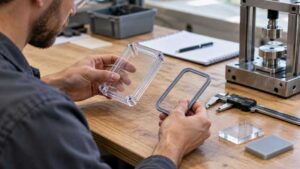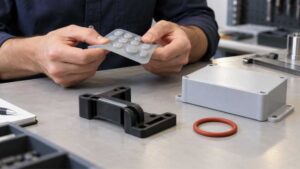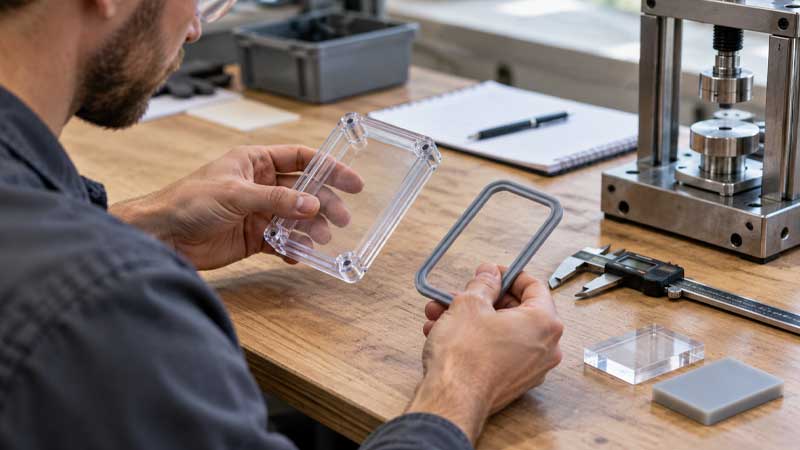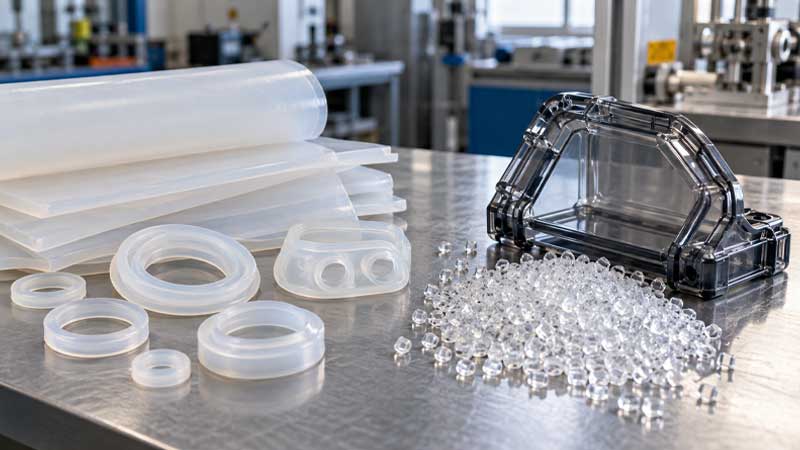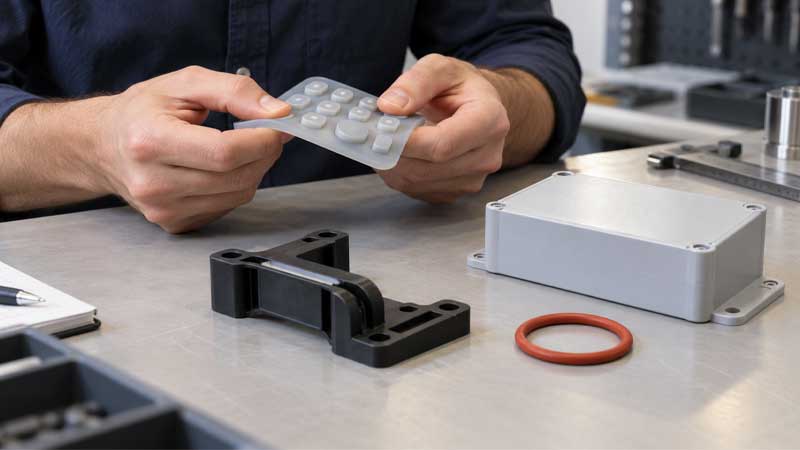
Silicone rubber and plastic can both make reliable molded parts, but they usually do different jobs. Silicone is a strong candidate when a component must flex, compress and recover. A suitable plastic is often better when it must support loads, locate other parts or keep a rigid shape. For many electronic interfaces, the most useful design combines a plastic housing with silicone keys or seals.
The decision becomes clearer when you compare a specific silicone compound with a specific plastic grade under the conditions the finished product will face. “Silicone vs plastic” is a starting question, not a complete material specification.
What Is Actually Being Compared?
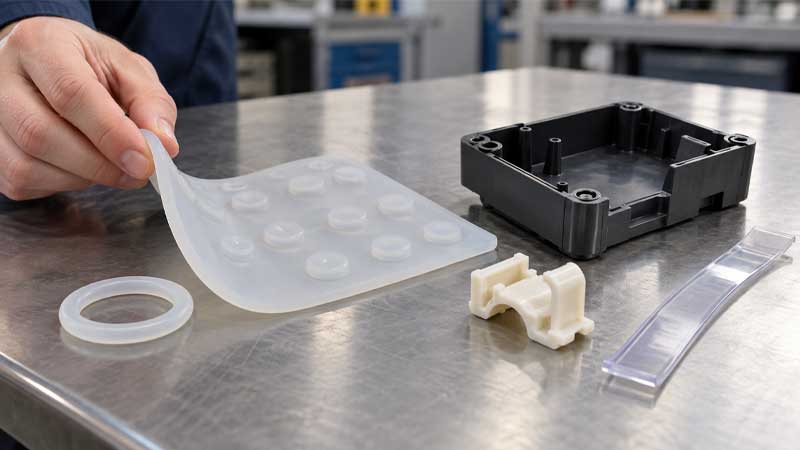
In this article, silicone means cured silicone rubber used for molded components. During curing, its polymer chains form a permanent network. The finished rubber can bend and recover, but it cannot normally be melted and molded again like a thermoplastic.
Plastic mainly refers to thermoplastics such as polypropylene (PP), acrylonitrile butadiene styrene (ABS), polycarbonate (PC) and polyamide (PA). They are heated for processing and solidify as they cool. Their properties vary widely: some grades are flexible, while others are stiff, reinforced or designed for elevated temperatures. Calling every plastic “rigid” or “heat sensitive” would hide important options.
If the alternative must also feel soft and elastic, a thermoplastic elastomer may be a closer comparison than ABS or PC. SKF’s Silicone vs TPE guide covers that separate decision.
Compare the Properties That Control Part Failure
The first question is what the part must do after it is assembled. A seal must maintain contact pressure. A keypad web must deform repeatedly and return. A housing must hold the PCB, display and key openings in position. Those jobs lead to different material tests.
| Design question | Silicone rubber: typical starting point | Thermoplastic: typical starting point | What to verify |
| Must it compress and recover? | Useful for molded seals, flexible webs and buttons | A flexible grade may work, but behavior varies by polymer | Compression set, repeated movement and retained force in the actual geometry |
| Must it hold a precise rigid shape? | Usually needs a supporting frame for structural duties | Suitable rigid or reinforced grades can provide support | Stiffness, creep, fit and dimensional change under load and temperature |
| Will it face heat or cold? | Many compounds keep useful elasticity over a broad range | Limits differ greatly among PP, PC, PA and specialty grades | Grade data at the load, duration and temperature that matter |
| Will it contact oils, cleaners or solvents? | Compatibility depends on formulation and the actual liquid | Compatibility also depends on resin, additives and stress | Swelling, cracking, loss of strength and appearance after the real exposure cycle |
| Will its surface be rubbed or pressed? | Web fatigue, tear and graphics wear may control life | Scratch, wear, stress cracking or switch wear may control life | Finished-part cycling and surface tests |
Elastic recovery and rigidity
Silicone’s elastic behavior is useful where a feature bends and returns. In a keypad, the thin web around each key helps create the press and return movement. In a seal, compression helps fill the gap between mating parts. A plastic frame performs a different job: it holds the openings and electronics in place while the soft part moves.
Material hardness does not settle this choice. Shore A is an indentation measurement commonly used for elastomers. Two silicone compounds with similar hardness can produce different key feel if their web thickness, angle and travel differ. Likewise, a seal’s initial softness does not prove it will retain enough contact pressure after long compression. Ask for the test that represents the part’s function.
Temperature under real loading
Silicone rubber often provides a broad service-temperature window, but the allowable range depends on compound, exposure time and required property. For orientation, WACKER’s silicone-rubber material guide gives −50 to +250 °C as a typical range and also notes property changes at elevated temperatures. That is a general material reference, not a rating for every silicone keypad, coating, contact or adhesive.
Plastic cannot be assigned one temperature limit. An ordinary PP housing and a glass-fiber-reinforced PA component have different behavior. For a loaded plastic part, check the proposed grade’s stiffness and deformation data at the relevant temperature and duration. For an assembled keypad, also check whether the housing, silicone and PCB stay aligned after thermal cycling. A material’s melting point or a brief heat-deflection result alone does not establish continuous performance of the complete product.
Chemicals, weathering and wear
Silicone rubber is often useful in outdoor parts because many compounds resist UV and ozone aging well. It is not automatically resistant to every oil or cleaner. Standard silicone can swell in some non-polar oils and hydrocarbon liquids; formulations differ. Plastics also vary, and some may stress-crack when a chemical contacts a loaded feature. Name the actual liquid, concentration, contact time and temperature before choosing either material.
Surface damage can change the answer as well. A thin silicone edge may tear against a sharp plastic opening. An unprotected printed legend may wear before the molded body fails. A rigid plastic keycap can protect the visible surface, yet its separate switch or elastic layer still needs to survive the required operating cycles. “Durability” should therefore name the failure being prevented: tearing, fading, contact failure, loss of tactile response or loss of sealing pressure.
How Do Manufacturing and Assembly Change the Decision?
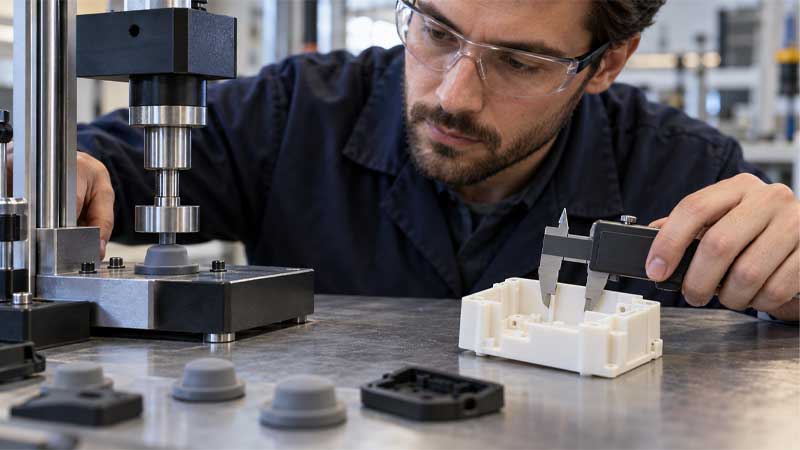
Silicone molding and thermoplastic molding use different process routes. Solid silicone is commonly compression molded, while liquid silicone rubber can be injection molded and cured in a heated tool. A thermoplastic is melted, shaped and cooled. The process choice affects mold design, parting lines, flash, cycle time, tolerances and how the part is removed from the tool.
For a silicone keypad, the supplier must review the web geometry, key spacing, release path and contact features. For a plastic housing or cap, ribs, wall thickness, draft, gates and shrinkage influence fit and appearance. A part that looks simple in CAD may become expensive if it needs tight alignment, secondary finishing or difficult assembly.
Price comparisons also need the same scope. Compare tooling, part cost at the expected annual volume, decoration, assembly, scrap, testing and replacement risk. Silicone is not guaranteed to cost more at every project volume, and a cheap molded key is not economical if it adds switches, sealing parts or rework elsewhere in the assembly.
Example: A Plastic Housing With Silicone Keys
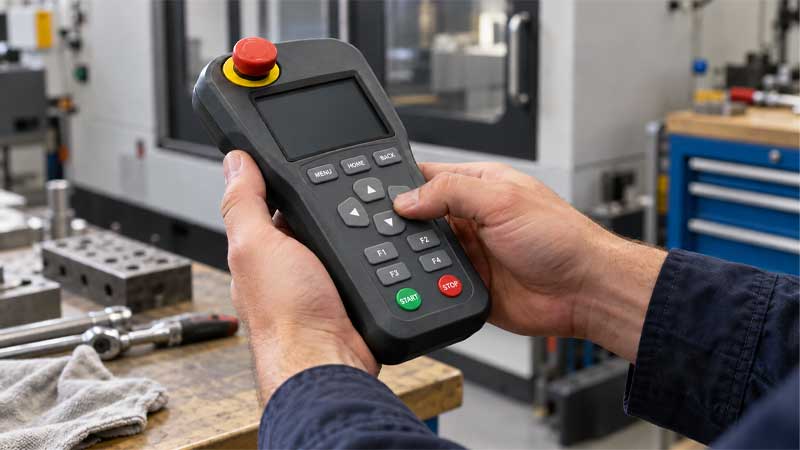
Consider a handheld industrial controller. Its housing must protect the electronics and keep the button openings aligned. The operator needs keys that can be found by touch and pressed repeatedly. A practical starting architecture is a rigid plastic enclosure, a molded silicone keypad underneath, and a PCB with the chosen contact system.
The plastic locates and supports. The silicone web gives the keys their movement and return. If the design uses conductive contacts, the keypad and PCB must maintain alignment through repeated presses. If the device needs protection from water or dust, the perimeter of the keypad, the housing joint and any other openings must be designed and tested together. A silicone sheet by itself does not give the enclosure an IP rating.
The visible key may be all silicone, or a rigid plastic keycap may sit on a silicone base. A separate plastic actuator over a mechanical switch is another option. These choices change touch feel, legend options, stack height, part count and sealing details. For a focused comparison of the key constructions in demanding conditions, see SKF’s silicone vs plastic keypad article. The Silicone Keypad Design Guide covers the geometry and integration questions that follow.
A Short Selection and Validation Checklist
Before freezing the material, give both engineering and purchasing teams the same design brief:
- Define the job of each part. Which feature must flex, seal, carry load, locate a PCB or carry a printed legend?
- Record service conditions. Include normal and peak temperature, duration, UV exposure, the exact oils or cleaners, frequency of pressing and expected storage conditions.
- Name the failure limit. Examples include unacceptable force drift, loss of electrical contact, visible legend wear, cracking, swelling or loss of sealing pressure.
- Shortlist actual grades and constructions. Review material datasheets and the mold, finish, retention and assembly route for each candidate. Do not select by a broad material name or hardness number alone.
- Test representative assemblies. For a keypad, measure force and travel, electrical contact, repeated cycling and graphics durability as applicable. For an environmental requirement, test the joined housing and keypad under the specified exposure and ingress procedure.
- Compare complete project cost. Use the same annual volume, inspection criteria, tooling life and assembly assumptions for each option.
Which Should You Choose?
Choose silicone rubber as a starting point when elastic recovery is central to the component’s function. Choose a suitable plastic when the part’s main job is rigid support, precise location or a structural surface. Use both when the product needs those functions in different places. Then confirm the specific grades, geometry and completed assembly under the conditions that matter to the application.
For a custom keypad or button project, SKF can review a drawing or 3D model together with the housing layout, required key feel, contact arrangement, environment, finish and target volume. Those inputs make a material recommendation and prototype test plan much more useful than a generic silicone-versus-plastic verdict.