Silicone Keypad Testing & Reliability Validation

Silicone keypad reliability depends on more than material selection. Silicone hardness, web structure, tactile design, conductive contact, molding accuracy, and environmental conditions all influence final performance.
SKF provides silicone keypad testing and reliability validation services to help OEM and ODM customers verify product performance from prototype development to mass production.
Our engineers evaluate critical parameters including actuation force, force travel curve, snap ratio, conductive resistance, cycle durability, compression recovery, and environmental stability. Testing results are used not only for quality verification but also for design optimization, helping customers reduce production risks and improve long-term keypad reliability.

Why Silicone Keypad Testing Matters

Silicone keypads are repeatedly compressed during operation. Every press creates mechanical stress on the silicone web structure, conductive pill, and contact interface.
Without proper validation, potential issues may appear after long-term use, including:
  • Increased actuation force
  • Reduced tactile feedback
  • Slow button recovery
  • Silicone web fatigue or cracking
  • Conductive contact instability
  • Permanent deformation after repeated compression
SKF combines silicone keypad manufacturing experience with performance testing to identify these risks before mass production.
Testing data helps engineers understand:
  • Whether the silicone compound provides suitable elasticity
  • Whether the keypad structure achieves the required tactile response
  • Whether the conductive contact remains stable after repeated operation
  • Whether the design can withstand the expected operating environment
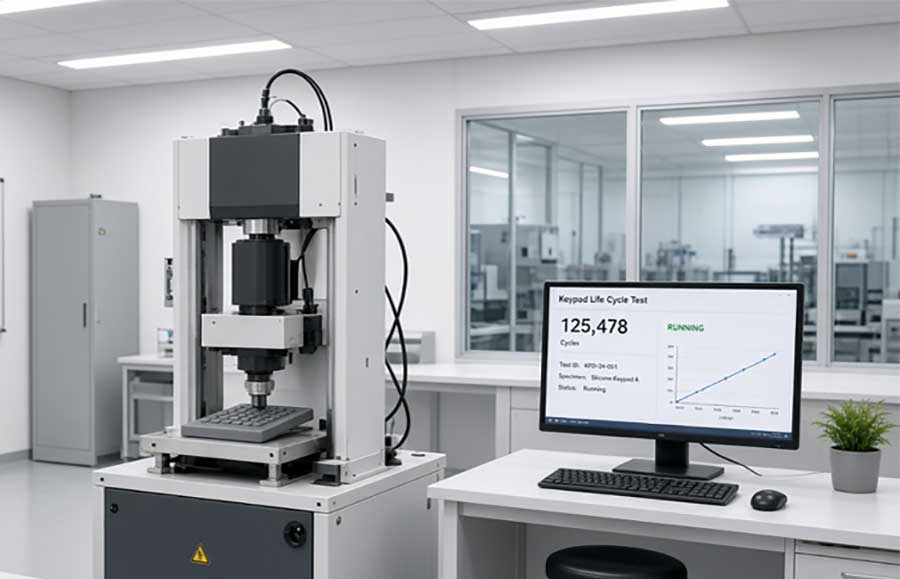
Laboratory with a silicone keypad mounted on a life cycle testing machine beside a monitor displaying running test data for Silicone Keypad Testing Services 1

Silicone Keypad Testing Capabilities

SKF provides comprehensive validation covering mechanical performance, electrical reliability, durability, and environmental resistance for different silicone keypad applications. Based on our silicone keypad manufacturing experience, we support testing and reliability evaluation for standard silicone rubber keypads, conductive silicone keypads, backlit silicone keypads, silicone button assemblies, and fully customized OEM keypad designs.
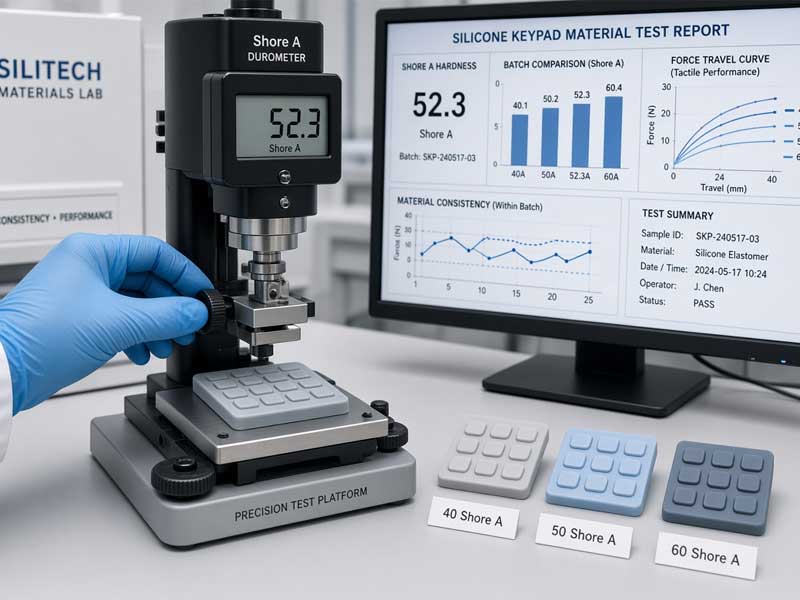
Engineer testing silicone keypad hardness using Shore A durometer on a precision platform with data monitor for Silicone Keypad Testing Services

Silicone Hardness Testing

Silicone hardness directly affects button feel, recovery speed, and structural durability.
SKF evaluates silicone rubber hardness to confirm material consistency and ensure the selected compound matches the application requirements.
Typical evaluation includes:
  • Shore A hardness measurement
  • Material batch comparison
  • Hardness variation analysis
Common silicone keypad hardness ranges depend on design requirements, but many keypad applications use silicone materials around 40–70 Shore A to balance flexibility, tactile response, and durability.
Incorrect hardness selection may cause:
  • Too soft: slow recovery, unstable tactile feedback
  • Too hard: high pressing force, reduced user comfort
SKF engineers evaluate hardness together with force travel data instead of treating hardness as an independent parameter.

Force Travel Testing and Tactile Performance Analysis

The tactile feeling of a silicone keypad is determined by the relationship between pressing force and displacement. SKF uses force travel testing to analyze key performance parameters, including actuation force, contact force, travel distance, return force, and overall force curve characteristics.

Typical silicone keypad designs may require an actuation force of approximately 80g–500g and a travel distance of around 0.3mm–2.0mm, depending on the application and user expectations. Industrial control panels usually require stronger tactile feedback and higher operating force to provide clear confirmation during operation, while portable electronic devices often focus on lower pressing force and smoother button response.

SKF engineers use force travel data to optimize key structural factors such as silicone web thickness, web angle, button geometry, silicone hardness, and conductive pill positioning. This analysis helps achieve the right balance between tactile feedback, operating comfort, and long-term durability.
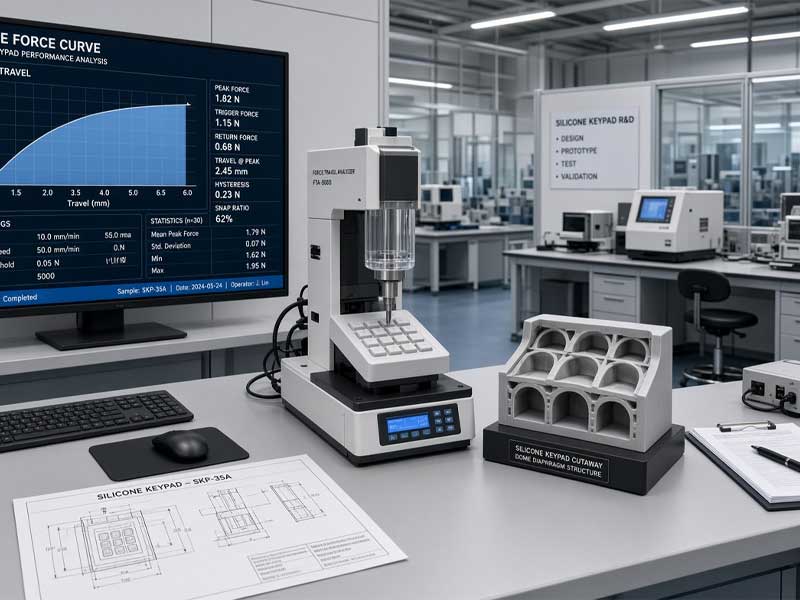
Wide lab view of force travel analyzer testing a silicone keypad with force curve monitor and cutaway model for Silicone Keypad Testing Services
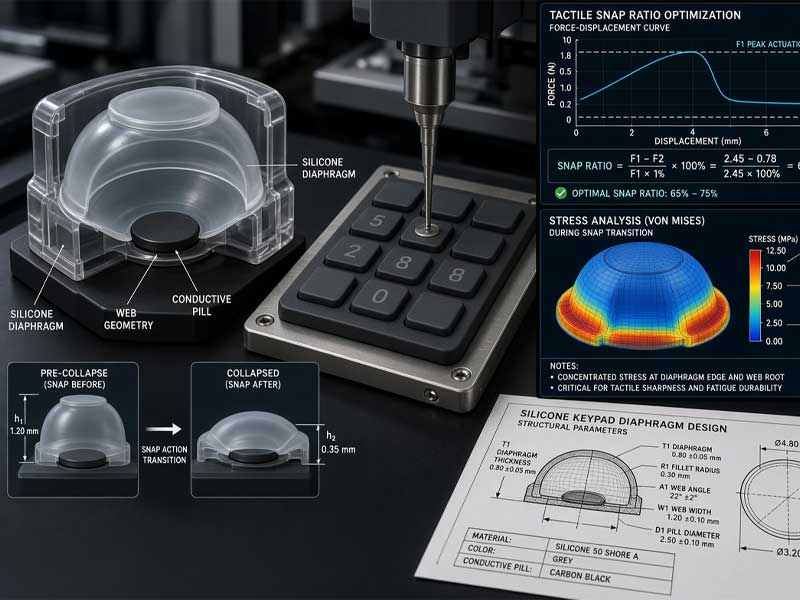
Engineering analysis of silicone keypad snap ratio with cutaway diaphragm model force curve and stress visualization for Silicone Keypad Testing Services
Snap ratio is an important indicator of silicone keypad tactile sharpness.
SKF evaluates:
Snap Ratio = (F1 – F2) / F1
Where:
  • F1 = Peak actuation force
  • F2 = Contact force
A suitable snap ratio provides clear tactile feedback. However, excessive snap characteristics may increase stress concentration around the silicone diaphragm and reduce fatigue life.
SKF analyzes the relationship between tactile performance and structural durability by reviewing:
  • Diaphragm geometry
  • Stress concentration areas
  • Web design
  • Material elasticity
This helps achieve a balance between satisfying button feel and long-term reliability.

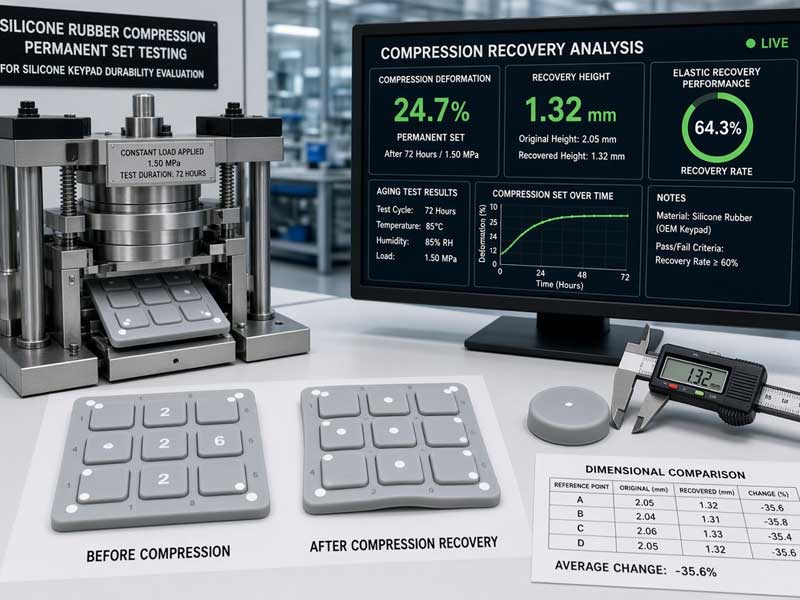
Compression Recovery and Permanent Deformation Testing

Silicone keypads must recover quickly after pressing.
Compression permanent set testing evaluates whether silicone materials maintain elasticity after long-term compression.
Testing focuses on:
  • Deformation percentage
  • Recovery ability
  • Aging behavior
Poor compression recovery may result in:
  • Slow button return
  • Reduced tactile response
  • Unstable operation
SKF uses compression performance data together with structural analysis to optimize silicone material selection and keypad geometry.
Silicone Keypad Testing Services lab with compression fixture on keypad before after samples and digital recovery analysis display
Silicone keypad lifetime depends on material properties, structural design, and operating conditions. SKF performs durability testing based on customer requirements, typically ranging from 100,000 cycles for general electronic applications to 500,000–1,000,000+ cycles for industrial or high-frequency applications. During life testing, engineers monitor:
 
Evaluation ItemTesting Purpose
Pressing cyclesVerify service life
Actuation force changeDetect tactile degradation
Return forceCheck recovery performance
Conductive resistanceConfirm electrical stability
Silicone structureIdentify fatigue or cracking
A keypad completing the required cycle count does not always mean optimal reliability. SKF evaluates performance changes throughout the test process to identify early signs of failure.

Conductive Silicone Keypad Testing

Conductive silicone keypads require both mechanical durability and stable electrical performance.
SKF evaluates conductive performance through:

Contact Resistance Testing

Testing includes:
  • Initial contact resistance measurement
  • Resistance change after cycling
  • Switching stability evaluation
The test helps identify issues such as:
  • Conductive pill wear
  • Insufficient contact pressure
  • PCB contact alignment problems

Electrical Reliability Validation

For conductive silicone keypads, SKF combines electrical measurement with mechanical life testing.
Typical validation includes:
  • Resistance before cycling
  • Resistance after hundreds of thousands of presses
  • Contact consistency between keys
This ensures reliable signal transmission throughout product operation.

Environmental Reliability Testing

Silicone keypads may operate in harsh environments involving temperature changes, humidity, cleaning agents, and outdoor exposure. SKF validates performance under different environmental conditions.

Temperature Resistance Testing

Silicone keypad validation may include:
  • Low-temperature exposure: -40°C to -60°C
  • High-temperature exposure: 80°C to 150°C+ depending on silicone material
Testing evaluates:
  • Hardness changes
  • Elastic recovery
  • Force variation
  • Surface condition

Humidity Resistance Testing

Humidity testing evaluates:
  • Silicone stability
  • Conductive reliability
  • Printing adhesion
  • Sealing performance

Chemical Resistance Testing

Common chemical exposure evaluations include:
  • Alcohol cleaning solutions
  • Oils
  • Detergents
  • Industrial chemicals
Testing verifies changes in:
  • Appearance
  • Hardness
  • Mechanical properties
  • Electrical performance

Silicone Keypad Testing Equipment

SKF uses professional testing equipment to validate product performance.
 
EquipmentFunction
Force travel testerMeasures actuation force and tactile response
Life cycle testerSimulates repeated pressing operation
Shore hardness testerMeasures silicone hardness
Resistance testerEvaluates conductive performance
Environmental chamberTests temperature and humidity resistance
Measuring equipmentVerifies dimensions and assembly accuracy

Silicone Keypad Validation Process

Requirement and Design Review

SKF engineers review product drawings, 3D models, silicone material requirements, operating environments, expected lifetime, and tactile performance targets before defining the appropriate validation approach. This review helps identify key testing requirements based on product structure and application conditions.

Customized Testing Plan

Based on product requirements, SKF defines suitable validation items for each silicone keypad project. The testing plan may include mechanical testing, electrical testing, life cycle testing, and environmental testing to verify overall performance and reliability.

Testing and Data Collection

Samples are evaluated under controlled testing conditions to ensure accurate and consistent results. Collected data includes initial performance values, performance changes during testing, and final validation results, providing engineering references for further optimization.

Engineering Analysis and Optimization

Testing results are reviewed to identify potential improvement opportunities during product development. For example, excessive actuation force may be caused by high silicone hardness, thick web structure, or incorrect geometry, which can be optimized through material adjustment, tooling modification, and web structure improvement. Reduced tactile response may result from an unsuitable snap ratio, material fatigue, or stress concentration, requiring adjustments to diaphragm geometry or button structure. Conductive instability may be related to carbon pill wear, contact pressure variation, or alignment issues, which can be improved through conductive pill design optimization and better molding accuracy.

Why Choose SKF for Silicone Keypad Testing?

SKF is not only a silicone keypad testing provider but also an experienced silicone keypad manufacturer.
Our testing capability is built on practical production experience, including:
By connecting testing results with manufacturing knowledge, SKF helps customers solve real product development challenges instead of only providing test data.

Frequently Asked Questions

Silicone keypad testing may include hardness testing, force travel analysis, snap ratio evaluation, life cycle testing, conductive resistance testing, compression recovery testing, and environmental validation.
Testing cycles depend on application requirements. SKF commonly validates products from 100,000 cycles to over 1,000,000 cycles for industrial applications.
Tactile performance is measured through force travel testing, including actuation force, travel distance, return force, and snap ratio analysis.
Yes. SKF performs conductive silicone keypad testing including contact resistance measurement and electrical reliability validation after repeated operation.
Testing should be performed during prototype development, engineering validation, and before mass production to identify potential reliability risks early.

Ask for a quote

Fill out the form below, and we will be in touch shortly.

询盘表单