
Backlighting Options
Backlighting is a critical functional element in modern human-machine interfaces (HMI).
It ensures clear visibility of legends and symbols in low-light, outdoor, or fully dark operating environments.
We design and manufacture custom silicone keypad backlighting systems that integrate optical engineering, silicone molding, and electronic control structures to achieve stable illumination, long service life, and consistent tactile performance.
Why Backlighting Matters in Silicone Keypads
Backlighting in silicone keypads is not simply for aesthetics.
It directly impacts operational safety, usability, and system reliability.
In industrial and mission-critical environments, operators often work under conditions such as:
- Low ambient lighting (control rooms, vehicles, ships)
- Night-time outdoor operation
- Emergency or high-pressure situations requiring fast response
- Enclosed equipment panels with no external light source
Without proper backlighting design, key identification becomes slow and error-prone, increasing operational risk.
Functional Advantages
- Instant recognition of key functions in dark environments
- Reduced operator fatigue during long shifts
- Lower error rate in control operations
- Improved human-machine interaction efficiency
Product-Level Advantages
- Higher perceived product value
- Stronger differentiation in industrial markets
- Enhanced compliance with professional equipment standards
- Improved brand perception in OEM/ODM projects
Backlighting Technology Overview
We offer multiple backlighting systems because different applications require different balances between brightness, thickness, cost, durability, and optical performance.
Each solution is engineered based on:
- Device structure
- Power system design
- Environmental conditions
- Expected lifecycle
- Cost target
LED Backlighting (PCB Integrated System)
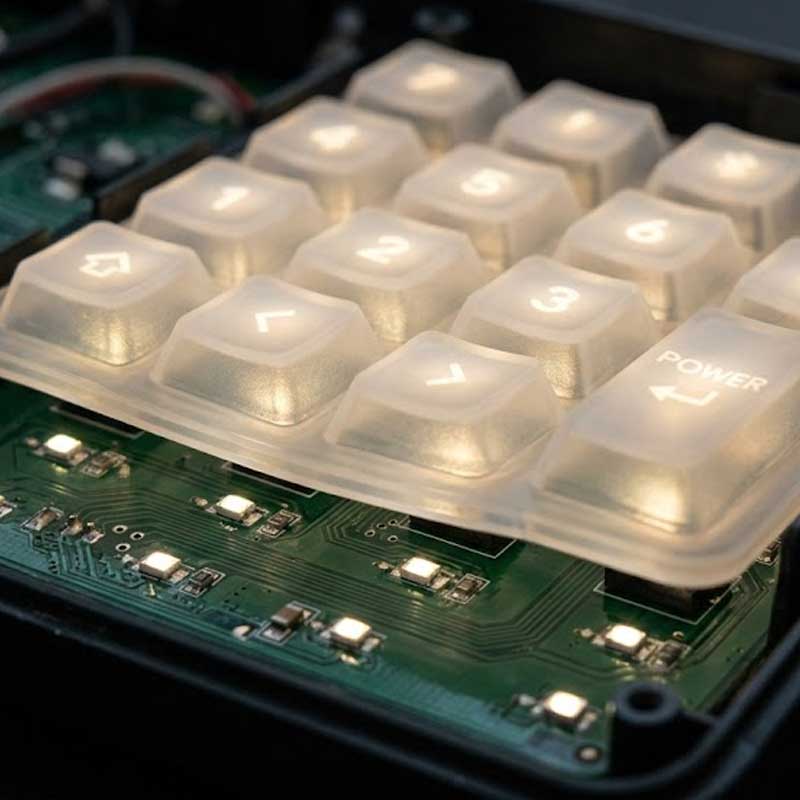
LED backlighting is the most widely used solution in silicone keypad systems. It relies on surface-mounted LEDs placed on a PCB beneath the silicone layer.
Light is emitted from discrete LED points and controlled through optical design and silicone translucency.
Engineering Structure
- PCB-mounted SMD LEDs
- Silicone keypad with translucent legends
- Optional light diffusion layer
- Housing for light isolation
Technical Advantages (expanded)
- High luminous efficiency with low power consumption
- Flexible design for single-color, dual-color, or full RGB systems
- Easy integration with control circuits and MCU systems
- Scalable from prototype to mass production
- Long operational lifespan (typically >50,000 hours)
Design Considerations
LED placement must be precisely aligned with key positions.
Incorrect spacing may cause uneven brightness or hotspot effects.
Laser Etched Light Transmission Keypads
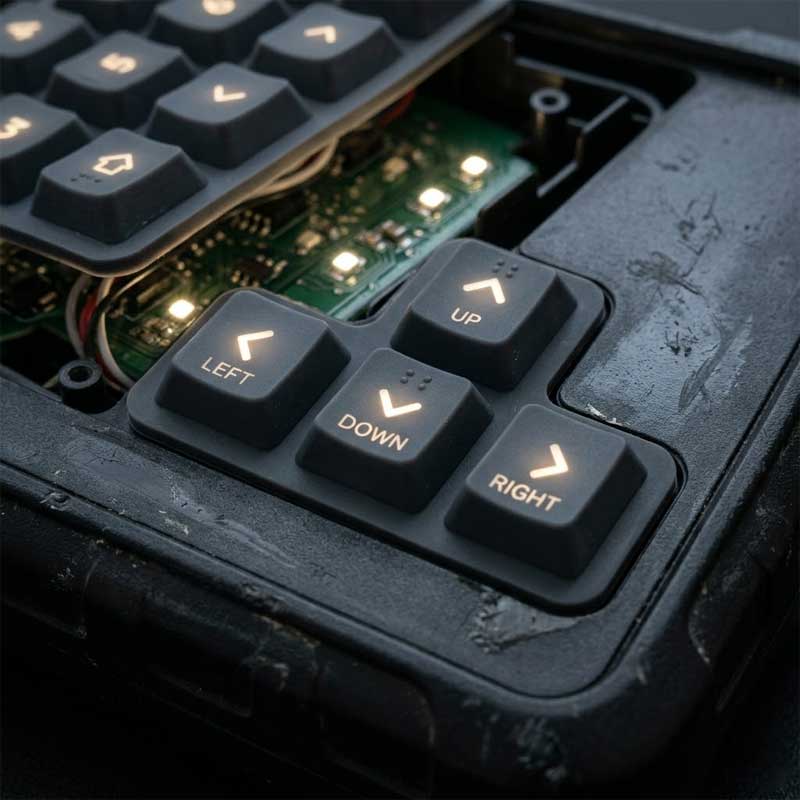
This method uses a fully opaque silicone surface combined with laser removal of top pigment layers to create transparent legends.
When backlight is activated, light passes only through the laser-etched areas.
Engineering Principle
- Multi-layer silicone surface coating
- Laser removes top pigment layer only
- Light transmission controlled by material depth
Technical Advantages
- Extremely sharp and high-contrast legends
- Excellent wear resistance (no fading from friction)
- Suitable for heavy-duty industrial environments
- Stable optical performance over long-term use
Key Strength
Unlike printed legends, laser-etched symbols do not degrade through surface abrasion, making them ideal for high-cycle usage systems.
Light Guide Film (LGF) Backlighting System
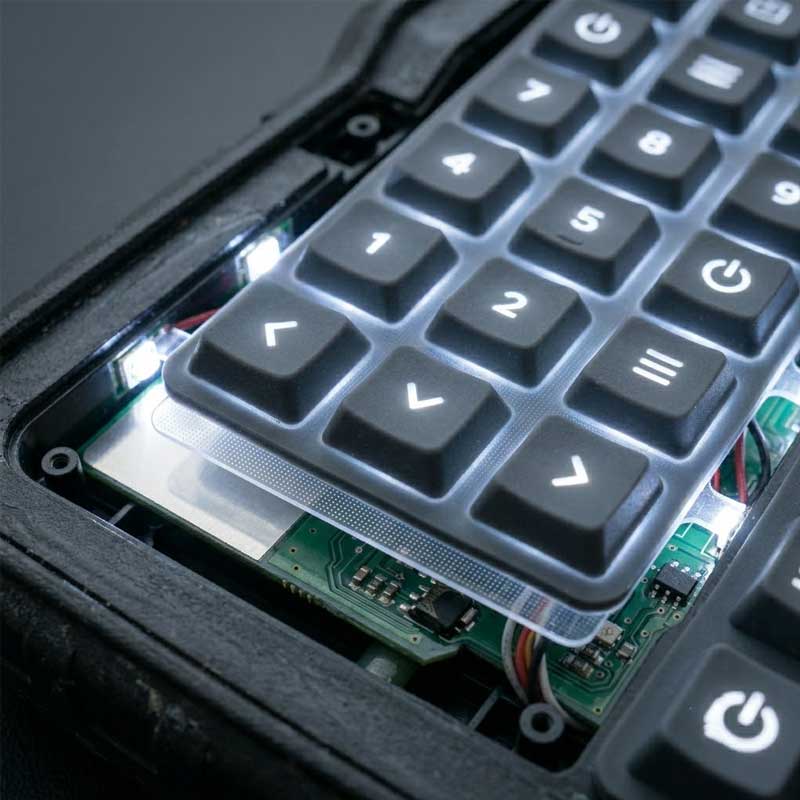
LGF technology uses a thin optical film that distributes LED light evenly across the entire keypad surface.
Instead of direct LED illumination, light is guided through micro-pattern structures.
Engineering Structure
- Side-mounted LED light source
- Light guide film with micro-dot pattern
- Reflective layer for uniform diffusion
- Silicone keypad on top layer
Technical Advantages
- Ultra-thin design suitable for compact devices
- Very uniform brightness across all keys
- Reduced number of LEDs required (cost optimization)
- Excellent energy efficiency for battery-powered devices
Engineering Challenge
LGF design requires precise optical simulation to ensure uniform light distribution and avoid edge brightness loss.
Electroluminescent (EL) Backlighting System
Electroluminescent panels generate light through phosphor excitation under an alternating electrical field.
Electroluminescence
Engineering Structure
- EL phosphor layer
- Transparent conductive electrodes
- AC driver circuit
- Silicone keypad overlay
Technical Advantages
- Extremely thin (can be <0.5mm total thickness)
- Smooth, uniform surface illumination without hotspots
- Flexible shape adaptation for curved interfaces
- Very low heat emission, safe for enclosed systems
Limitations (important for B2B transparency)
- Requires AC driving voltage (inverter needed)
- Brightness is lower compared to LED systems
- Gradual brightness decay over time
Translucent Silicone / Double-Shot Backlighting
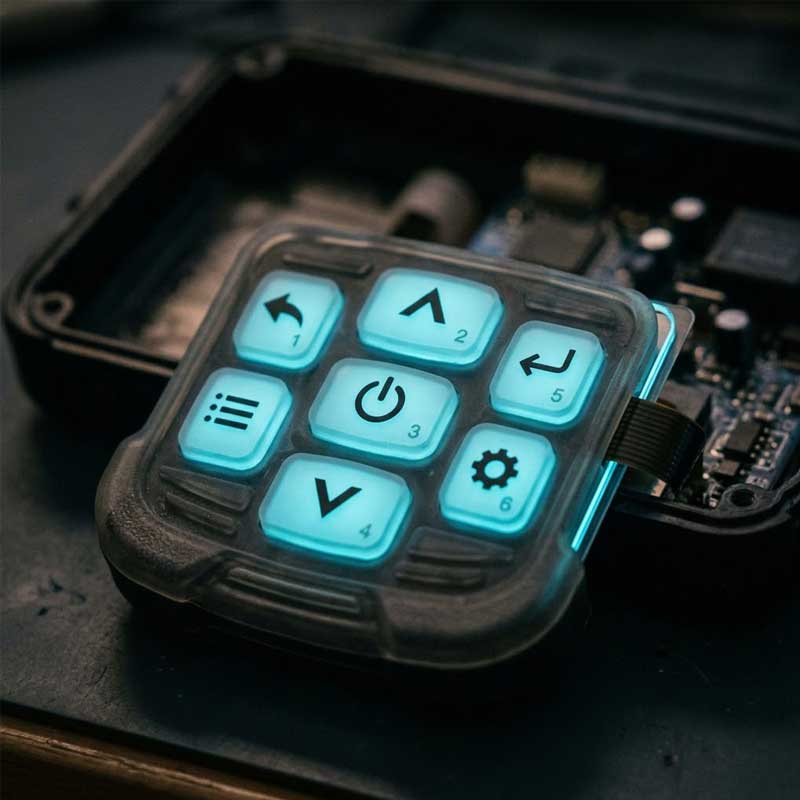
This method uses multi-material molding to create translucent legend areas within an otherwise opaque silicone keypad.
Light passes directly through engineered translucent zones.
Manufacturing Process
- Multi-shot injection or compression molding
- Precise material color and translucency control
- Integrated legend formation during molding
- No post-processing required
Technical Advantages
- Excellent waterproof and dustproof performance
- No risk of film peeling or laser wear
- Strong mechanical durability
- Excellent tactile feedback consistency
- Ideal for IP67–IP68 environments
Key Engineering Strength
This is the most structurally integrated solution, combining mechanical, optical, and sealing functions into a single molded component.
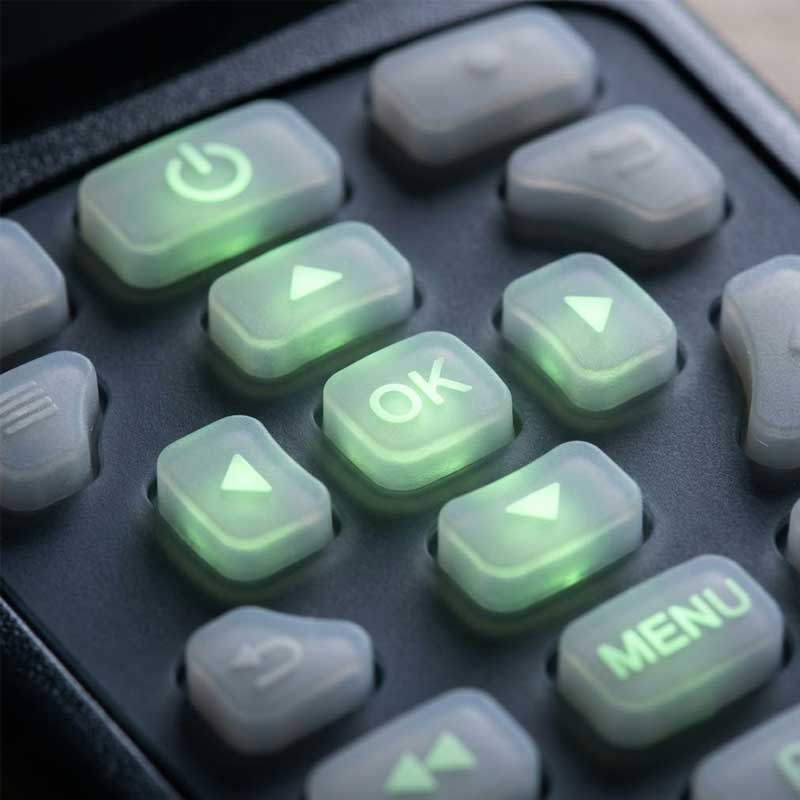
Engineering Challenges in Backlit Silicone Keypad Design
Backlit silicone keypad design is a multi-disciplinary engineering process involving optics, materials, and mechanical structure.
Light Uniformity Engineering
Achieving consistent illumination across all keys is one of the most important challenges in backlit silicone keypad design. Poor optical design can create visible hotspots directly above LEDs or dark areas between keys, reducing readability and perceived product quality. To ensure uniform brightness, engineers carefully optimize LED placement, incorporate diffusion layers or light guide films (LGF), adjust silicone translucency, and design reflective cavities that distribute light evenly throughout the keypad assembly.
Silicone Optical Matching
The optical properties of silicone play a critical role in backlighting performance. Silicone compounds must be formulated to provide the right balance between light transmission and legend visibility. Factors such as pigment concentration, material color, Shore A hardness, and light transmission rate all influence how light passes through the keypad. Proper material selection also ensures long-term optical stability under continuous LED exposure and elevated operating temperatures.
Legend Contrast Optimization
A successful backlit keypad must provide excellent visibility both when the backlight is on and when it is off. Engineers must carefully balance daytime readability, nighttime illumination, and overall contrast performance. This often involves selecting appropriate surface coatings, pigment colors, and laser-etching depths to ensure legends remain clear in bright environments while delivering sharp, evenly illuminated characters in low-light conditions. Anti-glare treatments may also be incorporated to improve viewing comfort.
Structural Stack Engineering
Backlit silicone keypads typically consist of multiple integrated layers, including the PCB and LED assembly, optical films such as LGF or diffusion layers, the silicone keypad itself, and the surrounding housing and sealing components. Each layer must be precisely aligned to ensure proper light transmission, consistent tactile response, and reliable mechanical performance. Even minor alignment variations can affect illumination quality, switch activation, and overall product reliability.
Environmental Protection Design
Many backlit silicone keypads are used in demanding industrial, medical, marine, and outdoor environments where long-term durability is essential. The backlighting system must be designed to maintain performance while meeting protection requirements such as IP65 to IP68 sealing. Materials and coatings are selected to withstand UV exposure, cleaning chemicals, moisture, dust, and wide temperature fluctuations. Effective environmental protection helps preserve optical clarity, tactile performance, and overall system reliability throughout the product lifecycle.
Application Engineering Scenarios
Backlit silicone keypads are engineered for environments where reliability is critical
Industrial Control Panels
Automotive Electronics
Medical Device Keypads
Marine Equipment
Custom Engineering Capabilities
We provide full OEM/ODM engineering support
Optical Design
- Light uniformity simulation
- LED positioning optimization
- LGF pattern design support
Material Engineering
- Silicone translucency tuning
- Color matching (Pantone-based)
- UV and aging resistance formulation
Structural Design
- PCB integration support
- Membrane switch hybrid design
- Waterproof sealing architecture
Production Support
- Prototype development
- Small batch engineering validation
- Mass production consistency control
Frequently Asked Questions
Which backlighting technology is best for outdoor industrial devices?
Laser etched and LED-based systems are most commonly used due to their durability and brightness stability.
Can LGF and silicone molding be combined?
Yes, LGF is often integrated beneath silicone keypads for uniform illumination.
What determines backlight uniformity?
LED placement, optical diffusion design, and silicone translucency all affect uniformity.
Is EL suitable for industrial applications?
It is suitable for low-power and thin devices but less common in high-brightness industrial systems.